Wu Banghua, Li Linjie, Cui Yue, Zheng Kai
School of Cyber Science and Engineering, Sichuan University, Chengdu, China.
School of Computer Science and Engineering, University of Electronic Science and Technology of China, Chengdu, China.
Front Pharmacol. 2022 Jan 21;12:827606. doi: 10.3389/fphar.2021.827606. eCollection 2021.
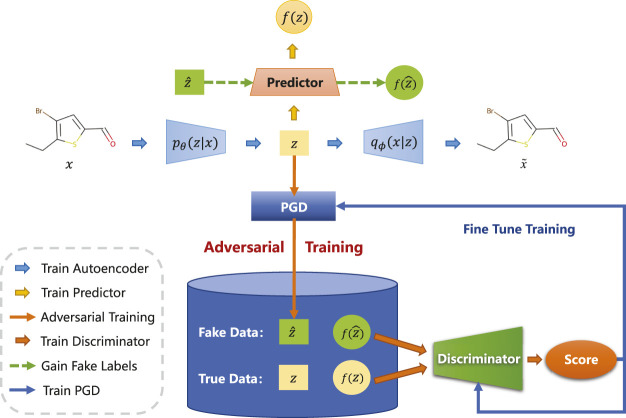
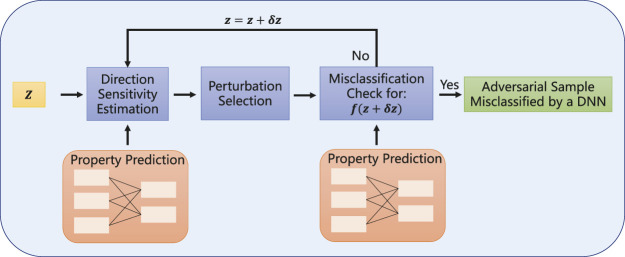
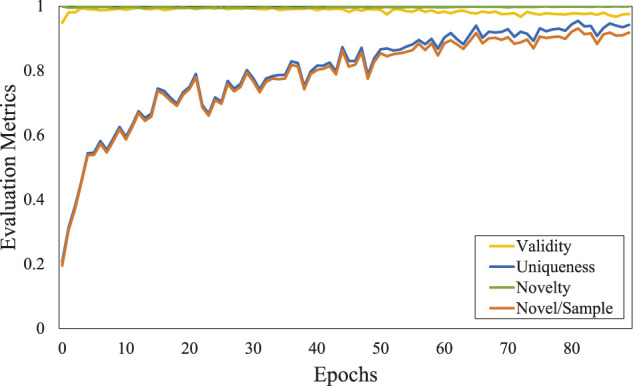
Molecular generation is an important but challenging task in drug design, as it requires optimization of chemical compound structures as well as many complex properties. Most of the existing methods use deep learning models to generate molecular representations. However, these methods are faced with the problems of generation validity and semantic information of labels. Considering these challenges, we propose a cross-adversarial learning method for molecular generation, CRAG for short, which integrates both the facticity of VAE-based methods and the diversity of GAN-based methods to further exploit the complex properties of Molecules. To be specific, an adversarially regularized encoder-decoder is used to transform molecules from simplified molecular input linear entry specification (SMILES) into discrete variables. Then, the discrete variables are trained to predict property and generate adversarial samples through projected gradient descent with corresponding labels. Our CRAG is trained using an adversarial pattern. Extensive experiments on two widely used benchmarks have demonstrated the effectiveness of our proposed method on a wide spectrum of metrics. We also utilize a novel metric named Novel/Sample to measure the overall generation effectiveness of models. Therefore, CRAG is promising for AI-based molecular design in various chemical applications.
分子生成是药物设计中一项重要但具有挑战性的任务,因为它需要优化化合物结构以及许多复杂的性质。现有的大多数方法使用深度学习模型来生成分子表示。然而,这些方法面临着生成有效性和标签语义信息的问题。考虑到这些挑战,我们提出了一种用于分子生成的交叉对抗学习方法,简称为CRAG,它整合了基于变分自编码器(VAE)方法的真实性和基于生成对抗网络(GAN)方法的多样性,以进一步挖掘分子的复杂性质。具体来说,使用一个对抗正则化的编码器 - 解码器将分子从简化分子输入线性条目规范(SMILES)转换为离散变量。然后,通过带有相应标签的投影梯度下降训练离散变量来预测性质并生成对抗样本。我们的CRAG使用对抗模式进行训练。在两个广泛使用的基准上进行的大量实验证明了我们提出的方法在广泛指标上的有效性。我们还使用一种名为“新颖性/样本”的新指标来衡量模型的整体生成有效性。因此,CRAG在各种化学应用中的基于人工智能的分子设计方面具有广阔前景。