Shi Shihua, Wang Fei, Yao Huan, Kou Shuo, Li Weihao, Chen Bonan, Wu Yongcan, Wang Xiaomin, Pei Caixia, Huang Demei, Wang Yilan, Zhang Pan, He Yacong, Wang Zhenxing
Department of Geriatric, Hospital of Chengdu University of Traditional Chinese Medicine, Chengdu, China.
Department of Rheumatology, Hospital of Chengdu University of Traditional Chinese Medicine, Chengdu, China.
Front Med (Lausanne). 2022 Jan 21;8:685734. doi: 10.3389/fmed.2021.685734. eCollection 2021.
Cellular immune responses including lymphocyte functions and immune effector cells are critical for the control of coronavirus infection. Chinese herbal medicine (CHM) potentially has a therapeutic effect for treatment of coronavirus disease 2019 (COVID-19). Nevertheless, there are limited clinical practice suggestions on immunogenicity of the CHM against SARS-CoV-2. To assess the effect of oral CHM on immunogenicity and whether oral CHM improves the clinical parameters through the immunity profile during COVID-19, we performed the present study.
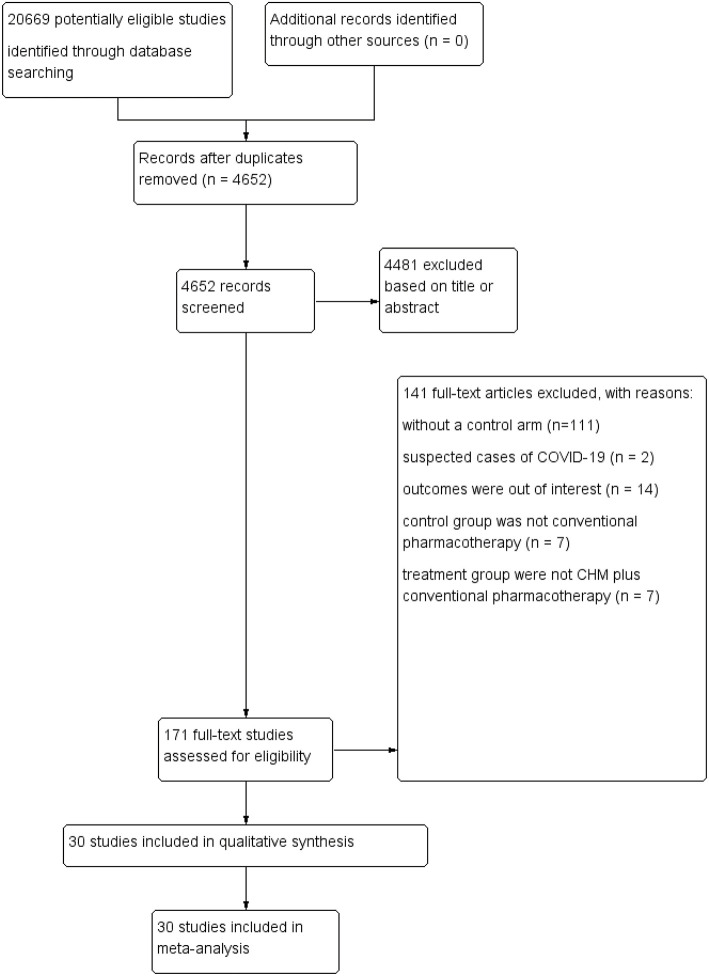
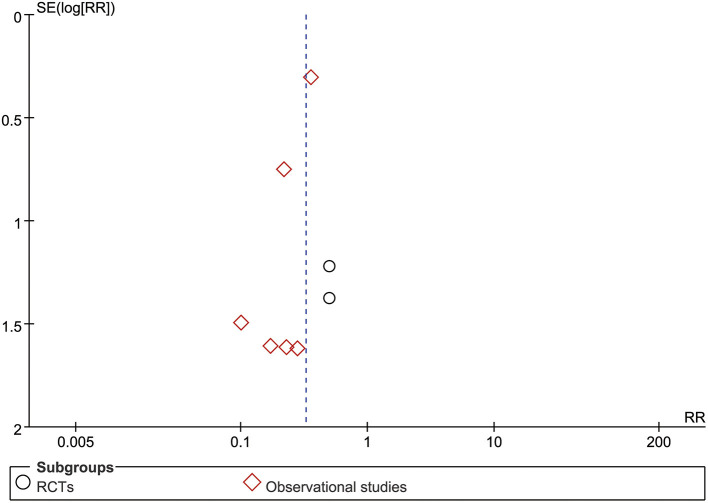
For this systematic review and meta-analysis, 11 databases were searched for relevant studies assessing oral CHM for COVID-19 on November 20, 2020 (updated March 9, 2021). Primary outcomes mainly included immunity profiles. Secondary outcomes included all-cause mortality; the remission time of fever, cough, chest tightness, and fatigue. The random effect was used to estimate the heterogeneity of the studies. Summary relative risks, weight mean difference and standardized mean difference were measured with 95% confidence intervals. Modified Jadad scale and Newcastle-Ottawa Scale were used to assess the risk of bias of randomized controlled trials (RCTs) and observational studies, respectively. The certainty of evidence was evaluated using the GRADE approach.
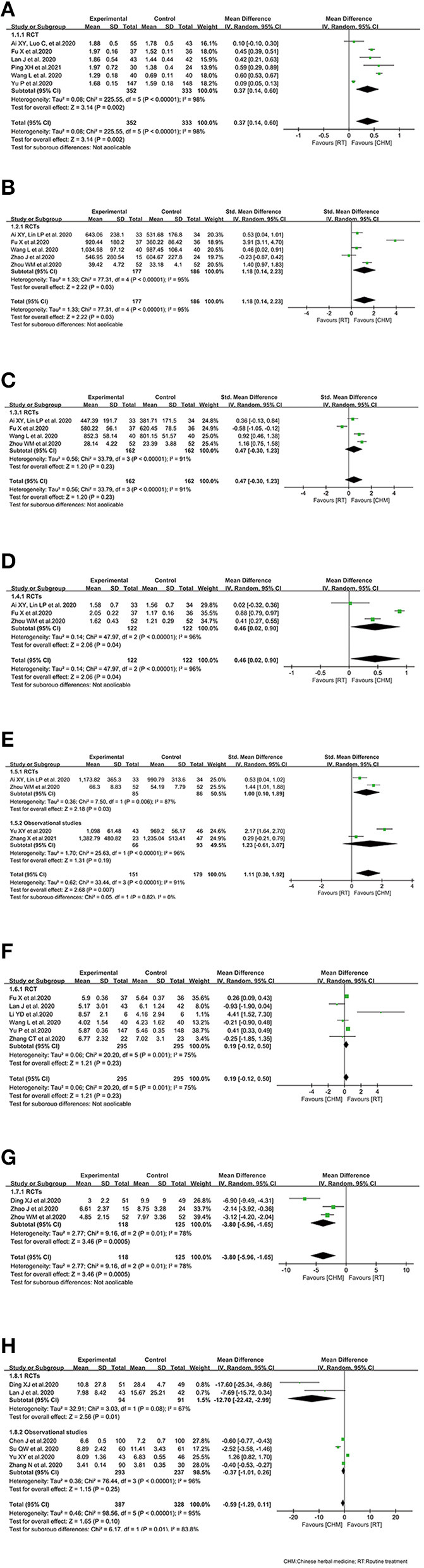
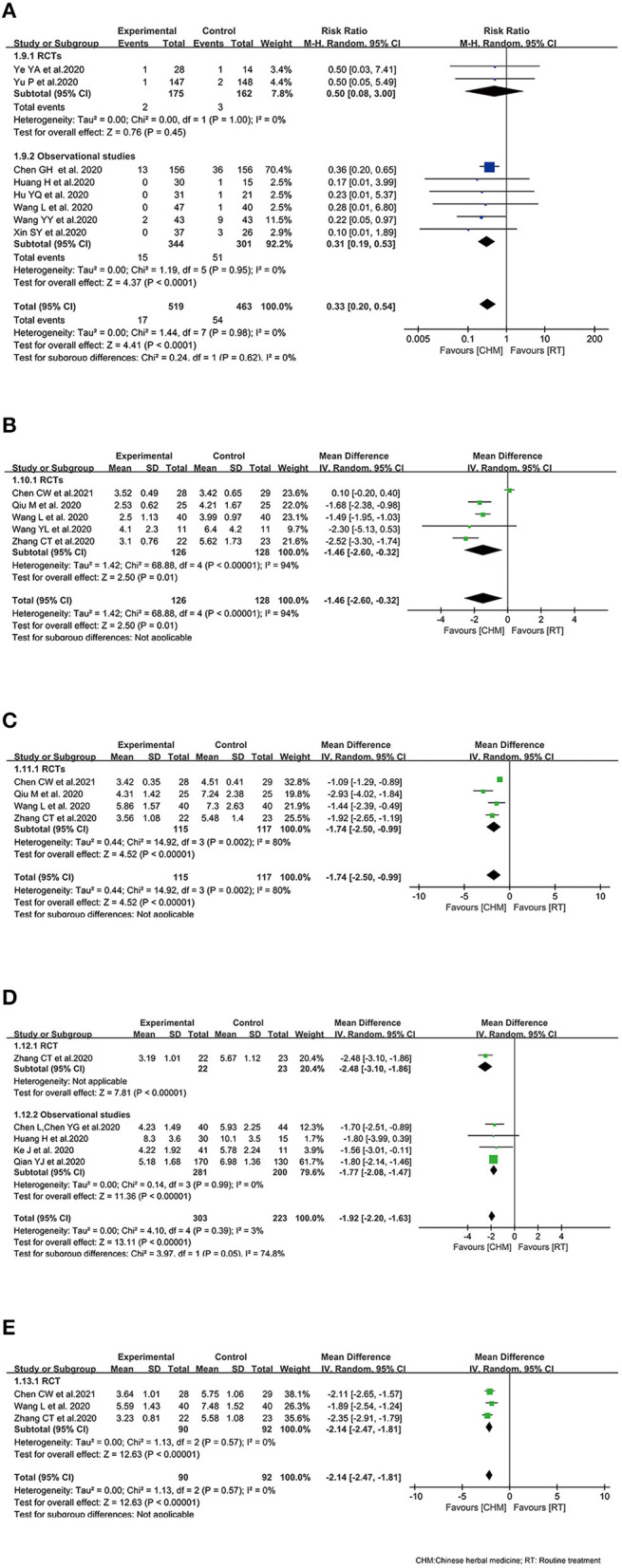
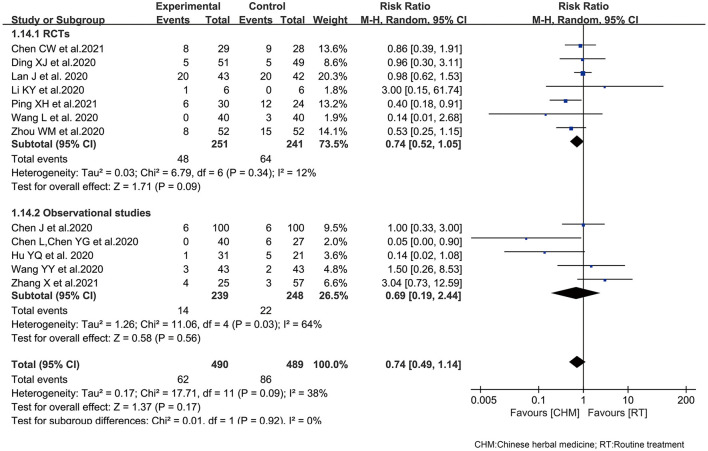
We analyzed findings from 3,145 patients in 30 eligible studies. Compared with routine treatment, oral CHM, as an adjuvant medicine, improved lymphocyte counts, CD4, and CD4/CD8 ratio with low quality of evidence; improved CD3 with moderate quality of evidence; and reduced TNF-α with low certainty of evidence. Besides, oral CHM, as an adjuvant medicine reduced the time to clinical symptoms remission with a lower risk of all-cause mortality, compared with routine treatment alone.
CHM may be recommended as an adjuvant immunotherapy for disease modification and symptom relief in COVID-19 treatment. However, large RCTs objectively assessing the efficacy of CHM on immune responses in COVID-19 are needed to confirm our findings.
包括淋巴细胞功能和免疫效应细胞在内的细胞免疫反应对于控制冠状病毒感染至关重要。中药可能对治疗2019冠状病毒病(COVID-19)具有治疗作用。然而,关于中药对严重急性呼吸综合征冠状病毒2(SARS-CoV-2)免疫原性的临床实践建议有限。为了评估口服中药对免疫原性的影响以及口服中药是否通过COVID-19期间的免疫谱改善临床参数,我们进行了本研究。
对于这项系统评价和荟萃分析,于2020年11月20日(2021年3月9日更新)检索了11个数据库,以查找评估口服中药治疗COVID-19的相关研究。主要结局主要包括免疫谱。次要结局包括全因死亡率;发热、咳嗽、胸闷和疲劳的缓解时间。采用随机效应估计研究的异质性。汇总相对风险、加权平均差和标准化平均差用95%置信区间进行测量。分别使用改良的 Jadad 量表和纽卡斯尔-渥太华量表评估随机对照试验(RCT)和观察性研究的偏倚风险。使用GRADE方法评估证据的确定性。
我们分析了30项符合条件的研究中3145例患者的研究结果。与常规治疗相比,口服中药作为辅助药物,以低质量证据改善了淋巴细胞计数、CD4和CD4/CD8比值;以中等质量证据改善了CD3;以低确定性证据降低了肿瘤坏死因子-α(TNF-α)。此外,与单独常规治疗相比,口服中药作为辅助药物可缩短临床症状缓解时间,全因死亡率风险较低。
中药可作为COVID-19治疗中改善病情和缓解症状的辅助免疫疗法推荐使用。然而,需要大型RCT客观评估中药对COVID-19免疫反应的疗效,以证实我们的研究结果。