Department of Emergency, the Second Affiliated Hospital of Guangzhou University of Chinese Medicine, Guangzhou, China; Department of Global Public Health, Karolinska Institute, Stockholm, Sweden.
Department of Emergency, the Second Affiliated Hospital of Guangzhou University of Chinese Medicine, Guangzhou, China; Guangdong Provincial Key Laboratory of Research on Emergency in TCM, Guangzhou, China.
Phytomedicine. 2021 May;85:153404. doi: 10.1016/j.phymed.2020.153404. Epub 2020 Nov 5.
Chinese herbal medicine (CHM) has been used for severe illness caused by coronavirus disease 2019 (COVID-19), but its treatment effects and safety are unclear.
This study reviews the effect and safety of CHM granules in the treatment of patients with severe COVID-19.
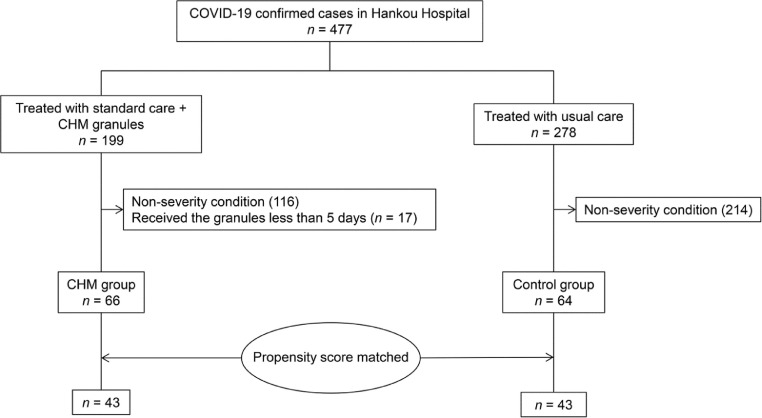
We conducteda single-center, retrospective study on patients with severe COVID-19 in a designated hospital in Wuhan from January 15, 2020 to March 30, 2020. The propensity score matching (PSM) was used to assess the effect and safety of the treatment using CHM granules. The ratio of patients who received treatment with CHM granules combined with usual care and those who received usual care alone was 1:1. The primary outcome was the time to clinical improvement within 28 days, defined as the time taken for the patients' health to show improvement by decline of two categories (from the baseline) on a modified six-category ordinal scale, or to be dischargedfrom the hospital before Day 28.
Using PSM, 43 patients (45% male) aged 65.6 (57-70) yearsfrom each group were exactly matched. No significant difference was observed in clinical improvement of patients treated with CHM granules compared with those who received usual (p = 0.851). However, the use of CHM granules reduced the 28-day mortality (p = 0.049) and shortened the duration of fever (4 days vs. 7 days, p = 0.002). The differences in the duration of cough and dyspnea and the difference in lung lesion ratio on computerized tomography scans were not significant.Commonly,patients in the CHM group had an increased D-dimer level (p = 0.036).
Forpatients with severe COVID-19, CHM granules, combined with usual care, showed no improvement beyond usual care alone. However, the use of CHM granules reduced the 28-day mortality rate and the time to fever alleviation. Nevertheless, CHM granules may be associated with high risk of fibrinolysis.
中药(CHM)已用于治疗由 2019 年冠状病毒病(COVID-19)引起的重症,但治疗效果和安全性尚不清楚。
本研究综述了 CHM 颗粒治疗重症 COVID-19 患者的疗效和安全性。
我们对 2020 年 1 月 15 日至 2020 年 3 月 30 日期间在武汉一家指定医院接受治疗的重症 COVID-19 患者进行了一项单中心、回顾性研究。采用倾向性评分匹配(PSM)评估 CHM 颗粒治疗的效果和安全性。接受 CHM 颗粒联合常规治疗的患者与接受常规治疗的患者比例为 1:1。主要结局为 28 天内临床改善的时间,定义为患者的健康状况通过改良的六级有序量表下降两级(自基线)或在第 28 天前出院的时间。
采用 PSM,两组各有 43 名(45%为男性)年龄为 65.6(57-70)岁的患者进行精确匹配。与接受常规治疗的患者相比,接受 CHM 颗粒治疗的患者的临床改善无显著差异(p = 0.851)。然而,使用 CHM 颗粒可降低 28 天死亡率(p = 0.049)和缩短发热持续时间(4 天 vs. 7 天,p = 0.002)。咳嗽和呼吸困难持续时间的差异以及计算机断层扫描肺部病变比例的差异无统计学意义。通常,CHM 组患者的 D-二聚体水平升高(p = 0.036)。
对于重症 COVID-19 患者,CHM 颗粒联合常规治疗并未显示出优于常规治疗的改善效果。然而,使用 CHM 颗粒可降低 28 天死亡率和发热缓解时间。然而,CHM 颗粒可能与纤溶风险增加有关。