Abdulkader Rizwan Suliankatchi, Venugopal Deneshkumar, Jeyashree Kathiresan, Al Zayer Zainab, Senthamarai Kannan K, Jebitha R
Manonmaniam Sundaranar University, Abishekapatti, Tirunelveli, India.
ICMR-National Institute of Epidemiology, Chennai, India.
J Patient Exp. 2022 Feb 1;9:23743735221077537. doi: 10.1177/23743735221077537. eCollection 2022.
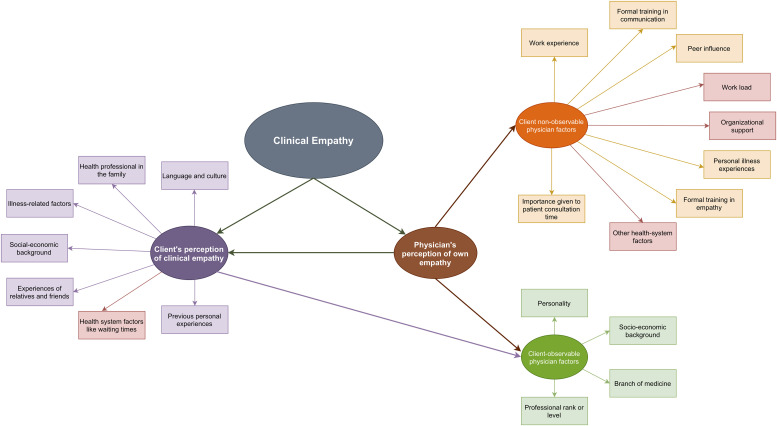
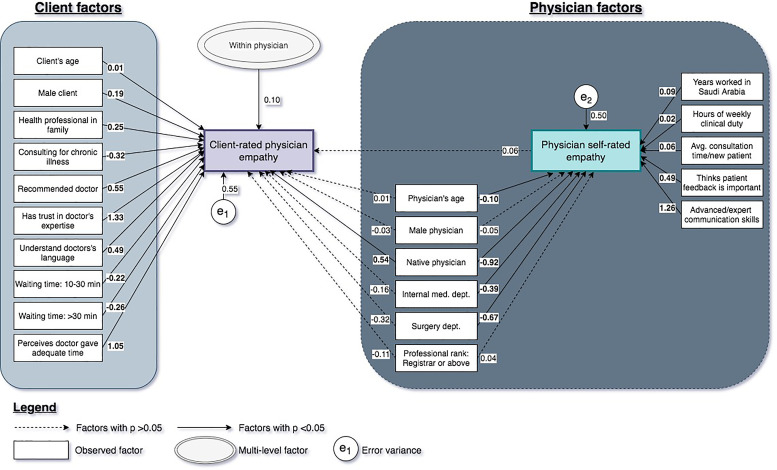
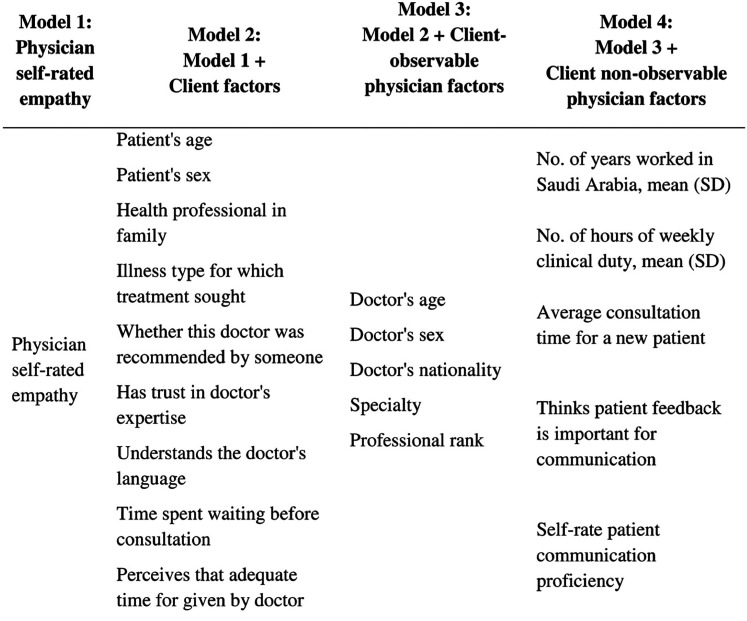
Clinical empathy is an important predictor of patient outcomes. Several factors affect physician's empathy and client perceptions. We aimed to assess the association between physician and client perception of clinical empathy, accounting for client, physician, and health system factors. We conducted a hospital-based cross-sectional study in 3 departments (family medicine, internal medicine, and surgery) of King Saud Medical City in Riyadh, Saudi Arabia. We interviewed 30 physicians and 390 clients from 3 departments. Physicians completed the Jefferson Scale of Empathy (JSE) and the clients responded to the Jefferson Scale of Patient Perceptions of Physician Empathy (JSPPPE). We used a hierarchical multilevel generalized structural equation approach to model factors associated with JSE and JSPPPE and their inter-relationship. Mean (SD) score of client-rated physician empathy was 26.6 (6) and that of physician self-rated was 111 (12.8). We found no association between the 2 ( = 0.06; 95% confidence intervals CI: -0.1, 0.21), even after adjusting for client, physician, and health system factors. Physician's nationality (0.49; 0.12, 0.85), adequate consultation time (1.05; 0.72, 1.38), and trust (1.33; 0.9, 1.75) were positively associated whereas chronic disease (-0.32; -0.56, -0.07) and higher waiting times (-0.26; -0.47, -0.05) were negatively associated. A physician's self-assessed empathy does not correlate with clients' perception. We recommend training and monitoring to enhance clinical empathy.
临床同理心是患者治疗效果的重要预测指标。有几个因素会影响医生的同理心和患者的认知。我们旨在评估医生和患者对临床同理心的认知之间的关联,并考虑患者、医生和卫生系统因素。我们在沙特阿拉伯利雅得的沙特国王医疗城的3个科室(家庭医学、内科和外科)进行了一项基于医院的横断面研究。我们采访了来自3个科室的30名医生和390名患者。医生完成了杰斐逊同理心量表(JSE),患者对医生同理心的患者认知杰斐逊量表(JSPPPE)做出了回应。我们使用分层多级广义结构方程方法来模拟与JSE和JSPPPE相关的因素及其相互关系。患者评定的医生同理心平均(标准差)得分为26.6(6),医生自评得分为111(12.8)。即使在调整了患者、医生和卫生系统因素后,我们发现两者之间没有关联(β = 0.06;95%置信区间CI:-0.1,0.21)。医生的国籍(β = 0.49;0.12,0.85)、充足的会诊时间(β = 1.05;0.72,1.38)和信任(β = 1.33;0.9,1.75)呈正相关,而慢性病(β = -0.32;-0.56,-0.07)和较长的等待时间(β = -0.26;-0.47,-0.05)呈负相关。医生的自我评估同理心与患者的认知不相关。我们建议进行培训和监测以增强临床同理心。