Department of Mechanical Engineering, The University of Texas at Dallas, Richardson, TX, 75080, USA.
Center of Systems Biology, The University of Texas at Dallas, Richardson, TX, 75080, USA.
Small. 2022 Mar;18(12):e2107832. doi: 10.1002/smll.202107832. Epub 2022 Feb 7.
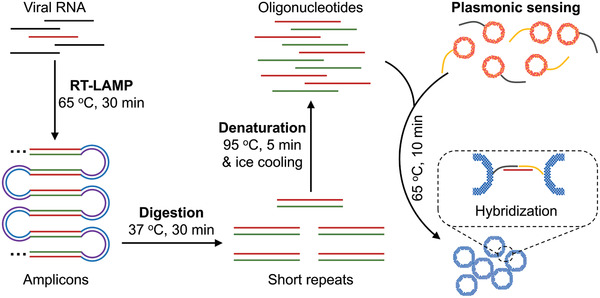
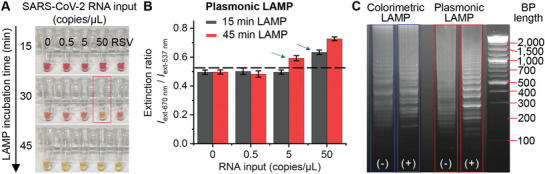
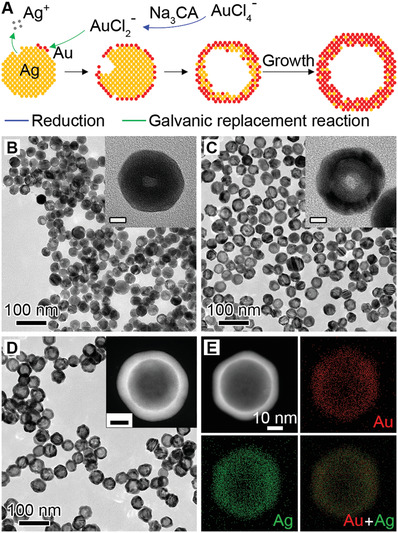
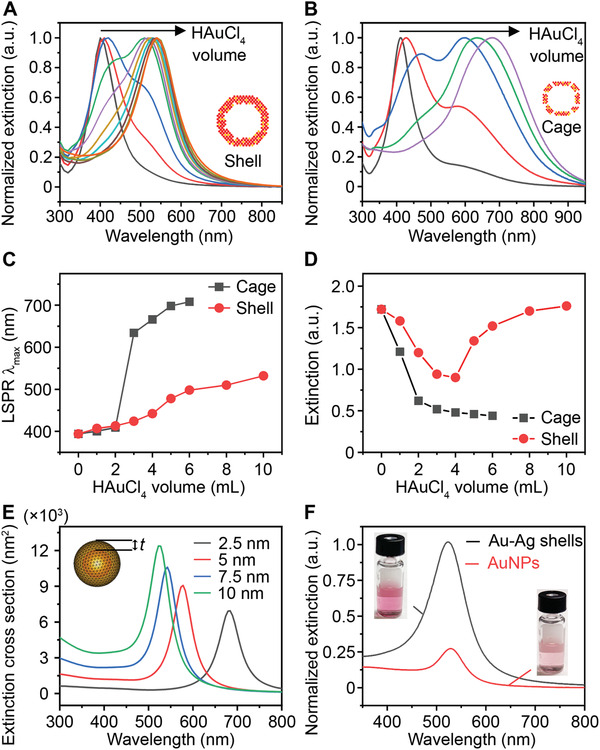
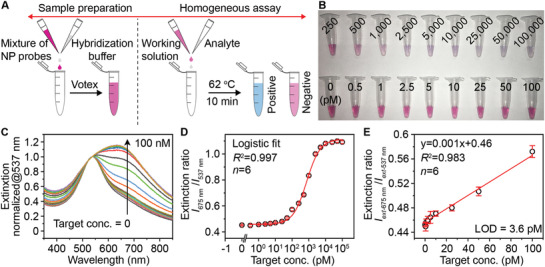
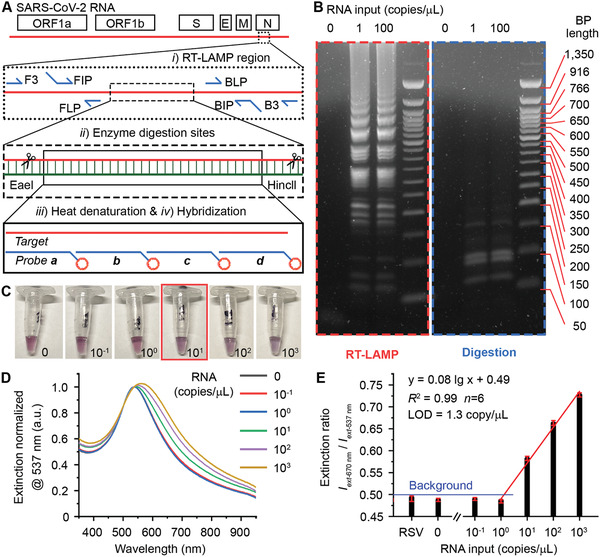
The ability to detect pathogens specifically and sensitively is critical to combat infectious diseases outbreaks and pandemics. Colorimetric assays involving loop-mediated isothermal amplification (LAMP) provide simple readouts yet suffer from the intrinsic non-template amplification. Herein, a highly specific and sensitive assay relying on plasmonic sensing of LAMP amplicons via DNA hybridization, termed as plasmonic LAMP, is developed for the severe acute respiratory syndrome-related coronavirus 2 (SARS-CoV-2) RNA detection. This work has two important advances. First, gold and silver (Au-Ag) alloy nanoshells are developed as plasmonic sensors that have 4-times stronger extinction in the visible wavelengths and give a 20-times lower detection limit for oligonucleotides over Au counterparts. Second, the integrated method allows cutting the complex LAMP amplicons into short repeats that are amendable for hybridization with oligonucleotide-functionalized Au-Ag nanoshells. In the SARS-CoV-2 RNA detection, plasmonic LAMP takes ≈75 min assay time, achieves a detection limit of 10 copies per reaction, and eliminates the contamination from non-template amplification. It also shows better detection specificity and sensitivity over commercially available LAMP kits due to the additional sequence identification. This work opens a new route for LAMP amplicon detection and provides a method for virus testing at its early representation.
特异性和灵敏地检测病原体对于应对传染病爆发和大流行至关重要。涉及环介导等温扩增(LAMP)的比色测定法提供了简单的读数,但存在固有非模板扩增的问题。在此,开发了一种高度特异和灵敏的基于 LAMP 扩增子 DNA 杂交的等离子体传感测定法,称为等离子体 LAMP,用于检测严重急性呼吸综合征相关冠状病毒 2(SARS-CoV-2)RNA。这项工作有两个重要进展。首先,开发了金和银(Au-Ag)合金纳米壳作为等离子体传感器,其在可见光波长下的消光强度强 4 倍,对寡核苷酸的检测限比 Au 对应物低 20 倍。其次,该集成方法允许将复杂的 LAMP 扩增子切割成短重复序列,这些短重复序列可与寡核苷酸功能化的 Au-Ag 纳米壳进行杂交。在 SARS-CoV-2 RNA 检测中,等离子体 LAMP 的检测时间约为 75 分钟,检测限为每个反应 10 个拷贝,并且消除了非模板扩增的污染。由于额外的序列识别,它还显示出比市售的 LAMP 试剂盒更好的检测特异性和灵敏度。这项工作为 LAMP 扩增子检测开辟了新途径,并为早期病毒检测提供了一种方法。