Institute of Biological Sciences, Federal University of Pará, Belem, Brazil.
Institute of Biological Sciences, Federal University of Pará, Belem, Brazil
BMJ Open. 2022 Feb 7;12(2):e054271. doi: 10.1136/bmjopen-2021-054271.
The emergence of SARS-CoV-2 and its pandemic spread generated serious concern about the impact of the infection on vulnerable indigenous populations of the Brazilian Amazon. Thus, this study aimed to perform a seroepidemiological survey of anti-SARS-CoV-2 antibodies in those populations.
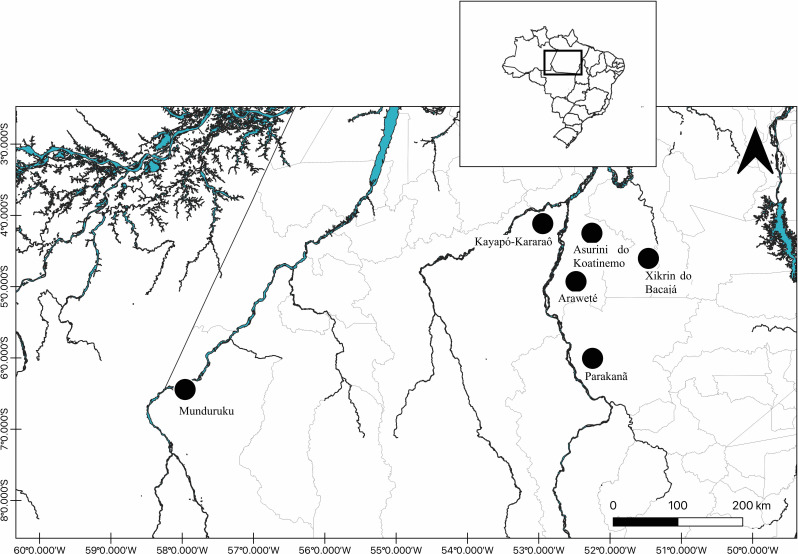
Six indigenous ethnic groups living in the State of Pará (Northern Brazil) were investigated. The villages of Xikrin do Bacajá, Assurini, Araweté, Parakanã, Munduruku and Kararaô were visited from October 2020 to January 2021.
We performed a cross-sectional study to investigate the prevalence of anti-spike (S1) IgG antibodies. Plasma was tested for the presence of anti-SARS-CoV-2 IgM and IgG antibodies using two assays (a lateral flow rapid test and an ELISA). A total of 1185 individuals of both sexes were enrolled in the study.
The prevalences of IgM and IgG antibodies were 6.9% and 68.1%, respectively, ranging from 0% to 79.6%, with significant differences (p<0.001) between age groups in three communities (Araweté, Xikrin and Munduruku) and a virulence rate of 0.86%. The overall IgG prevalence obtained by rapid tests and ELISAs were similar, and the agreement of the results between the two tests was 80%, which was classified as good (kappa=0.4987; p<0.001; sensitivity of 82.1% and specificity of 71.6%). Herd immunity was probably attained, similar to that found in other communities of the Amazon.
SARS-CoV-2 spread rapidly among the indigenous populations investigated, but it had a low mortality rate. It is necessary to expand serological investigations to other communities in the Amazon region of Brazil.
SARS-CoV-2 的出现及其大流行传播引起了人们对感染对巴西亚马逊地区脆弱的土著人群的影响的严重关注。因此,本研究旨在对这些人群进行 SARS-CoV-2 抗体的血清流行病学调查。
调查了居住在巴伊亚州(巴西北部)的六个土著族群。2020 年 10 月至 2021 年 1 月期间,我们走访了 Xikrin do Bacajá、Assurini、Araweté、Parakanã、Munduruku 和 Kararaô 等村庄。
我们进行了一项横断面研究,以调查抗刺突(S1)IgG 抗体的流行率。使用两种检测方法(侧向流动快速检测和 ELISA)检测血浆中是否存在抗 SARS-CoV-2 IgM 和 IgG 抗体。共有 1185 名男女被纳入研究。
IgM 和 IgG 抗体的流行率分别为 6.9%和 68.1%,范围为 0%至 79.6%,在三个社区(Araweté、Xikrin 和 Munduruku)中,年龄组之间存在显著差异(p<0.001),病毒载量率为 0.86%。快速检测和 ELISA 获得的 IgG 总体流行率相似,两种检测方法的结果一致性为 80%,分类为良好(kappa=0.4987;p<0.001;敏感性为 82.1%,特异性为 71.6%)。可能已经获得了群体免疫力,类似于在亚马逊地区的其他社区中发现的情况。
SARS-CoV-2 在调查的土著人群中迅速传播,但死亡率较低。有必要扩大对巴西亚马逊地区其他社区的血清学调查。