Fernández Villalobos Nathalie Verónica, Marsall Patrick, Torres Páez Johanna Carolina, Strömpl Julia, Gruber Jens, Lotto Batista Martín, Pohl Daria, Concha Gustavo, Frickmann Hagen, de la Hoz Restrepo Fernando Pio, Schneiderhan-Marra Nicole, Krause Gérard, Dulovic Alex, Strengert Monika, Kann Simone
Department of Epidemiology, PhD Programme, Helmholtz Centre for Infection Research (HZI), Braunschweig-Hannover, Germany.
Multiplex Immunoassays, NMI Natural and Medical Sciences Institute at the University of Tübingen (NMI), Reutlingen, Germany.
Commun Med (Lond). 2023 Oct 20;3(1):151. doi: 10.1038/s43856-023-00376-9.
Although anti-SARS-CoV-2 humoral immune responses and epidemiology have been extensively studied, data gaps remain for certain populations such as indigenous people or children especially in low- and middle-income countries. To address this gap, we evaluated SARS-CoV-2 seroprevalence and humoral immunity towards the parental B.1 strain, local SARS-CoV-2 variants, and endemic coronaviruses in children from Colombia from March to April 2021.
We performed a cross-sectional seroprevalence study with 80 children from Bogotá and expanded our analysis by comparing results with an independent observational study of 82 children from the Wiwa community living in the north-eastern Colombian territories. Antibody IgG titers towards SARS-CoV-2 and the endemic coronaviruses as well as ACE2 binding inhibition as a proxy for neutralization towards several SARS-CoV-2 variants were analyzed using two multiplex-based immunoassays.
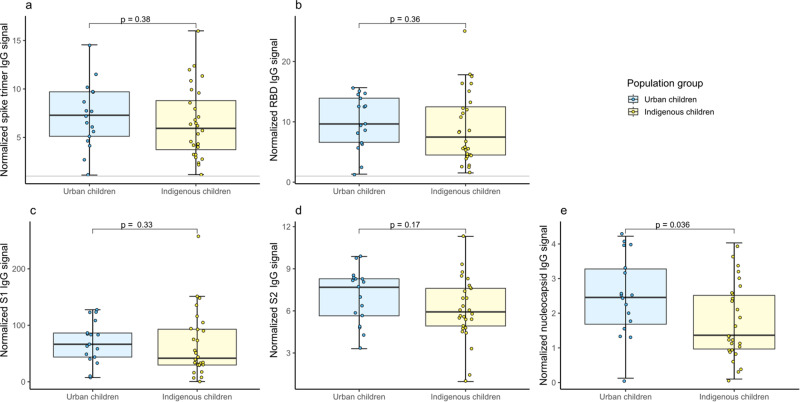
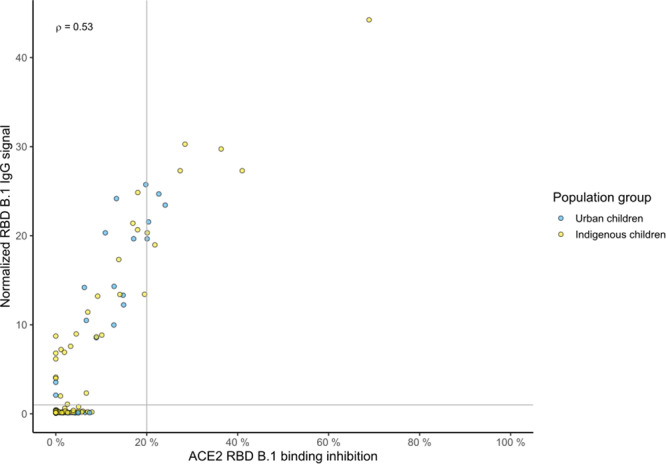
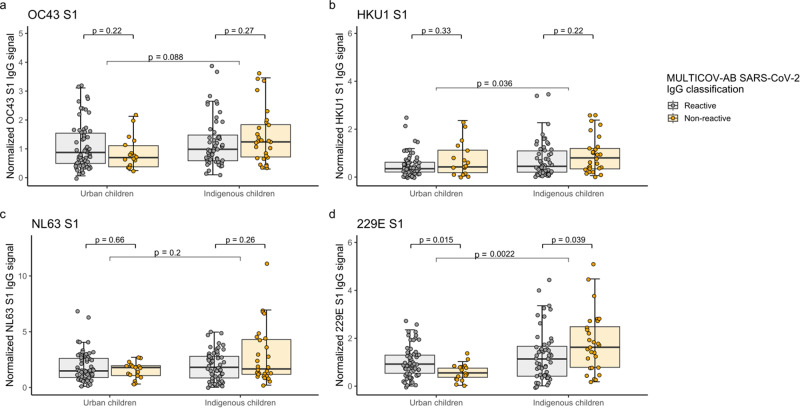
While we find seroprevalence estimates of 21.3% in children from Bogotá, seroprevalence is higher with 34.1% in Wiwa children. We observe a robust induction of antibodies towards the surface-exposed spike protein, its S1-, S2- and receptor-binding-subdomains in all SARS-CoV-2 seropositive children. Only nucleocapsid-specific IgG is significantly lower in the indigenous participants. ACE2 binding inhibition is low for all SARS-CoV-2 variants examined. We observe a dominance of NL63 S1 IgG levels in urban and indigenous children which suggests an early exposure to this respiratory virus independent of living conditions and geographic location. SARS-CoV-2 seropositivity does not correlate with antibody levels towards any of the four endemic coronaviruses indicating the absence of cross-protective immunity.
Overall, antibody titers, but in particular ACE2 binding inhibition are low within Colombian samples, requiring further investigation to determine any potential clinical significance.
尽管针对严重急性呼吸综合征冠状病毒2(SARS-CoV-2)的体液免疫反应和流行病学已得到广泛研究,但对于某些人群,如原住民或儿童,尤其是在低收入和中等收入国家,仍存在数据空白。为了填补这一空白,我们于2021年3月至4月评估了哥伦比亚儿童中SARS-CoV-2的血清阳性率以及针对原始B.1毒株、当地SARS-CoV-2变体和地方性冠状病毒的体液免疫。
我们对来自波哥大的80名儿童进行了横断面血清阳性率研究,并通过将结果与一项对居住在哥伦比亚东北部地区的维瓦社区的82名儿童进行的独立观察性研究结果进行比较,扩大了我们的分析。使用两种基于多重免疫分析的方法,分析了针对SARS-CoV-2和地方性冠状病毒的抗体IgG滴度,以及作为对几种SARS-CoV-2变体中和作用替代指标的血管紧张素转换酶2(ACE2)结合抑制情况。
我们发现波哥大儿童的血清阳性率估计为21.3%,而维瓦儿童的血清阳性率更高,为34.1%。我们观察到,在所有SARS-CoV-2血清阳性儿童中,针对表面暴露的刺突蛋白、其S1、S2和受体结合亚结构域的抗体均有强烈诱导。只有核衣壳特异性IgG在原住民参与者中显著较低。对于所有检测的SARS-CoV-2变体,ACE2结合抑制率都很低。我们观察到城市和原住民儿童中NL63 S1 IgG水平占主导,这表明无论生活条件和地理位置如何,这些儿童都较早接触过这种呼吸道病毒。SARS-CoV-2血清阳性与针对四种地方性冠状病毒中任何一种的抗体水平均无相关性,这表明不存在交叉保护性免疫。
总体而言,哥伦比亚样本中的抗体滴度,尤其是ACE2结合抑制率较低,需要进一步研究以确定其任何潜在的临床意义。