Institute of Genetic Epidemiology, Department of Genetics and Pharmacology (S.C., L.F., P.D., S.S., R.G., C.L., F.K.), Medical University of Innsbruck, Austria.
Université de La Réunion, INSERM UMR 1188 DéTROI, Sainte-Clotilde, France (K.C., I.K., C.C.-H.-F., B.N., S.R.-M., A.G., M.R., O.M., V.B., G.L.).
Circ Genom Precis Med. 2022 Apr;15(2):e003489. doi: 10.1161/CIRCGEN.121.003489. Epub 2022 Feb 8.
Lp(a) (lipoprotein [a]) is a highly atherogenic lipoprotein strongly associated with coronary artery disease (CAD). Lp(a) concentrations are chiefly determined genetically. Investigation of large pedigrees with extreme Lp(a) using modern whole-genome approaches may unravel the genetic determinants underpinning this pathological phenotype.
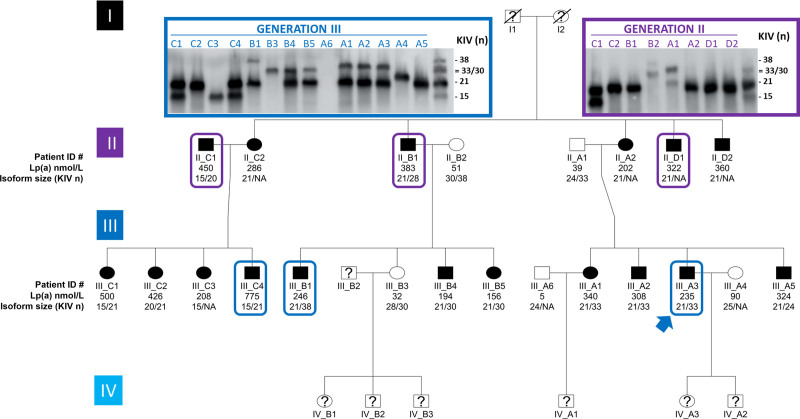
A large family characterized by high Lp(a) and increased CAD incidence was recruited by cascade screening. Plasma lipids, lipoproteins, and apolipoproteins concentrations, as well as the size of apo(a) isoforms, were determined enzymatically by high-resolution mass spectrometry and Western blot, respectively. Whole-exome sequencing was performed to search for rare defects in modifier genes. Genetic risk scores (GRS) for Lp(a) and CAD were calculated and their discriminative power was assessed.
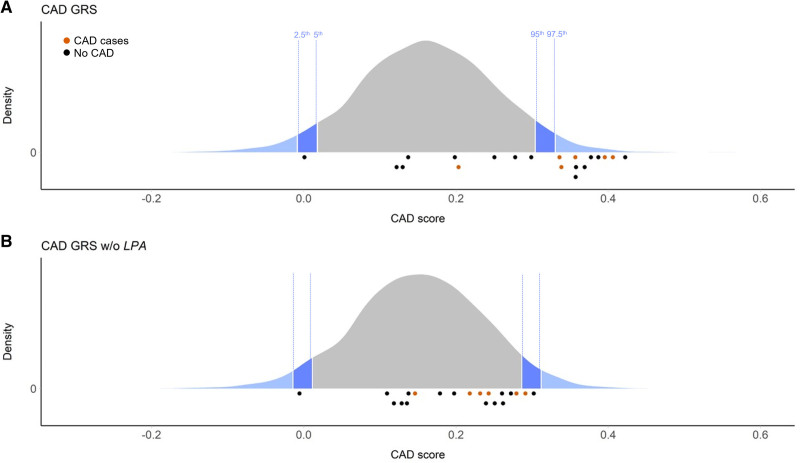
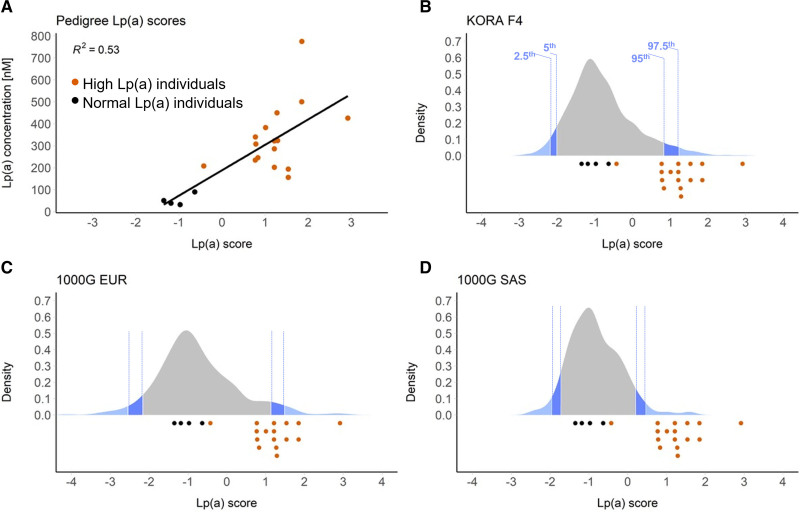
Seventeen individuals displayed extreme Lp(a) levels including 6 with CAD. Whole-exome sequencing showed no hint for genetic defects outside the locus. The extreme Lp(a) phenotype segregated with the presence of a short apo(a) isoform containing 21 Kringle IV domains. This allele was characterized by the presence of three rare strongly Lp(a) increasing single nucleotide polymorphisms and a significantly increased load of oxidized phospholipids per Lp(a) particle. An Lp(a) GRS consisting of 48 single nucleotide polymorphisms that represent 2001 genome-wide significant single nucleotide polymorphisms, efficiently captured the hyper-Lp(a) phenotype and discriminated affected and nonaffected individuals with great accuracy. The genome-wide GRS for CAD, encompassing 6.6 million single nucleotide polymorphisms, was very high for most family members (>97.5 percentile of the reference population), but this observation was no longer valid when the contribution of the locus was omitted.
High-Lp(a) phenotypes can be successfully captured using the Lp(a) GRS even among closely related family members. In hyper-Lp(a) individuals, can be a major locus driving a very high CAD GRS. This underpins the large contribution of the locus to the cardiovascular genetic risk in families.
脂蛋白(a)(Lp(a))是一种高度致动脉粥样硬化的脂蛋白,与冠心病(CAD)密切相关。Lp(a)浓度主要由遗传决定。使用现代全基因组方法研究具有极端 Lp(a)的大型家系,可以揭示这种病理表型的遗传决定因素。
通过级联筛选招募了一个以高 Lp(a)和增加 CAD 发生率为特征的大家庭。通过高分辨率质谱和 Western blot 分别测定血浆脂质、脂蛋白和载脂蛋白浓度以及载脂蛋白(a)同工型的大小。进行全外显子组测序以寻找修饰基因的罕见缺陷。计算 Lp(a)和 CAD 的遗传风险评分(GRS)并评估其判别能力。
17 人表现出极端的 Lp(a)水平,其中 6 人患有 CAD。全外显子组测序未发现 以外的遗传缺陷迹象。极端 Lp(a)表型与存在包含 21 个 Kringle IV 结构域的短载脂蛋白(a)同工型有关。该等位基因的特征是存在三个罕见的强烈增加 Lp(a)的单核苷酸多态性和每个 Lp(a)颗粒上显著增加的氧化磷脂负荷。由代表 2001 个全基因组显著单核苷酸多态性的 48 个单核苷酸多态性组成的 Lp(a)GRS,有效地捕获了高 Lp(a)表型,并以很高的准确度区分了受影响和未受影响的个体。包含 660 万个单核苷酸多态性的 CAD 的全基因组 GRS,对于大多数家庭成员来说都非常高(参考人群的>97.5 百分位),但当省略 位点的贡献时,这种观察结果不再有效。
即使在近亲家庭成员中,使用 Lp(a)GRS 也可以成功捕获高 Lp(a)表型。在高 Lp(a)个体中, 可以是驱动非常高 CAD GRS 的主要基因座。这说明了 位点对家族心血管遗传风险的巨大贡献。