Instituto de Química, Universidade de Brasília, Campus Universitário Darcy Ribeiro, Brasília, DF, CEP: 70910-900, Brazil.
Embrapa Agroenergia, Parque Estação Biológica, PqEB s/n°, W3 Norte, Brasília, DF, CEP: 70770-901, Brazil.
Sci Rep. 2022 Feb 8;12(1):2122. doi: 10.1038/s41598-022-06245-0.
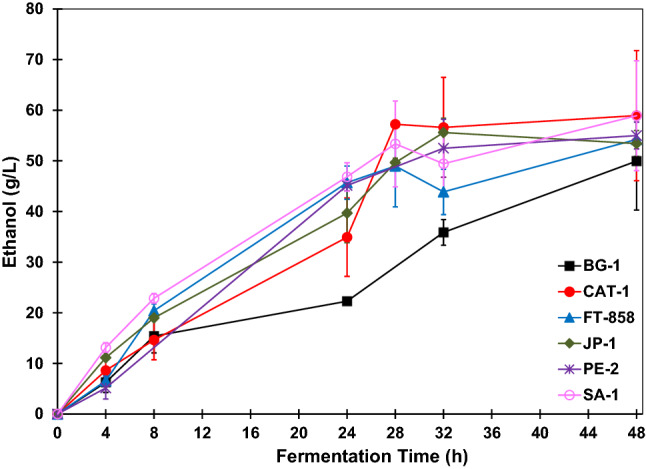
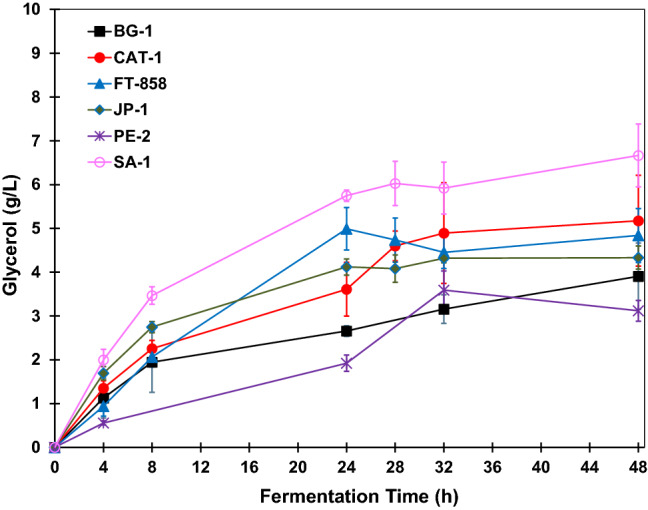
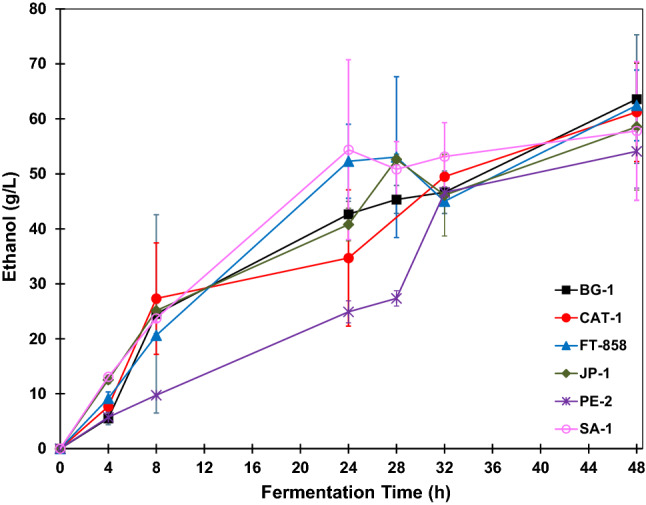
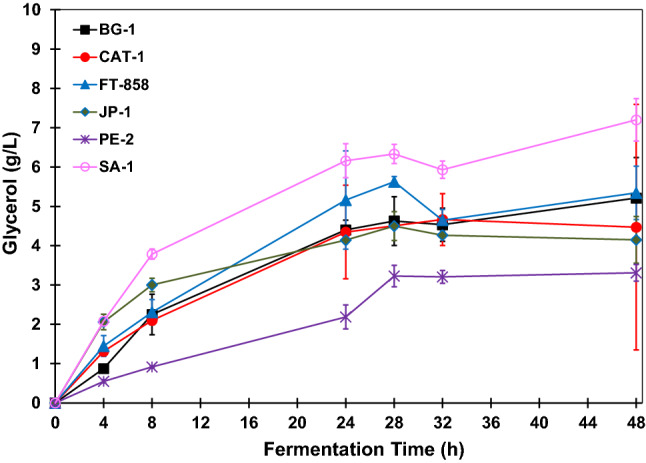
Ethanol is the main biofuel produced by fermentation route and the search for new feedstocks to produce fuel ethanol is still a great challenge. This work aims to compare the ethanol production from a new irrigated rice cultivar BRS AG to the conventional cultivar BRS PAMPA applied in Brazil. Six different commercial strains of Saccharomyces cerevisiae (BG-1, CAT-1, FT-858, JP-1, PE-2, and SA-1) were applied in fermentation reactions. Fermentations performed with BRS PAMPA rice revealed that the highest yields were achieved with strain SA-1, corresponding to 93.0% of the theoretical maximum and final ethanol concentration of 58.92 g L, and with CAT-1, a yield of 92.7% and final ethanol concentration of 58.93 g L. For the fermentations with BRS AG rice, the highest yields were obtained with strain FT-858, exhibiting a 89.6% yield and final ethanol concentration of 62.45 g L, and with CAT-1, 87.9% yield and final ethanol concentration of 61.25 g L were achieved. The most appropriate microorganism for ethanol production using BRS PAMPA rice and BRS AG rice was CAT-1. Comparatively, the ethanol yield and productivity using BRS AG were higher than those observed for BRS PAMPA for all strains, except for PE-2 and SA-1 that led to very similar results. The experimental results showed that the giant rice BRS AG is an excellent feedstock for fuel ethanol production in lowland fields.
乙醇是通过发酵途径生产的主要生物燃料,寻找生产燃料乙醇的新原料仍然是一个巨大的挑战。本工作旨在比较巴西应用的新型灌溉水稻品种 BRS AG 与常规品种 BRS PAMPA 生产乙醇的情况。应用了六种不同的酿酒酵母商业菌株(BG-1、CAT-1、FT-858、JP-1、PE-2 和 SA-1)进行发酵反应。用 BRS PAMPA 水稻进行的发酵表明,SA-1 菌株的产率最高,达到理论最大值的 93.0%,最终乙醇浓度为 58.92 g/L,CAT-1 菌株的产率为 92.7%,最终乙醇浓度为 58.93 g/L。对于 BRS AG 水稻的发酵,FT-858 菌株的产率最高,达到 89.6%,最终乙醇浓度为 62.45 g/L,CAT-1 菌株的产率为 87.9%,最终乙醇浓度为 61.25 g/L。用于生产 BRS PAMPA 水稻和 BRS AG 水稻乙醇的最合适微生物是 CAT-1。相比之下,除了 PE-2 和 SA-1 导致非常相似的结果外,使用 BRS AG 的乙醇产率和生产率均高于所有菌株对 BRS PAMPA 的观察结果。实验结果表明,巨型水稻 BRS AG 是低地农田生产燃料乙醇的优良原料。