189697Global Clinical Biomarkers and Companion Diagnostics, Translational Medicine, Global Development, EMD Serono Research and Development Institute, Billerica, MA, USA.
2792Immunology and Immuno-Oncology Bioinformatics, Translational Medicine, Global Development, EMD Serono Research and Development Institute, Billerica, MA, USA.
Technol Cancer Res Treat. 2022 Jan-Dec;21:15330338221076304. doi: 10.1177/15330338221076304.
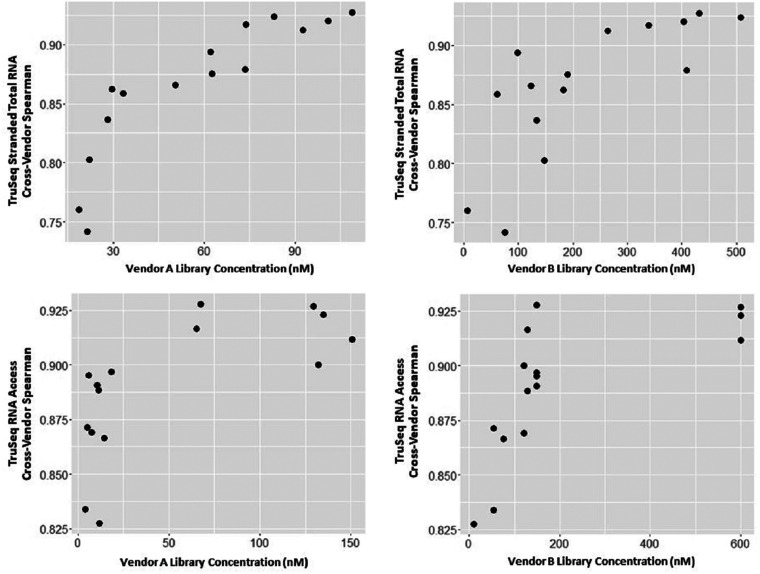
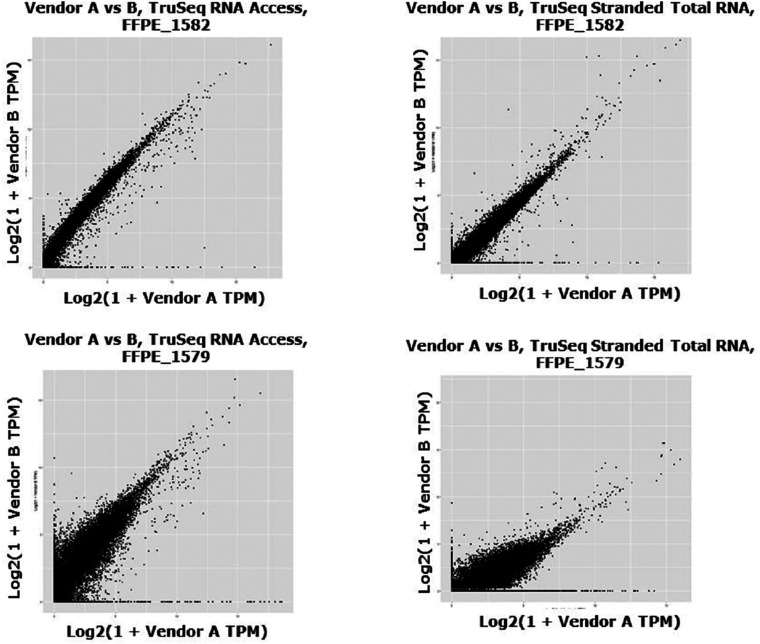
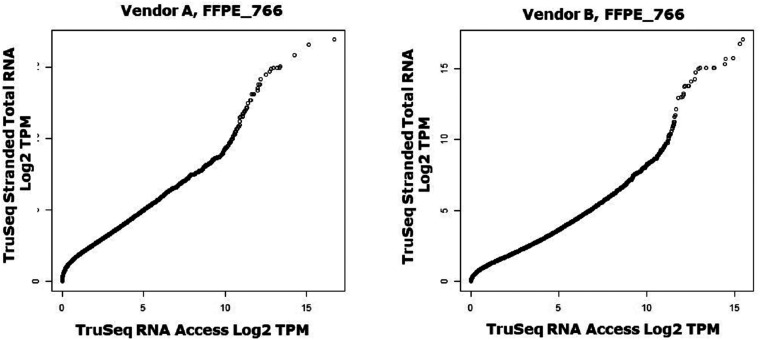
RNA extraction and library preparation from formalin-fixed, paraffin-embedded (FFPE) samples are crucial pre-analytical steps towards achieving optimal downstream RNA sequencing (RNASeq) results. In this study, we assessed 2 Illumina library preparation methods for RNA-Seq analysis using archived FFPE samples from human cancer indications at 2 independent vendors. Twenty-five FFPE samples from 5 indications (non-small cell lung cancer, colorectal cancer, renal carcinoma, breast cancer, and hepatocellular carcinoma) were included, covering a wide range of sample storage durations (3-25 years-old), sample qualities, and specimen types (resection vs core needle biopsy). Each sample was processed independently by both vendors. Total RNA was isolated using the Qiagen miRNeasy FFPE kit followed by library construction using either TruSeq Stranded Total RNA library preparation kit with Ribo-Zero Gold, or TruSeq RNA Access library preparation kit. Libraries were normalized to 20 pM and sequenced on an Illumina HiSeq 2500 using V3 chemistry in paired-end mode with a read length of 2 × 50 bp. The data were processed through a standard RNASeq pipeline to produce counts and transcripts per millions for each gene in each sample to compare 2 library kits at 2 different vendors. Our data showed that TruSeq RNA Access libraries yield over 80% exonic reads across different quality samples, indicating higher selectivity of the exome pull down by the capture approach compared to the random priming of the TruSeq Stranded Total kit. The overall QC data for FFPE RNA extraction, library preparation, and sequencing generated by the 2 vendors are comparable, and downstream gene expression quantification results show high concordance as well. With the TruSeq Stranded Total kit, the mean Spearman correlation between vendors was 0.87 and the mean Pearson correlation was 0.76. With the TruSeq RNA Access kit, the mean Spearman correlation between vendors was 0.89 and the mean Pearson correlation was 0.73. Interestingly, examination of the cross-vendor correlations compared to various common QC statistics suggested that library concentration is better correlated with consistency between vendors than is the RNA quantity. Our analyses provide evidence to guide selection of sequencing methods for FFPE samples in which the sample quality may be severely compromised.
从福尔马林固定、石蜡包埋(FFPE)样本中提取 RNA 并制备文库是实现最佳下游 RNA 测序(RNASeq)结果的关键分析前步骤。在这项研究中,我们评估了 2 种 Illumina 文库制备方法,用于对来自 2 个独立供应商的人类癌症样本的 FFPE 样本进行 RNA-Seq 分析。共纳入 25 例来自 5 种适应证(非小细胞肺癌、结直肠癌、肾细胞癌、乳腺癌和肝细胞癌)的 FFPE 样本,涵盖了广泛的样本储存时间(3-25 年)、样本质量和标本类型(切除与核心针活检)。每个样本均由 2 个供应商独立处理。使用 Qiagen miRNeasy FFPE 试剂盒提取总 RNA,然后使用 TruSeq stranded Total RNA 文库制备试剂盒与 Ribo-Zero Gold 或 TruSeq RNA Access 文库制备试剂盒构建文库。将文库归一化为 20 pM,并在 Illumina HiSeq 2500 上使用 V3 化学进行测序,以 2×50 bp 的读长进行配对端测序。通过标准 RNA-Seq 管道对数据进行处理,以生成每个样本中每个基因的计数和每百万转录物,从而比较 2 个供应商的 2 种文库试剂盒。我们的数据表明,TruSeq RNA Access 文库在不同质量的样本中产生超过 80%的外显子reads,这表明与 TruSeq Stranded Total 试剂盒的随机引物相比,该捕获方法对外显子的选择性更高。2 个供应商生成的 FFPE RNA 提取、文库制备和测序的整体 QC 数据相当,下游基因表达定量结果也高度一致。使用 TruSeq Stranded Total 试剂盒,供应商之间的平均 Spearman 相关性为 0.87,平均 Pearson 相关性为 0.76。使用 TruSeq RNA Access 试剂盒,供应商之间的平均 Spearman 相关性为 0.89,平均 Pearson 相关性为 0.73。有趣的是,与各种常见 QC 统计数据相比,对跨供应商相关性的检查表明,与 RNA 量相比,文库浓度与供应商之间的一致性更好相关。我们的分析提供了证据,以指导在样本质量可能严重受损的 FFPE 样本中选择测序方法。