Department of Cognitive Behavioral Physiology, Graduate School of Medicine, Chiba University, Chiba, Japan.
Cognitive Behavioral Therapy Center, Chiba University Hospital, Chiba, Japan.
J Med Internet Res. 2022 Feb 9;24(2):e28747. doi: 10.2196/28747.
The treatment of insomnia with sleep medication causes problems such as long-term use, dependence, and significant economic losses, including medical expenses. Evidence-based lifestyle guidance is required to improve insomnia symptoms not only in person but also in easy-to-use web-based formats.
This study aims to clarify whether unguided internet-based cognitive behavioral therapy (ICBT) or the Three Good Things (TGT) exercise, both administered as self-help internet interventions without email support, could improve insomnia symptoms compared with a waiting list control (WLC) group.
A 4-week program was implemented, and participants were randomly allocated to 1 of the 3 groups. The primary outcome measure was the Pittsburgh Sleep Questionnaire (PSQI) score at 4 weeks compared with baseline.
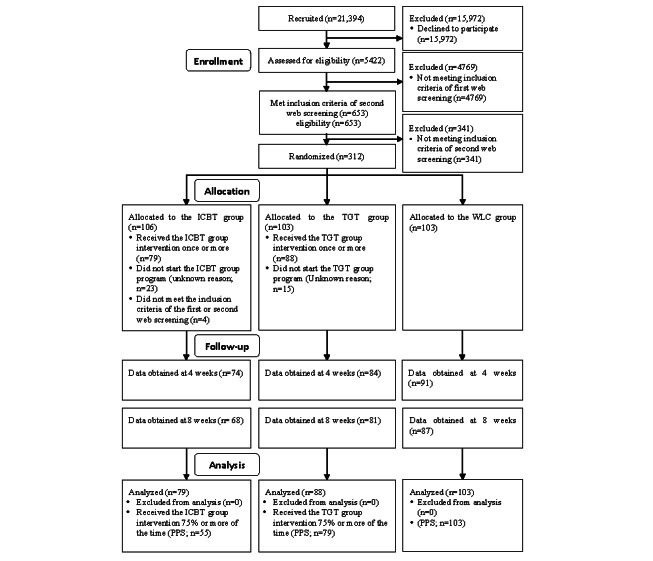
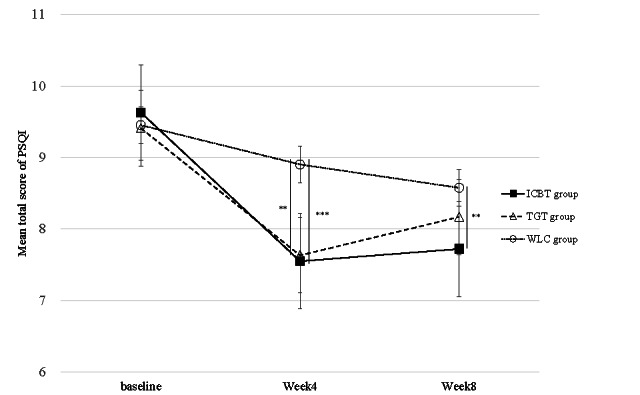
Of the 21,394 individuals invited to participate, 312 (1.46%) met the eligibility criteria and were randomly assigned to 1 of the 3 groups. Of these 312 individuals, 270 (86.5%; ICBT 79/270, 29.3%; TGT 88/270, 32.6%; and WLC 103/270, 38.1%) completed a postintervention survey at 4 and 8 weeks. The adjusted mean changes of the primary outcome measure (PSQI) in the ICBT (-1.56, 95% CI -2.52 to -0.59; P<.001) and TGT (-1.15, 95% CI -2.08 to -0.23; P=.002) groups at 4 weeks from baseline showed a significant improvement compared with the WLC group. The adjusted mean changes in the secondary outcome measures of sleep onset latency, total sleep time, Athens Insomnia Scale score, and Patient Health Questionnaire-9 score at 4 weeks from baseline, as well as in the PSQI at 8 weeks from baseline, showed significant improvement for ICBT. Moreover, total sleep time, Athens Insomnia Scale, and Patient Health Questionnaire-9 scores at 4 weeks from baseline showed a significant improvement in the TGT group compared with the WLC group.
A total of 4 weeks of unguided ICBT and TGT exercises improved insomnia.
University Hospital Medical Information Network Clinical Trial Registry UMIN000034927; https://center6.umin.ac.jp/cgi-open-bin/ctr_e/ctr_view.cgi?recptno=R000039814.
睡眠药物治疗失眠会导致长期使用、依赖和重大经济损失等问题,包括医疗费用。需要循证生活方式指导来改善失眠症状,不仅要在个人层面,还要在易于使用的网络格式中。
本研究旨在阐明无指导的基于互联网的认知行为疗法(ICBT)或“三件好事”(TGT)锻炼是否可以改善失眠症状,这两种方法均作为无需电子邮件支持的自助式互联网干预措施,与等待名单对照(WLC)组相比。
实施了 4 周的方案,参与者被随机分配到 3 个组中的 1 个。主要结局测量指标是与基线相比,4 周时的匹兹堡睡眠问卷(PSQI)评分。
在邀请参加的 21394 人中,有 312 人(1.46%)符合入选标准,并被随机分配到 3 个组中的 1 个。在这 312 人中,有 270 人(86.5%;ICBT 79/270,29.3%;TGT 88/270,32.6%;WLC 103/270,38.1%)在 4 周和 8 周时完成了干预后的调查。主要结局测量指标(PSQI)在 ICBT(-1.56,95%CI-2.52 至-0.59;P<.001)和 TGT(-1.15,95%CI-2.08 至-0.23;P=.002)组的调整后平均变化与 WLC 组相比,在 4 周时显示出显著改善。次要结局测量指标的调整后平均变化,包括睡眠潜伏期、总睡眠时间、雅典失眠量表评分和患者健康问卷-9 评分,以及 8 周时的 PSQI,在 ICBT 中显示出显著改善。此外,与 WLC 组相比,TGT 组在 4 周时的总睡眠时间、雅典失眠量表和患者健康问卷-9 评分也显示出显著改善。
4 周的无指导 ICBT 和 TGT 锻炼改善了失眠。
大学医院医疗信息网临床试验注册 UMIN000034927;https://center6.umin.ac.jp/cgi-open-bin/ctr_e/ctr_view.cgi?recptno=R000039814。