U.O.S. Terapia Conservativa della Malattia Renale Cronica, U.O.C. Nefrologia, Dipartimento di Scienze Mediche e Chirurgiche, Fondazione Policlinico Universitario A. Gemelli IRCCS, Rome, Italy.
Dipartimento Universitario di Medicina e Chirurgia Traslazionale, Università Cattolica del Sacro Cuore, Rome, Italy.
Nephrol Dial Transplant. 2023 Jan 23;38(1):177-183. doi: 10.1093/ndt/gfac037.
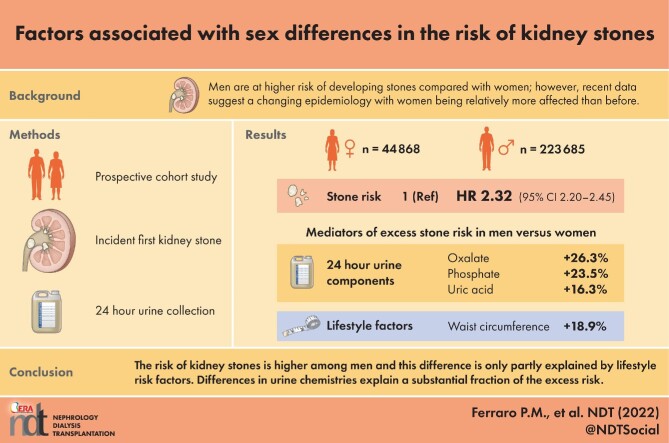
Men are at higher risk of developing stones compared with women; however, recent data suggest a changing epidemiology, with women being relatively more affected than before.
To estimate the proportion of excess risk among men, we analysed data from large cohorts (Health Professionals Follow-up Study and Nurses' Health Study I and II). Kidney stone incidence rates were computed and hazard ratios (HRs) and 95% confidence intervals (CIs) generated with age-adjusted Cox proportional regression models. Mediation analysis estimated the excess risk for men explained by risk factors, including waist circumference, high blood pressure, diabetes, use of thiazides and dietary intake. The 24-h urine composition was also examined.
The analysis included 268 553 participants, contributing 5 872 249 person-years of follow-up. A total of 10 302 incident stones were confirmed and the overall incidence rate was 271 and 159 per 100 000 person-years for men and women, respectively. The age-adjusted HR was 2.32 (95% CI 2.20, 2.45) and the risk of stones was consistently higher across categories of age (HRs ranging from 2.02 to 2.76) for men compared with women. The risk remained higher among men, but tended to decrease over time (48.1%), while it increased among women. Urine supersaturations for calcium oxalate and uric acid were higher among men, primarily because of higher oxalate (26.3%), uric acid (16.3%), phosphate (23.5%) and lower pH.
The risk of kidney stones is higher among men and this difference is only partly explained by lifestyle risk factors; differences in urine chemistries explain a substantial fraction of the excess risk.
男性患结石的风险高于女性;然而,最近的数据表明,结石的流行病学正在发生变化,女性的发病率相对高于以前。
为了估计男性的超额风险比例,我们分析了来自大型队列(健康专业人员随访研究和护士健康研究 I 和 II)的数据。计算了肾结石发病率,并使用年龄调整的 Cox 比例风险回归模型生成了危险比(HR)和 95%置信区间(CI)。中介分析估计了腰围、高血压、糖尿病、噻嗪类药物使用和饮食摄入等危险因素对男性超额风险的影响。还检查了 24 小时尿液成分。
该分析包括 268553 名参与者,提供了 5872249 人年的随访。共确诊 10302 例结石事件,男性和女性的总发病率分别为 271 和 159/100000 人年。年龄调整后的 HR 为 2.32(95%CI 2.20,2.45),男性的结石风险在各个年龄段(HR 范围为 2.02 至 2.76)均高于女性。男性的风险仍然较高,但随着时间的推移呈下降趋势(48.1%),而女性的风险则呈上升趋势。男性尿液中草酸钙和尿酸的过饱和度较高,主要是由于草酸(26.3%)、尿酸(16.3%)、磷酸盐(23.5%)较高和 pH 值较低。
男性患肾结石的风险较高,这种差异仅部分由生活方式危险因素解释;尿液化学成分的差异解释了大部分超额风险。