Telethon Kids Institute, University of Western Australia, P.O. Box 855, West Perth, Western Australia, 6872, Australia.
School of Population and Global Health, The University of Western Australia, Perth, Australia.
BMC Public Health. 2022 Feb 9;22(1):263. doi: 10.1186/s12889-022-12663-6.
Diabetes in pregnancy (DIP), which includes pre-gestational and gestational diabetes, is more prevalent among Aboriginal women. DIP and its adverse neonatal outcomes are associated with diabetes and cardiovascular disease in the offspring. This study investigated the impact of DIP on trends of large for gestational age (LGA) in Aboriginal and non-Aboriginal populations, and added to the limited evidence on temporal trends of DIP burden in these populations.
We conducted a retrospective cohort study that included all births in Western Australia between 1998 and 2015 using linked population health datasets. Time trends of age-standardised and crude rates of pre-gestational and gestational diabetes were estimated in Aboriginal and non-Aboriginal mothers. Mixed-effects multivariable logistic regression was used to estimate the association between DIP and population LGA trends over time.
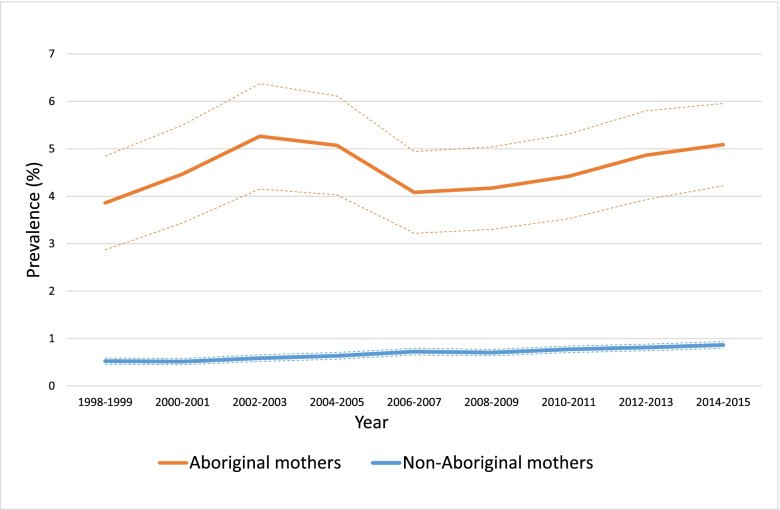
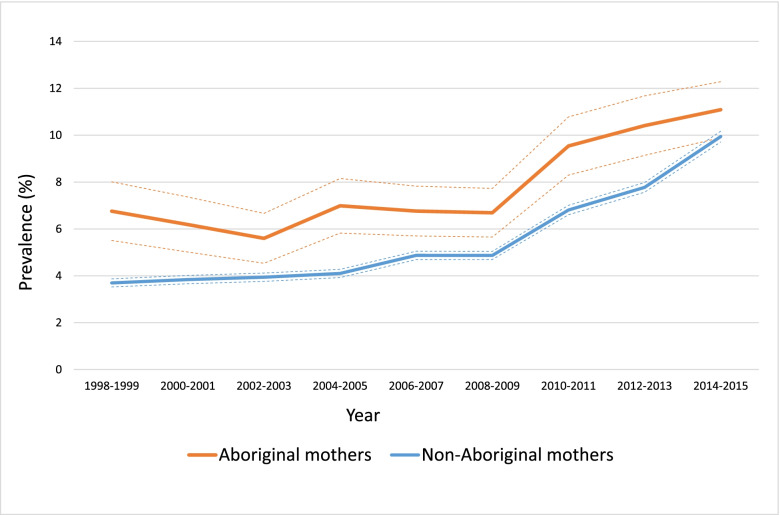
Over the study period, there were 526,319 births in Western Australia, of which 6.4% were to Aboriginal mothers. The age-standardised annual rates of pre-gestational diabetes among Aboriginal mothers rose from 4.3% in 1998 to 5.4% in 2015 and remained below 1% in non-Aboriginal women. The comparable rates for gestational diabetes increased from 6.7 to 11.5% over the study period in Aboriginal women, and from 3.5 to 10.2% among non-Aboriginal mothers. LGA rates in Aboriginal babies remained high with inconsistent and no improvement in pregnancies complicated by gestational diabetes and pre-gestational diabetes, respectively. Regression analyses showed that DIP explained a large part of the increasing LGA rates over time in Aboriginal babies.
There has been a substantial increase in the burden of pre-gestational diabetes (Aboriginal women) and gestational diabetes (Aboriginal and non-Aboriginal) in recent decades. DIP appears to substantially contribute to increasing trends in LGA among Aboriginal babies.
妊娠糖尿病(DIP)包括孕前和孕期糖尿病,在原住民妇女中更为普遍。DIP 及其不良新生儿结局与后代的糖尿病和心血管疾病有关。本研究调查了 DIP 对原住民和非原住民人群中巨大儿(LGA)趋势的影响,并补充了这些人群中 DIP 负担的时间趋势的有限证据。
我们进行了一项回顾性队列研究,使用链接的人口健康数据集,包括 1998 年至 2015 年期间在西澳大利亚州的所有分娩。估计了原住民和非原住民母亲中孕前和孕期糖尿病的年龄标准化和粗率的时间趋势。使用混合效应多变量逻辑回归估计 DIP 与人群 LGA 随时间变化的趋势之间的关联。
在研究期间,西澳大利亚州有 526319 例分娩,其中 6.4%是原住民母亲。原住民母亲中孕前糖尿病的年龄标准化年发病率从 1998 年的 4.3%上升到 2015 年的 5.4%,而非原住民女性的发病率仍低于 1%。同期,原住民女性的妊娠期糖尿病发病率从 6.7%上升到 11.5%,而非原住民母亲的发病率从 3.5%上升到 10.2%。原住民婴儿的 LGA 率仍然很高,妊娠期糖尿病和孕前糖尿病分别使妊娠复杂化,其 LGA 率没有改善,且不一致。回归分析表明,DIP 解释了原住民婴儿 LGA 率随时间增加的大部分原因。
在最近几十年中,孕前糖尿病(原住民妇女)和妊娠期糖尿病(原住民和非原住民)的负担显著增加。DIP 似乎是原住民婴儿 LGA 趋势增加的主要原因。