Guangdong Immune Cell Therapy Engineering and Technology Research Center, Center for Protein and Cell-Based Drugs, Institute of Biomedicine and Biotechnology, Shenzhen Institutes of Advanced Technology, Chinese Academy of Sciences, Shenzhen, China.
University of Chinese Academy of Sciences, Beijing , China.
Front Immunol. 2022 Jan 24;13:781660. doi: 10.3389/fimmu.2022.781660. eCollection 2022.
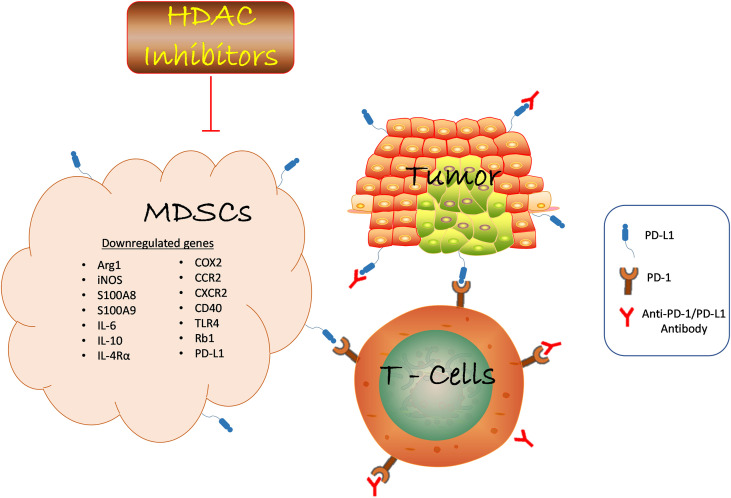
Immunotherapy has emerged as a promising approach to combat immunosuppressive tumor microenvironment (TME) for improved cancer treatment. FDA approval for the clinical use of programmed death receptor 1/programmed death-ligand 1 (PD-1/PD-L1) inhibitors revolutionized T cell-based immunotherapy. Although only a few cancer patients respond to this treatment due to several factors including the accumulation of immunosuppressive cells in the TME. Several immunosuppressive cells within the TME such as regulatory T cells, myeloid cells, and cancer-associated fibroblast inhibit the activation and function of T cells to promote tumor progression. The roles of epigenetic modifiers such as histone deacetylase (HDAC) in cancer have long been investigated but little is known about their impact on immune cells. Recent studies showed inhibiting HDAC expression on myeloid-derived suppressor cells (MDSCs) promoted their differentiation to less suppressive cells and reduced their immunosuppressive effect in the TME. HDAC inhibitors upregulated PD-1 or PD-L1 expression level on tumor or immune cells sensitizing tumor-bearing mice to anti-PD-1/PD-L1 antibodies. Herein we discuss how inhibiting HDAC expression on MDSCs could circumvent drawbacks to immune checkpoint inhibitors and improve cancer immunotherapy. Furthermore, we highlighted current challenges and future perspectives of HDAC inhibitors in regulating MDSCs function for effective cancer immunotherapy.
免疫疗法已成为一种有前途的方法,可以对抗免疫抑制性肿瘤微环境 (TME),以改善癌症治疗效果。FDA 批准程序性死亡受体 1/程序性死亡配体 1 (PD-1/PD-L1) 抑制剂用于临床,这彻底改变了基于 T 细胞的免疫疗法。尽管由于多种因素,包括 TME 中免疫抑制细胞的积累,只有少数癌症患者对这种治疗有反应。TME 中的几种免疫抑制细胞,如调节性 T 细胞、髓样细胞和癌相关成纤维细胞,抑制 T 细胞的激活和功能,从而促进肿瘤进展。表观遗传修饰剂(如组蛋白去乙酰化酶 (HDAC))在癌症中的作用早已被研究,但对其对免疫细胞的影响知之甚少。最近的研究表明,抑制髓系来源的抑制细胞 (MDSC) 上的 HDAC 表达可促进其向抑制作用较弱的细胞分化,并降低其在 TME 中的免疫抑制作用。HDAC 抑制剂上调肿瘤或免疫细胞上的 PD-1 或 PD-L1 表达水平,使荷瘤小鼠对抗 PD-1/PD-L1 抗体敏感。本文讨论了如何抑制 MDSC 上的 HDAC 表达,可以规避免疫检查点抑制剂的缺点,并改善癌症免疫治疗。此外,我们强调了 HDAC 抑制剂在调节 MDSC 功能以实现有效癌症免疫治疗方面的当前挑战和未来展望。