McDermott Paul, McKevitt Aideen, Hanlon Alison
School of Veterinary Medicine, Veterinary Sciences Centre, University College Dublin, Dublin, Ireland.
Veterinary Department, Department of Environment, Climate Change, and Agriculture, Mayo County Council, Castlebar, Ireland.
Front Vet Sci. 2022 Jan 24;8:795227. doi: 10.3389/fvets.2021.795227. eCollection 2021.
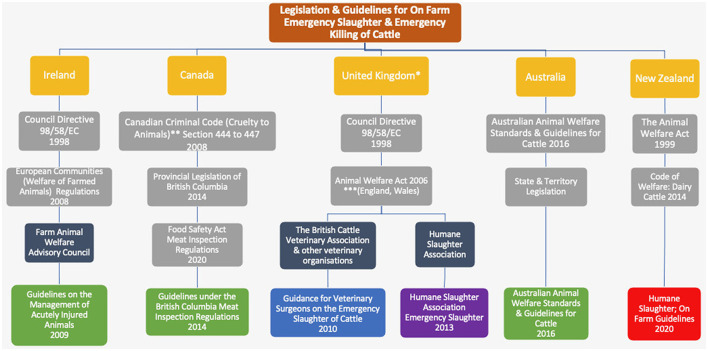
In July 2009, the Farm Animal Welfare Advisory Council (FAWAC) in the Republic of Ireland published Animal Welfare Guidelines for the Management of Acutely Injured Animals on Farm in support of a new Irish regulation designed to permit on-farm emergency slaughter (OFES) of cattle. The purpose of this study was to evaluate the FAWAC guidelines, to determine if they remain fit for purpose by comparing them with five guidelines on the management of acutely injured cattle from four jurisdictions purposively selected because of their relevance to OFES, and to represent geographical and organisational diversity; The United Kingdom, Australia, New Zealand and British Columbia/Canada.
Content and Thematic Analysis were used to compare the incidence and frequency of themes in the six guidelines using NVIVO 12.
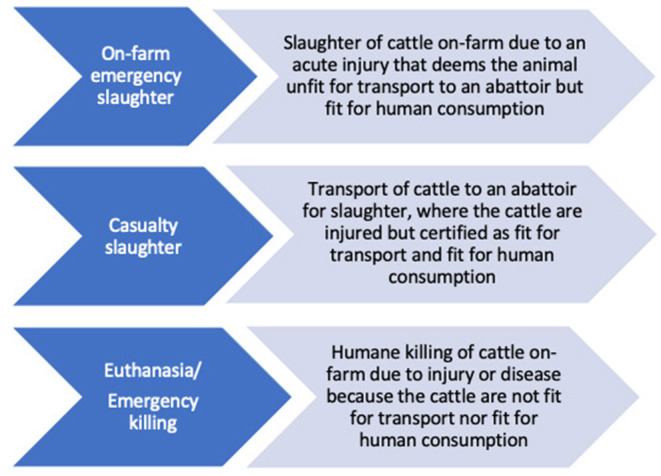
Humane killing and slaughter of animals and the prevention of unnecessary suffering at time of killing were emphasised in all guidelines. Thematic Analysis identified seven primary themes ("parent nodes"): animal welfare; decision tree; certification; legislation; stakeholders; transport and; veterinary ethics. Parent nodes encompassed 26 secondary themes ("child nodes") including casualty slaughter, on-farm emergency slaughter, euthanasia, unnecessary suffering, animal owner, private veterinary practitioner, official veterinarian and fitness for transport. Guidelines outlined stakeholders' roles in relation to all aspects of managing acutely injured cattle. Results showed similarities between FAWAC, the British Cattle Veterinary Association and the British Columbian/Canadian guidelines in relation to OFES as a method to address acutely injured cattle. OFES is not allowed in Australia or New Zealand as a method of managing acutely injured cattle.
Animal welfare guidelines play a pivotal role in informing all stakeholders involved in the management of acutely injured cattle. Guidelines vary from prescriptive standard operating procedures on actions that should be undertaken for food safety reasons, to descriptive guidance upholding practicalities in relation to equipment and methods to be used in managing acutely injured cattle not meant for human consumption. The FAWAC guidelines remain substantially relevant today and consistent with other welfare guidelines published in the jurisdictions that formed part of the study. However, they need to be reviewed to align with current regulations.
2009年7月,爱尔兰共和国农场动物福利咨询委员会(FAWAC)发布了《农场急性受伤动物管理的动物福利指南》,以支持一项旨在允许农场对牛进行紧急屠宰(OFES)的新爱尔兰法规。本研究的目的是评估FAWAC指南,通过将其与因与OFES相关而有目的地选择的四个司法管辖区(英国、澳大利亚、新西兰和不列颠哥伦比亚省/加拿大)关于急性受伤牛管理的五项指南进行比较,确定它们是否仍然适用;以代表地理和组织多样性。
使用内容分析和主题分析,通过NVIVO 12比较六项指南中主题的发生率和频率。
所有指南都强调了动物的人道宰杀以及在宰杀时防止不必要的痛苦。主题分析确定了七个主要主题(“父节点”):动物福利;决策树;认证;立法;利益相关者;运输;以及兽医伦理。父节点包含26个次要主题(“子节点”),包括伤亡屠宰、农场紧急屠宰、安乐死、不必要的痛苦、动物主人、私人执业兽医、官方兽医和运输适宜性。指南概述了利益相关者在管理急性受伤牛的各个方面的作用。结果显示,FAWAC、英国牛兽医协会和不列颠哥伦比亚省/加拿大的指南在将OFES作为处理急性受伤牛的一种方法方面存在相似之处。在澳大利亚和新西兰,不允许将OFES作为管理急性受伤牛的一种方法。
动物福利指南在告知所有参与急性受伤牛管理的利益相关者方面发挥着关键作用。指南各不相同,从出于食品安全原因应采取的行动的规定性标准操作程序,到关于管理非供人类食用的急性受伤牛所使用的设备和方法的实用性的描述性指导。FAWAC指南如今仍然基本相关,并且与作为研究一部分的各司法管辖区发布的其他福利指南一致。然而,需要对其进行审查以符合现行法规。