Department of Agronomy, MNS-University of Agriculture, Multan, Pakistan.
Department of Plant and Environmental Sciences, University of Copenhagen, Copenhagen, Denmark.
PLoS One. 2022 Feb 10;17(2):e0263323. doi: 10.1371/journal.pone.0263323. eCollection 2022.
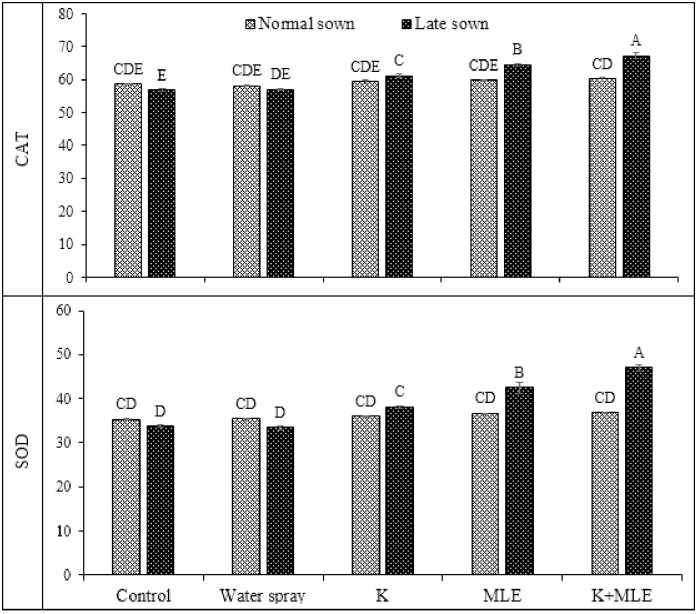
Chickpea (Cicer arietinum L.) is of prime importance because of vital source of protein as major food legume. Globally, it is cultivated on large area to meet dietary requirements of humans. Climatic extremes (erratic rainfall, extreme high and low temperature) are key restrains for its production. Optimum sowing time is considered as an important factor to address climatic variations and to attain maximum yield. Foliar application of potassium (K) has also been reported to increase resistance against abiotic stresses. Similarly, exogenous application of plant based growth substances (bio-stimulants) like moringa leaf extract (MLE) are extensively used to enhance productivity of field crops. Therefore, current study was planned to evaluate the impact of foliar applied K and MLE on growth, physiology and productivity of kabuli chickpea grown under varying sowing dates. There were two sowing dates (normal sown; November 15 and late sown; December 15, 2020). Experiment was comprised of treatments i.e. control, water spray, foliar application of K at 1%, foliar application of MLE at 3% and combined application of K and MLE. Foliar applied K and MLE significantly improved physiological, biochemical and yield attributes of kabuli chickpea cultivated under normal and late sown conditions. Increase in growth and yield attributes like plant height, number of nodules per plant, nodules dry weight, branches and pods per plant, 100- grain weight, biological and grain yield were recorded in case of combined foliar application of K and MLE in normal and late sown chickpea. Maximum improvement in gas exchange attributes (stomatal conductance and transpiration rate), chlorophyll contents, antioxidants (catalase, superoxide dismutase and ascorbate peroxidase) and osmolytes (proline) were recorded with combined application of K and MLE in both sowing dates. Thus, combined applied K and MLE can be used to enhance productivity of kabuli chickpea.
鹰嘴豆(Cicer arietinum L.)是一种非常重要的作物,因为它是一种重要的蛋白质来源,是主要的食用豆类。在全球范围内,它被广泛种植,以满足人类的饮食需求。气候极端(不稳定的降雨、极端的高低温度)是其生产的主要限制因素。最佳播种时间被认为是应对气候变化和获得最大产量的重要因素。叶面喷施钾肥(K)也被报道可以提高作物的抗逆性。同样,外源施用植物生长物质(生物刺激素),如辣木叶提取物(MLE),也被广泛用于提高大田作物的生产力。因此,本研究旨在评估叶面喷施 K 和 MLE 对不同播种日期下种植的卡布里鹰嘴豆的生长、生理和产量的影响。有两个播种日期(正常播种;11 月 15 日和晚播;2020 年 12 月 15 日)。试验包括对照、水喷雾、叶面喷施 1%的 K、叶面喷施 3%的 MLE 和 K 和 MLE 的联合应用等处理。叶面喷施 K 和 MLE 显著提高了正常和晚播条件下种植的卡布里鹰嘴豆的生理、生化和产量特性。在正常和晚播鹰嘴豆中,结合叶面喷施 K 和 MLE 可提高株高、每株根瘤数、根瘤干重、每株分枝和荚数、百粒重、生物量和籽粒产量等生长和产量特性。在两种播种日期下,联合应用 K 和 MLE 可显著提高气体交换特性(气孔导度和蒸腾速率)、叶绿素含量、抗氧化剂(过氧化氢酶、超氧化物歧化酶和抗坏血酸过氧化物酶)和渗透调节剂(脯氨酸)。因此,联合施用 K 和 MLE 可以提高卡布里鹰嘴豆的产量。