Discipline of Audiology, School of Health Sciences, University of KwaZulu-Natal, Westville Campus, Durban.
S Afr J Commun Disord. 2022 Jan 31;69(1):e1-e12. doi: 10.4102/sajcd.v69i1.839.
There is slow progress in early hearing detection and intervention (EHDI) services within South Africa. Audiologists are EHDI gatekeepers and can provide valuable insights into the barriers and facilitators that can progressively move EHDI towards best practice in South Africa.
The study aimed to determine the barriers and facilitators to EHDI in KwaZulu-Natal as reported by audiologists/speech therapists and audiologists (A/STAs).
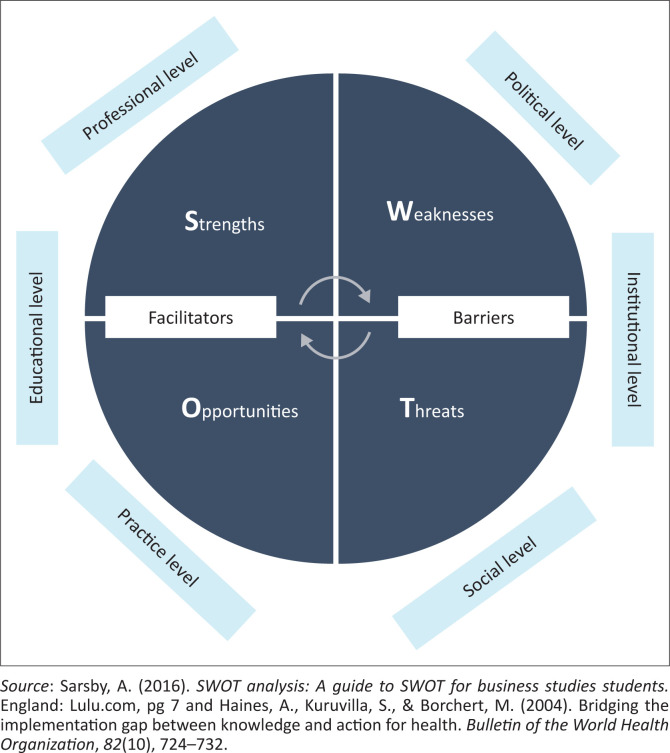
A descriptive qualitative approach was used. Telephonic interviews were conducted with 12 A/STAs working in public and private healthcare facilities, using the strengths, weaknesses, opportunities, threats (SWOT) conceptual framework. Data was analysed using thematic analysis in conjunction with NVivo software.
One of the main barriers perceived by A/STAs, affecting EHDI was the lack of resources in healthcare facilities. The participants indicated that although there was a guideline in place to guide practice, it may be more suited to an urban area versus a rural area. Poor knowledge and awareness of EHDI was also identified as a barrier. Information provided from A/STAs at grassroots level, in the various provinces, may benefit in developing a more contextually relevant and practical guideline. Facilitators included; development of task teams specifically for EHDI programmes, creation of improved communication networks for collaboration and communication, training of healthcare professionals and improving data management systems.
Strategies such as an increase in resources, further education and training, development of contextually relevant, culturally, and linguistically diverse practices and protocols need to be in place to improve EHDI implementation. Further research, clinical implications and limitations are provided emanating from the study.
南非在早期听力检测和干预(EHDI)服务方面进展缓慢。听力学家是 EHDI 的把关人,可以为南非逐步将 EHDI 推向最佳实践提供有价值的见解,了解其中的障碍和促进因素。
本研究旨在确定夸祖鲁-纳塔尔省听力学家/言语治疗师和听力学家(A/STAs)报告的 EHDI 的障碍和促进因素。
采用描述性定性方法。使用优势、劣势、机会、威胁(SWOT)概念框架,对在公立和私立医疗机构工作的 12 名 A/STAs 进行了电话访谈。使用 NVivo 软件结合主题分析对数据进行分析。
A/STAs 认为,影响 EHDI 的主要障碍之一是医疗保健设施缺乏资源。参与者表示,尽管有指导实践的准则,但它可能更适合城市地区,而不是农村地区。EHDI 知识和意识薄弱也被确定为障碍。从各个省份的基层 A/STAs 提供的信息可能有助于制定更具上下文相关性和实用性的指南。促进因素包括:专门为 EHDI 计划成立工作组、创建改进的协作和沟通交流网络、培训医疗保健专业人员和改进数据管理系统。
需要采取增加资源、进一步教育和培训、制定具有文化和语言多样性的、切合实际的相关实践和协议等策略,以改善 EHDI 的实施。本研究提供了进一步的研究、临床意义和局限性。