Department of Paediatrics, Faculty of Health Sciences, University of the Witwatersrand, Johannesburg.
S Afr J Commun Disord. 2021 Jan 27;68(1):e1-e8. doi: 10.4102/sajcd.v68i1.741.
The Health Professions Council of South Africa (HPCSA) issued early hearing detection and intervention guidelines, which has universal newborn hearing screening (UNHS) as one of the important goals. Despite established evidence of the importance of UNHS globally, there has been no mandated formalised and standardised implementation as yet in South Africa.
The aim of this study was to describe the outcomes of newborn hearing screening (NHS) in an academic secondary level hospital in Johannesburg, South Africa.
This was a prospective non-experimental feasibility study over a 3-month period, involving conducting hearing screening of 121 neonates. Audiologists conducted a risk factor assessment, otoscopic examinations and distortion product otoacoustic emissions (DPOAEs) screening on each neonate, with follow-up appointments for re-screening and diagnostic audiological assessments for all neonates with refer findings. Data were analysed using STATA intercooled version 11©, through both descriptive and inferential statistics (Fisher's exact test), with significance established where p-values less than 0.05 were considered statistically significant.
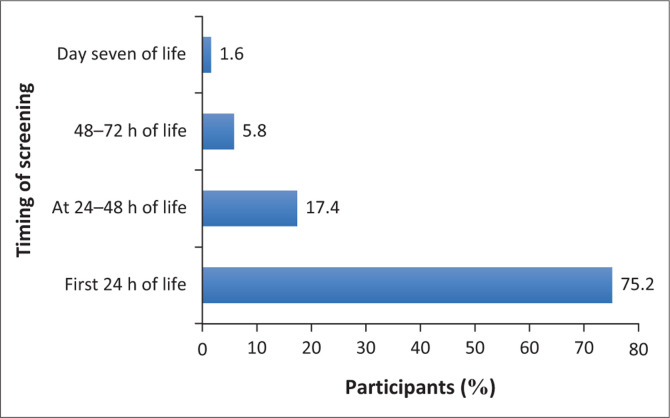
Of the 121 neonates screened, the majority (75%) were screened in the first 24 h of life. A high refer rate (47%) of the total sample was found on DPOAE screening. No maternal or neonatal risk factors were found to be significantly associated with refer findings.
Findings contribute towards the existing evidence base that raises implications for successful implementation of NHS programmes in public healthcare in South Africa. Screening protocols need to consider the timing of screening, the measures and procedures adopted in the screening protocols, as well as the follow-up strategies.
南非健康职业理事会(HPCSA)发布了早期听力检测和干预指南,其中将新生儿普遍听力筛查(UNHS)作为一个重要目标。尽管全球范围内已经有了关于 UNHS 重要性的既定证据,但南非尚未强制实施规范化和标准化的程序。
本研究旨在描述南非约翰内斯堡一所学术性二级医院的新生儿听力筛查(NHS)结果。
这是一项为期 3 个月的前瞻性非实验可行性研究,涉及对 121 例新生儿进行听力筛查。听力学家对每个新生儿进行危险因素评估、耳镜检查和畸变产物耳声发射(DPOAE)筛查,并为所有有转诊发现的新生儿安排重新筛查和诊断性听力学评估的随访预约。使用 STATA 冷却版 11© 进行数据分析,包括描述性和推断性统计(Fisher 确切检验),当 p 值小于 0.05 时认为具有统计学意义。
在筛查的 121 例新生儿中,大多数(75%)在生命的头 24 小时内接受了筛查。在 DPOAE 筛查中,总样本的转诊率(47%)较高。未发现母体或新生儿危险因素与转诊发现有显著关联。
这些发现为 NHS 计划在南非公共医疗保健中的成功实施提供了依据。筛查方案需要考虑筛查时间、筛查方案中采用的措施和程序,以及后续策略。