Division of Biochemistry, ICAR-Indian Agricultural Research Institute, New Delhi, 110012, India.
Decode Genomics Private Limited, New Delhi, India.
Sci Rep. 2022 Feb 10;12(1):2241. doi: 10.1038/s41598-022-06009-w.
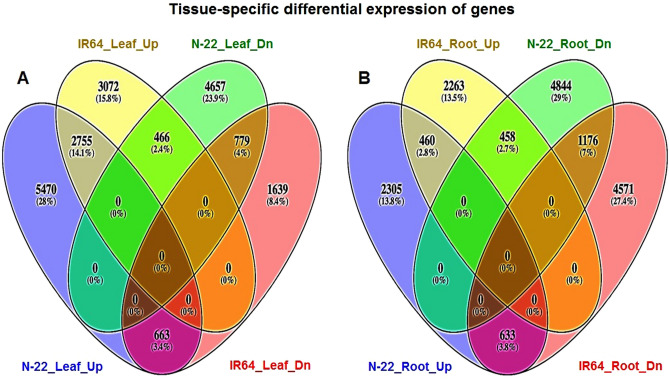
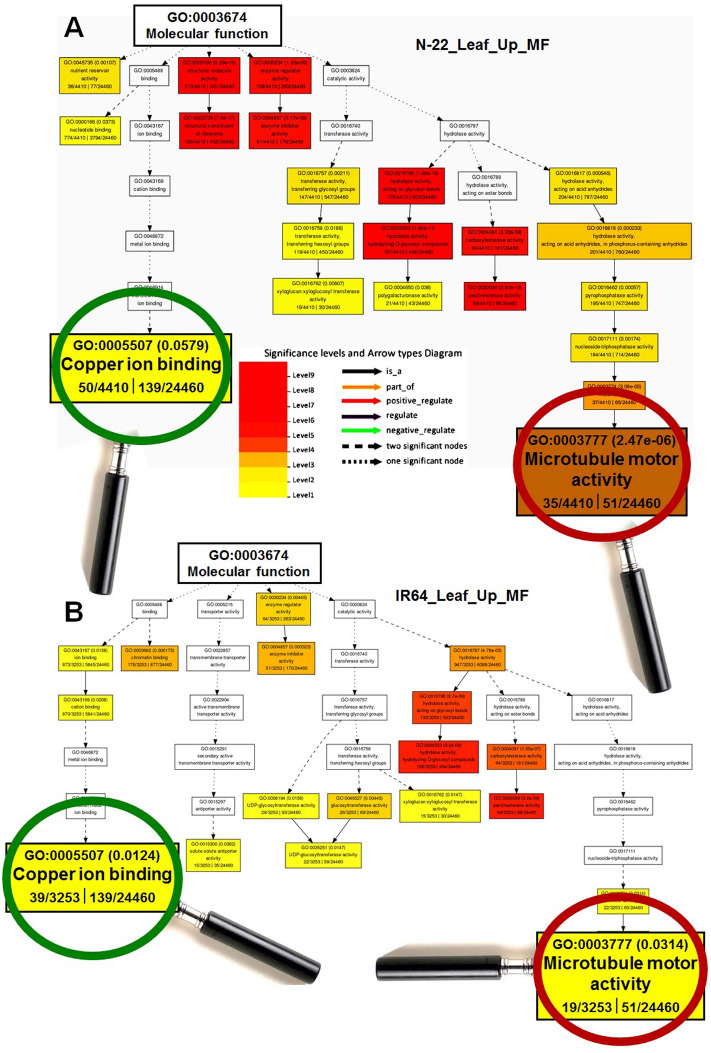
Rice cultivation by transplanting requires plenty of water. It might become a challenging task in future to grow rice by transplanting due to the climatic change, water and labor scarcities. Direct-sown rice (DSR) is emerging as a resource-conserving and climate-smart alternative to transplanted rice (TPR). However, no specific variety has been bred for dry/direct-sown conditions. The present study was undertaken to decipher the molecular basis of genetic plasticity of rice under different planting methods. Comparative RNA-seq analysis revealed a number (6133) of genes exclusively up-regulated in Nagina-22 (N-22) leaf under DSR conditions, compared to that (3538) in IR64 leaf. Several genes up-regulated in N-22 were down-regulated in IR64. Genes for growth-regulation and nutrient-reservoir activities, transcription factors, translational machinery, carbohydrate metabolism, cell cycle/division, and chromatin organization/epigenetic modifications were considerably up-regulated in the leaf of N-22 under DSR conditions. Complementary effects of these factors in rendering genetic plasticity were confirmed by the agronomic/physiological performance of rice cultivar. Thus, growth-regulation/nutrient-reservoir activities, transcription factors, and translational machinery are important molecular factors responsible for the observed genetic plasticity/adaptability of Nagina-22 to different planting methods. This might help to develop molecular markers for DSR breeding, replacing TPR with DSR for better water-productivity, and minimizing greenhouse-gas emission necessary for negative emission agriculture.
水稻移栽需要大量的水。由于气候变化、水资源和劳动力短缺,未来通过移栽种植水稻可能会成为一项具有挑战性的任务。直播水稻(DSR)作为一种节约资源和应对气候变化的替代移栽水稻(TPR)的方法正在出现。然而,目前还没有专门为旱地/直播条件培育的特定品种。本研究旨在揭示不同种植方式下水稻遗传可塑性的分子基础。比较 RNA-seq 分析显示,与 IR64 叶片相比,Nagina-22(N-22)叶片在 DSR 条件下有 6133 个基因特异性地上调,而在 IR64 叶片中有 3538 个基因特异性地上调。N-22 中上调的几个基因在 IR64 中下调。在 DSR 条件下,与生长调节和养分储备活性、转录因子、翻译机制、碳水化合物代谢、细胞周期/分裂以及染色质组织/表观遗传修饰相关的基因在 N-22 叶片中显著上调。这些因素的互补效应通过水稻品种的农艺/生理表现得到了证实。因此,生长调节/养分储备活性、转录因子和翻译机制是导致 Nagina-22 对不同种植方式表现出遗传可塑性/适应性的重要分子因素。这可能有助于开发用于 DSR 育种的分子标记,用 DSR 替代 TPR,以提高水生产力,并减少负排放农业所需的温室气体排放。