Grube Maike M, Scheidt-Nave Christa, Gaertner Beate, Lüdtke Denise, Bosnjak Michael, Heinrich Stephanie, Lahmann Nils, Meyer Gabriele, Rapp Kilian, Riedel-Heller Steffi, Schäufele Martina, Wolf-Ostermann Karin, Zank Susanne, Fuchs Judith
Robert Koch Institute, Berlin.
Leibniz Institute for Psychology Information Trier.
J Health Monit. 2019 Jun 27;4(2):86-101. doi: 10.25646/5990. eCollection 2019 Jun.
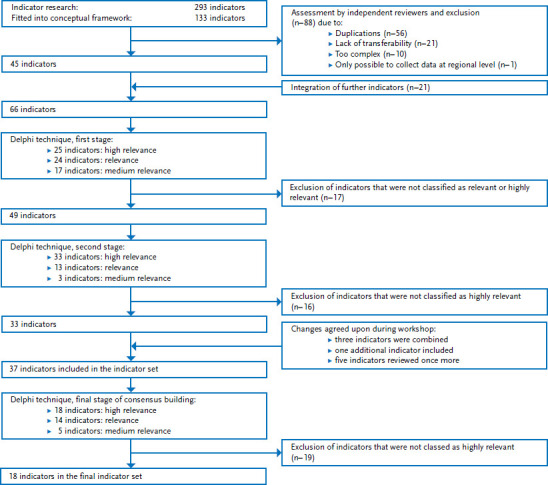
Selecting relevant indicators is an important step in the development of public health monitoring for older people. Indicators can be used to combine information comprehensively from various data sources and enable recurring, comparable findings to be made about the health of older people. Indicators were systematically compiled from existing international monitoring systems. An indicator set on health in old age was developed using a multistage, structured consensus-based process together with an interdisciplinary panel of experts. The resulting 18 indicators were assigned to three health areas: (1) environmental factors, (2) activities and participation, and (3) personal factors. Data sources that can be used for the indicators are the health surveys within the framework of the Robert Koch Institute's (RKI) health monitoring system, as well as surveys from other research institutes and official statistics. In the future, the indicator set is to be developed further and integrated into an overall approach that is geared towards health reporting and the monitoring of chronic diseases in all phases of life.
选择相关指标是老年人公共卫生监测发展中的重要一步。指标可用于综合整合来自各种数据源的信息,并能够就老年人的健康状况得出反复可比的结果。指标是从现有的国际监测系统中系统整理出来的。通过一个多阶段、基于结构化共识的过程,与一个跨学科专家小组共同制定了一套老年健康指标。最终得出的18项指标被归入三个健康领域:(1)环境因素,(2)活动与参与,以及(3)个人因素。可用于这些指标的数据源包括罗伯特·科赫研究所(RKI)健康监测系统框架内的健康调查,以及其他研究机构的调查和官方统计数据。未来,该指标集将进一步完善,并纳入一个面向健康报告和全生命周期慢性病监测的整体方法中。