Prabhakar Himanshu, Bock Clive H, Kerr William L, Kong Fanbin
Department of Food Science & Technology, University of Georgia, Athens, GA, USA.
USDA-ARS-SEFNTRL, Byron, GA, USA.
Curr Res Food Sci. 2022 Jan 21;5:261-271. doi: 10.1016/j.crfs.2022.01.015. eCollection 2022.
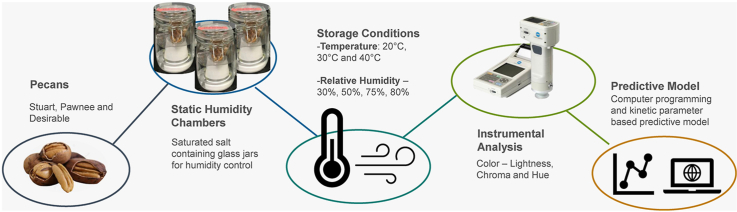
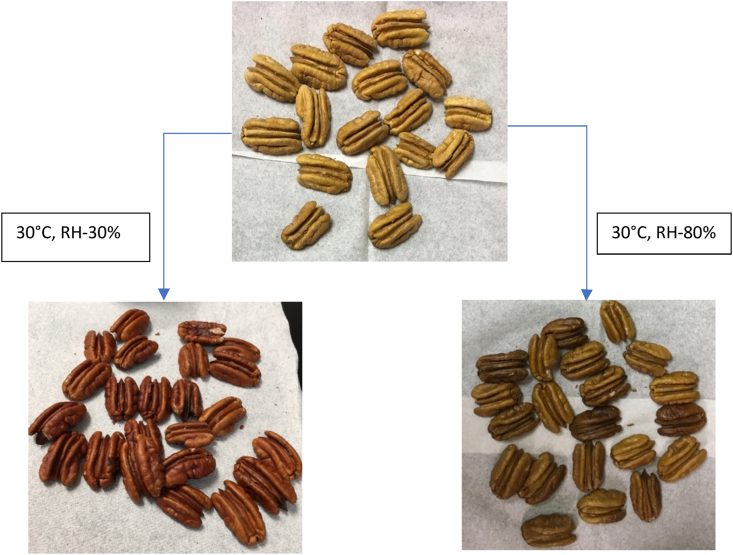
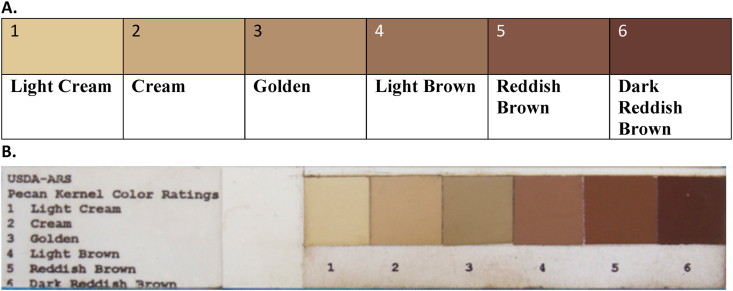
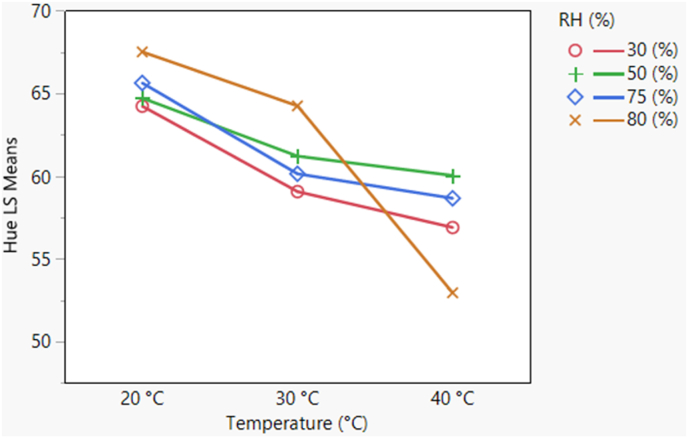
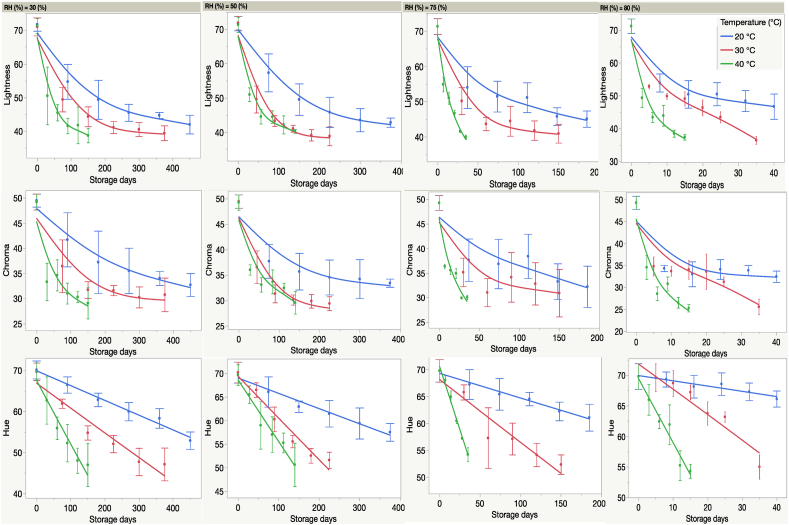
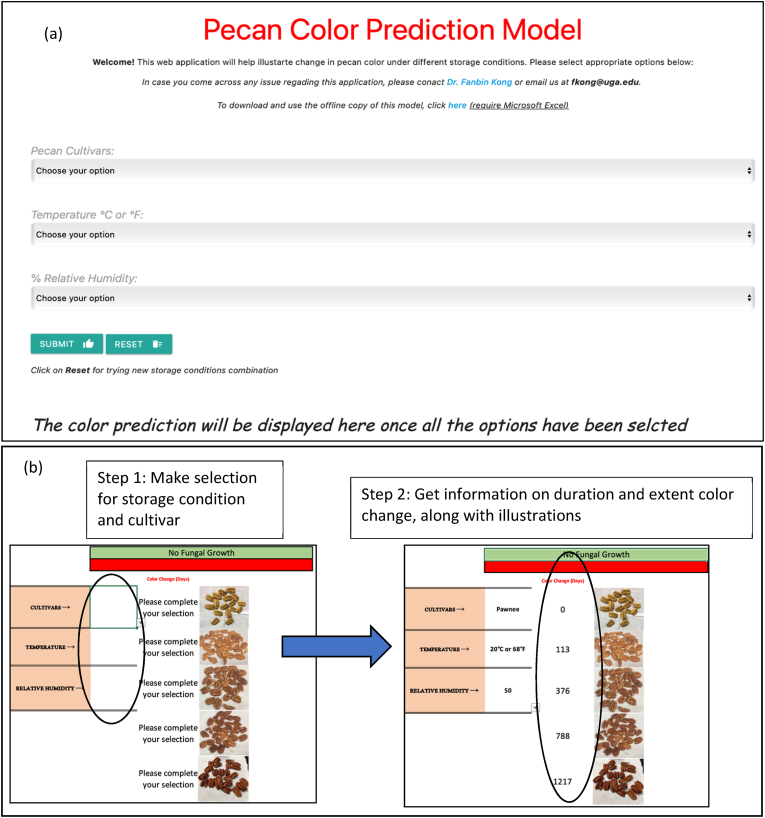
Postharvest changes in pecan nutmeat color are affected by many factors, both internal and external. The temperature, relative humidity (RH) of the surrounding environment, and storage time are major factors contributing to color deterioration of the nutmeats. Kinetic models have long been employed to provide insights into the physical and chemical changes in food systems; however, no kinetic model has been developed describing the color changes of pecan nutmeats during storage. The objective of this research was to determine the effect of temperature, RH and storage time on pecan nutmeat color change. Pecan nutmeats of three commercially important cultivars (Stuart, Pawnee and Desirable) were subjected to different temperatures (20, 30 and 40 °C) and RH conditions (30, 50, 75% and 80%) for up to 450 days in simulated storage. The observed color changes of the pecan nutmeats were measured as lightness, chroma and hue (LCh). Additionally, the USDA pecan color rating scale was digitized to encourage its use among researchers. It was observed that the change in hue followed a zero-order decay whereas change in lightness and chroma followed a first-order decay. The value of the reaction constants ranged from 0.010 to 1.315 day. An Arrhenius model was used to estimate the activation energy (E) corresponding to different storage conditions. The values revealed significant effects of temperature, RH and storage days on color degradation. The breakdown of flavonoids and reaction products from Maillard browning could be responsible for the formation of the reddish-brown color observed in degraded nutmeats. The kinetic parameters and models were used to develop a user-friendly online interface for predicting color change depending on selected parameters, with illustrations of the resulting pecan color (https://tinyurl.com/uspecans). The results of this study will aid pecan growers, processors and researchers to predict and visualize changes in color of pecan nutmeats during storage under various conditions of temperature and RH, and duration of storage. Although the study used cultivars Stuart, Pawnee and Desirable, the results likely have more general applicability to other cultivars too.
山核桃果仁颜色的采后变化受到许多内部和外部因素的影响。周围环境的温度、相对湿度(RH)以及储存时间是导致果仁颜色劣变的主要因素。长期以来,动力学模型一直被用于深入了解食品系统中的物理和化学变化;然而,尚未开发出描述山核桃果仁在储存期间颜色变化的动力学模型。本研究的目的是确定温度、相对湿度和储存时间对山核桃果仁颜色变化的影响。将三个具有商业重要性的山核桃品种(斯图尔特、波尼和理想)的果仁在模拟储存条件下,分别置于不同温度(20、30和40°C)和相对湿度条件(30、50、75%和80%)下长达450天。观察到的山核桃果仁颜色变化通过明度、色度和色调(LCh)来衡量。此外,美国农业部山核桃颜色评级量表被数字化,以鼓励研究人员使用。观察到色调变化遵循零级衰减,而明度和色度变化遵循一级衰减。反应常数的值范围为0.010至1.315天⁻¹。使用阿伦尼乌斯模型来估计对应于不同储存条件的活化能(E)。这些值揭示了温度、相对湿度和储存天数对颜色降解有显著影响。黄酮类化合物的分解和美拉德褐变的反应产物可能是导致劣化果仁中出现红棕色的原因。利用动力学参数和模型开发了一个用户友好的在线界面,用于根据选定参数预测颜色变化,并展示所得山核桃颜色(https://tinyurl.com/uspecans)。本研究结果将有助于山核桃种植者、加工者和研究人员预测和可视化在不同温度、相对湿度条件以及储存时间下,山核桃果仁在储存期间的颜色变化。尽管本研究使用了斯图尔特、波尼和理想品种,但结果可能对其他品种也具有更广泛的适用性。