Department of Small Animal Neurology, Davies Veterinary Specialists, Higham Gobion, SG5 3HR, UK.
Department of Small Animal Neurology, Clinica Veterinaria San Marco, Viale dell'Industria, Veggiano, 35030, Italy.
J Small Anim Pract. 2022 Jun;63(6):454-459. doi: 10.1111/jsap.13480. Epub 2022 Feb 10.
Report the rate of recurrent clinical signs following successful treatment of cervical intervertebral disc extrusion, and explore the association between treatment method and recurrence.
Medical records of dogs with MRI- or CT-confirmed cervical intervertebral disc extrusion were reviewed to verify that they recovered. Type of treatment, site of initial extrusion and whether dogs re-presented with recurrent clinical signs were recorded. Recurrence was considered presumed if based on clinical signs or confirmed if based on repeat cross-sectional imaging.
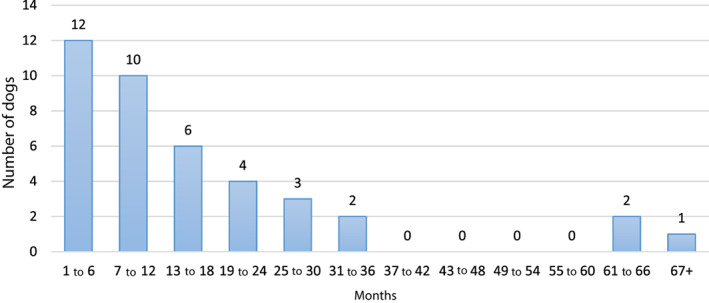
Complete recovery was documented following medical (36/119, 30.3%) or surgical (83/119, 69.7%) management of initial cervical disc extrusion. There was a recurrence of consistent clinical signs in 40 of 119 (34%) cases, of which 27 of 83 (33%) were initially managed surgically and 13 of 36 (36%) medically. In 24 of 40 (60%) cases, there was imaging confirmation of recurrent extrusion; in medically managed dogs, recurrence mostly occurred at the same site, whereas after surgery, recurrence most commonly involved an adjacent disc. Of the 40 recurrences, 32 (80%) occurred within 2 years of diagnosis. Rate of recurrence was similar between treatment methods in both univariable and multivariable time-to-event analyses (hazard ratio 1.03; 95% confidence interval: 0.67 to 1.53; P=0.87).
Following successful initial medical or surgical treatment, clinical signs consistent with recurrent cervical disc extrusion occurred with similar frequency. Medically treated cases tended to have recurrence at the same site as initial presentation, whereas surgical treatment prevented this. Recurrence usually occurred within 2 years. The retrospective study design, small number of recurrences and lack of imaging confirmation of every recurrence should be considered when interpreting the results.
报告颈椎间盘突出症成功治疗后临床症状复发的发生率,并探讨治疗方法与复发之间的关系。
回顾性分析经 MRI 或 CT 证实的颈椎间盘突出症犬的病历,以确认其已康复。记录治疗类型、初次突出部位以及犬是否再次出现临床症状。如果基于临床症状则认为是疑似复发,如果基于重复的横断面成像则认为是确诊复发。
经医学(36/119,30.3%)或手术(83/119,69.7%)治疗颈椎间盘突出症后,完全康复的病例有 36/119(30.3%)。119 例中有 40 例(34%)出现一致的临床症状复发,其中 83 例(33%)最初经手术治疗,36 例(36%)经医学治疗。40 例中有 24 例(60%)的影像学证实复发;在经医学治疗的犬中,复发大多发生在同一部位,而手术后,复发最常见于相邻的椎间盘。40 例复发中,32 例(80%)发生在诊断后 2 年内。在单变量和多变量时间事件分析中,治疗方法之间的复发率相似(风险比 1.03;95%置信区间:0.67 至 1.53;P=0.87)。
在初次成功的医学或手术治疗后,出现与颈椎间盘突出症复发一致的临床症状的频率相似。经医学治疗的病例复发倾向于与初次发病时的同一部位,而手术治疗则可预防这种情况。复发通常发生在 2 年内。在解释结果时,应考虑研究设计为回顾性、复发病例数量较少以及并非每例复发都进行影像学确认的问题。