Violini Francesca, Tirrito Federica, Cozzi Francesca, Contiero Barbara, Anesi Simone, Zini Eric, Toni Cristina
Willows Veterinary Centre & Referral Service, Part of Linnaeus Veterinary Limited, Solihull, United Kingdom.
AniCura Istituto Veterinario Novara, Novara, Italy.
Front Vet Sci. 2024 Aug 29;11:1438300. doi: 10.3389/fvets.2024.1438300. eCollection 2024.
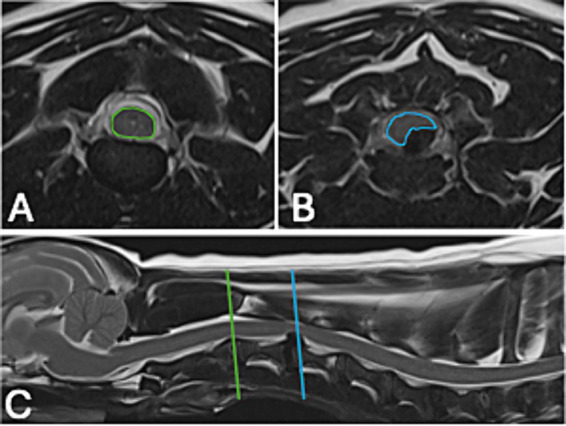
Large clinical studies regarding cervical intervertebral disc extrusion (IVDE) in Dachshunds are lacking. This retrospective multicentric study therefore aims to describe the clinical features, magnetic resonance imaging (MRI) findings and outcomes of Dachshunds diagnosed with cervical IVDE.
Medical records of Dachshunds with cervical IVDE were reviewed for signalment, onset of clinical signs, neurological examination, MRI features, treatment and outcome.
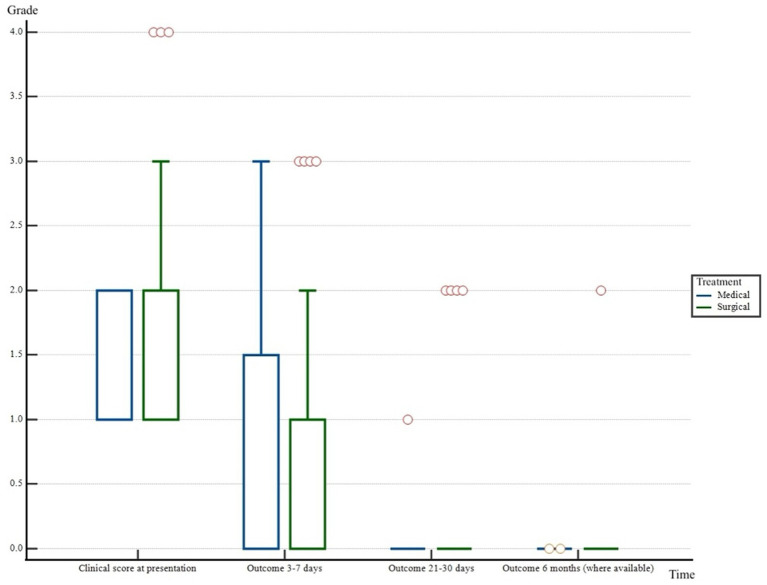
Eighty Dachshunds were included in the study, mostly ambulatory (55% grade 1 and 33% grade 2) and without nerve root signature (85% of cases) on presentation. Information on coat type was available for 56% of dogs; specifically, 41% were smooth-haired, 9% were long-haired and 6% were wire-haired Dachshunds. There were 29 (36%) neutered female, 27 (34%) male entire, 15 (19%) male neutered and 9 (11%) entire female dogs. The onset of clinical signs was most often >48 h (84%). The most common intervertebral disc space affected was C2-C3 (38%) and foraminal IVDEs were reported in 14% of dogs. A foraminal IVDE was diagnosed in only 25% of dogs presented with nerve root signatures. Most dogs (77.5%) were treated surgically. In this group, a higher body condition score on presentation and a higher mean spinal cord compression ratio calculated on MRI were directly and moderately associated with a longer hospitalization time ( = 0.490 = 0.005 and = 0.310 = 0.012, respectively). The recovery time was longer in dogs with an onset of clinical signs <24 h or 24-48 h compared to those with an onset of clinical signs >48 h (3.1 ± 6.5 days versus 1.6 ± 6.2, < 0.001) in both medically and surgically treated groups. Data about the outcome was available for 83% of dogs. Eighty percent of the entire population of dogs was considered to have completely returned to normal. There was no association between the therapeutic choice (surgical versus medical management) and the outcome of the dogs included in this study.
关于腊肠犬颈椎间盘突出症(IVDE)的大型临床研究尚属空白。因此,这项回顾性多中心研究旨在描述被诊断为颈椎IVDE的腊肠犬的临床特征、磁共振成像(MRI)表现及预后情况。
回顾腊肠犬颈椎IVDE的病历,包括信号特征、临床症状出现时间、神经学检查、MRI特征、治疗方法及预后。
80只腊肠犬纳入本研究,就诊时大多能自主活动(55%为1级,33%为2级)且无神经根体征(85%的病例)。56%的犬有被毛类型信息;具体而言,41%为短毛犬,9%为长毛犬,6%为刚毛腊肠犬。有29只(36%)绝育雌性犬、27只(34%)未绝育雄性犬、15只(19%)绝育雄性犬和9只(11%)未绝育雌性犬。临床症状出现时间大多>48小时(84%)。最常受累的椎间盘间隙为C2 - C3(38%),14%的犬报告有椎间孔型IVDE。在有神经根体征的犬中,仅25%被诊断为椎间孔型IVDE。大多数犬(77.5%)接受了手术治疗。在这组犬中,就诊时较高的身体状况评分和MRI计算出的较高平均脊髓压迫率与较长的住院时间直接且中度相关(分别为r = 0.490,P = 0.005和r = 0.310,P = 0.012)。与临床症状出现时间>48小时的犬相比,临床症状出现时间<24小时或24 - 48小时的犬无论在药物治疗组还是手术治疗组,恢复时间都更长(3.1±6.5天对1.6±6.2天,P<0.001)。83%的犬有预后数据。80%的犬被认为已完全恢复正常。本研究中犬的治疗选择(手术与药物治疗)与预后之间无相关性。