Centre for Clinical Research, Kenya Medical Research Institute, Nairobi, Kenya.
Department of Epidemiology, Harvard T.H. Chan School of Public Health, Boston, MA, USA.
J Affect Disord. 2022 Apr 15;303:155-160. doi: 10.1016/j.jad.2022.02.012. Epub 2022 Feb 11.
The Kessler psychological distress scale (K10) is a brief screening tool that assesses psychological distress in both clinical and epidemiological settings. Despite wide applicability of the K10 globally, there are no data on psychometric properties of the K10 in Kenya. This study investigated the reliability, factor structure, and construct validity of the K10 as a measure of psychological distress among adults in Kenya.
A total of 2556 adults attending 11 outpatient clinics in the western and coastal regions of Kenya without a history or clinical diagnosis of psychotic disorders were included. Data were collected on demographic characteristics of the participants and the K10. Internal consistency was evaluated using Cronbach's alpha. Construct validity and factor structures of the K10 were evaluated using both exploratory factor analysis (EFA) and confirmatory factor analysis (CFA) approaches.
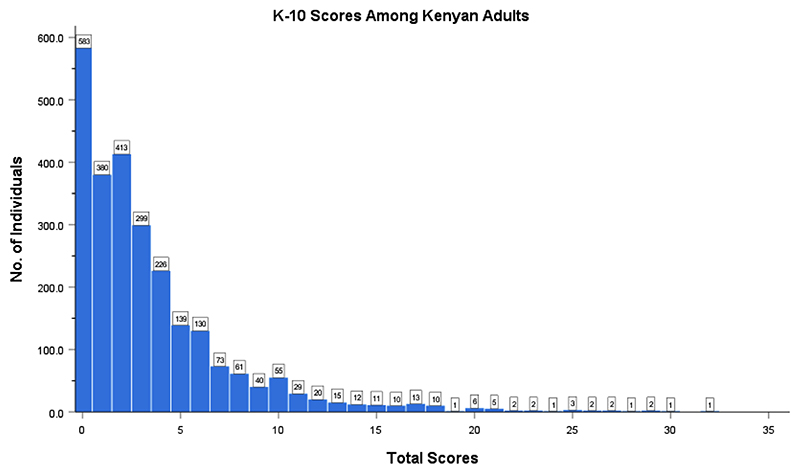
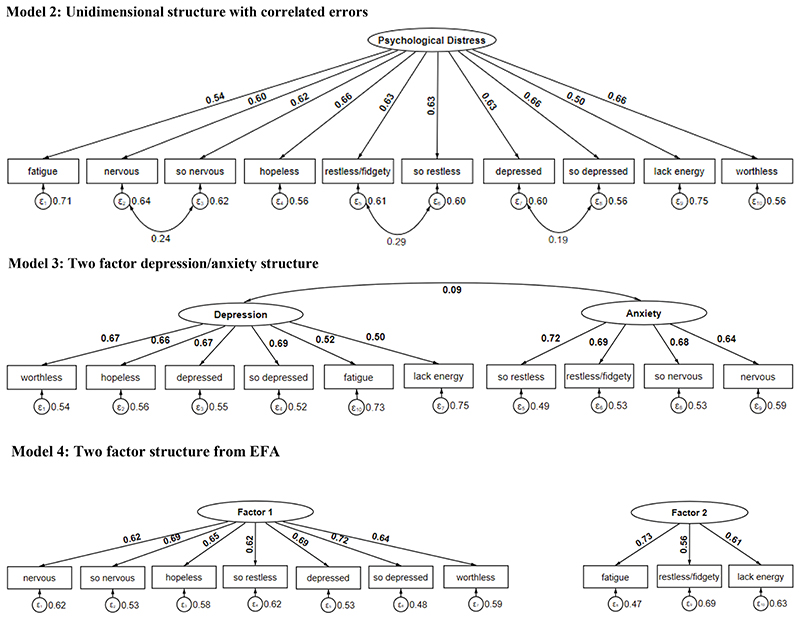
The mean K10 score was 3.4 and Cronbach's alpha was 0.85, indicating good internal consistency (reliability). EFA resulted in a two-factor solution that accounted for 67.6% of variance. CFA results indicated that a unidimensional model with correlated errors best fit the data.
The K10 was only administered to a control group of our study population, which had low levels of psychological distress.
The K10 has good construct validity and reliability for use as a broad measure of psychological distress in Kenyan adults and may be useful in general medical setting to assess anxiety and depressive disorders.
凯斯勒心理困扰量表(K10)是一种简短的筛查工具,可用于评估临床和流行病学环境中的心理困扰。尽管 K10 在全球具有广泛的适用性,但肯尼亚尚未有关于 K10 的心理测量特性的数据。本研究旨在调查 K10 在肯尼亚成年人中作为心理困扰测量工具的可靠性、因子结构和构念效度。
共纳入了 2556 名在肯尼亚西部和沿海地区 11 家门诊诊所就诊的成年人,他们没有精神障碍病史或临床诊断。收集了参与者的人口统计学特征和 K10 数据。使用 Cronbach's alpha 评估内部一致性。使用探索性因子分析(EFA)和验证性因子分析(CFA)方法评估 K10 的构念效度和因子结构。
K10 的平均得分为 3.4,Cronbach's alpha 为 0.85,表明具有良好的内部一致性(可靠性)。EFA 得出了一个能解释 67.6%方差的两因素模型。CFA 结果表明,一个具有相关误差的单维模型最能拟合数据。
K10 仅在我们研究人群的对照组中进行了管理,该对照组的心理困扰程度较低。
K10 在肯尼亚成年人中具有良好的构念效度和可靠性,可作为广泛的心理困扰测量工具使用,也可能在一般医疗环境中用于评估焦虑和抑郁障碍。