Division of Rheumatology, Department of Medicine, National University Hospital, Singapore, Singapore.
Department of Medicine, Yong Loo Lin School of Medicine, National University of Singapore, Singapore, Singapore.
Front Immunol. 2022 Jan 28;13:807050. doi: 10.3389/fimmu.2022.807050. eCollection 2022.
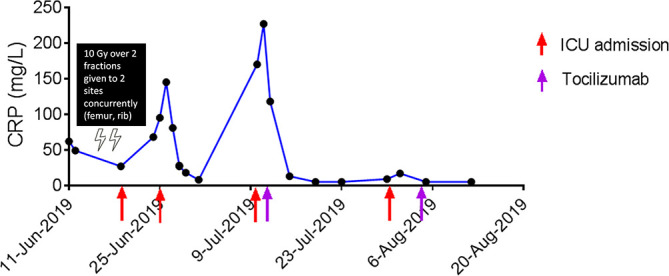
Cytokine release syndrome (CRS) is a phenomenon of immune hyperactivation described in the setting of immunotherapy. Unlike other immune-related adverse events, CRS triggered by immune checkpoint inhibitors (ICIs) is not well described. The clinical characteristics and course of 25 patients with ICI-induced CRS from 2 tertiary hospitals were abstracted retrospectively from the medical records and analyzed. CRS events were confirmed by 2 independent reviewers and graded using the Lee et al. scale. The median duration of CRS was 15.0 days (Q1; Q3 6.3; 29.8) and 10 (40.0%) had multiple episodes of CRS flares. Comparing the clinical factors and biomarkers in Grades 1-2 and 3-5 CRS, we found that patients with Grades 3-5 CRS had following: (i) had longer time to fever onset [25.0 days (Q1; Q3 13.0; 136.5) vs. 3.0 days (Q1; Q3 0.0; 18.0), p=0.027]; (ii) more cardiovascular (p=0.002), neurologic (p=0.001), pulmonary (p=0.044) and rheumatic (p=0.037) involvement; (iii) lower platelet count (p=0.041) and higher urea (p=0.041) at presentation compared to patients with Grades 1-2 CRS. 7 patients (28.0%) with Grades 1-2 CRS were rechallenged using ICIs without event. 9 patients (36.0%) were treated with pulse methylprednisolone and 6 patients (24.0%) were treated with tocilizumab. Despite this, 3 patients (50%) who received tocilizumab had fatal (Grade 5) outcomes from ICI-induced CRS. Longer time to fever onset, lower platelet count and higher urea at presentation were associated with Grade 3-5 CRS. These parameters may be used to predict which patients are likely to develop severe CRS.
细胞因子释放综合征 (CRS) 是一种免疫过度激活的现象,在免疫治疗中有所描述。与其他免疫相关不良事件不同,免疫检查点抑制剂 (ICI) 引发的 CRS 描述得还不够充分。从 2 家三级医院的病历中回顾性提取了 25 例 ICI 诱导的 CRS 患者的临床特征和病程,并进行了分析。CRS 事件由 2 位独立评审员确认,并使用 Lee 等人的量表进行分级。CRS 的中位持续时间为 15.0 天(Q1;Q3 6.3;29.8),10 例(40.0%)有多次 CRS 发作。比较 1-2 级和 3-5 级 CRS 的临床因素和生物标志物,我们发现 3-5 级 CRS 患者有以下特点:(i)发热开始时间较长[25.0 天(Q1;Q3 13.0;136.5)比 3.0 天(Q1;Q3 0.0;18.0),p=0.027];(ii)更多的心血管(p=0.002)、神经(p=0.001)、肺(p=0.044)和风湿(p=0.037)受累;(iii)血小板计数较低(p=0.041),尿素水平较高(p=0.041)与 1-2 级 CRS 患者相比。7 例(28.0%)1-2 级 CRS 患者再次接受 ICI 治疗无事件发生。9 例(36.0%)患者接受脉冲甲基强的松龙治疗,6 例(24.0%)患者接受托珠单抗治疗。尽管如此,3 例(50%)接受托珠单抗治疗的患者因 ICI 诱导的 CRS 而出现(5 级)致命结局。发热开始时间较长、血小板计数较低和尿素水平较高与 3-5 级 CRS 相关。这些参数可用于预测哪些患者可能发展为严重的 CRS。