Department of Respiratory Medicine, Tokyo Metropolitan Cancer and Infectious Diseases Center Komagome Hospital, Japan.
Department of Cardiology, Tokyo Metropolitan Cancer and Infectious Diseases Center Komagome Hospital, Japan.
Intern Med. 2021 Nov 1;60(21):3459-3462. doi: 10.2169/internalmedicine.5922-20. Epub 2021 Mar 29.
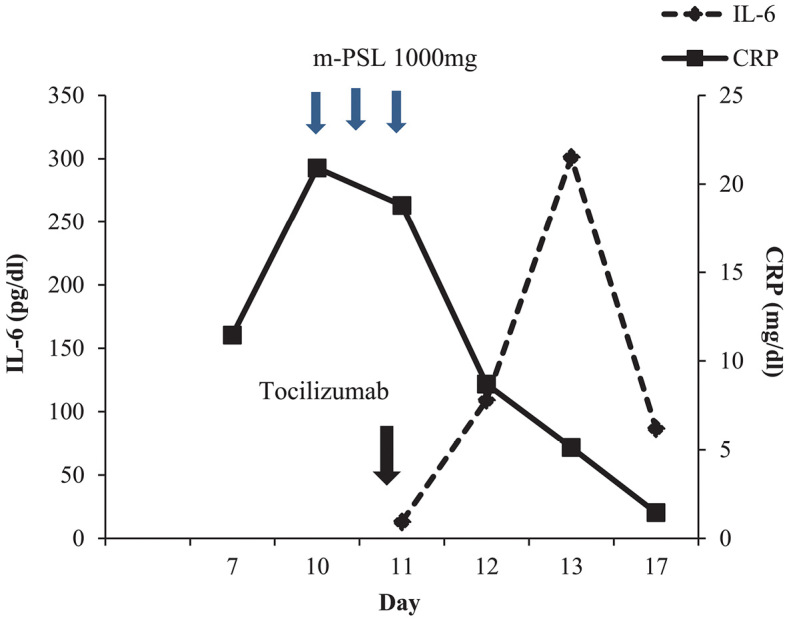
Immune-related adverse events, including autoimmune toxicity, may develop as a consequence of immune-checkpoint inhibitor (ICI) cancer therapy. Cytokine release syndrome (CRS) is a severe and life-threatening cytokine-associated toxicity that can develop after adoptive T-cell therapy. We herein report a rare case of severe CRS after ICI therapy for advanced non-small-cell lung cancer. He presented with a prolonged high fever, cardiogenic shock, and disseminated intravascular coagulation after the first course of programed death ligand-1 inhibitor and platinum-based doublet chemotherapy. He recovered by steroid pulse therapy and tocilizumab. CRS is a rare but life-threatening adverse event of ICI therapy and therefore warrants awareness.
免疫相关不良反应,包括自身免疫毒性,可能是由于免疫检查点抑制剂(ICI)癌症治疗引起的。细胞因子释放综合征(CRS)是一种严重的、危及生命的细胞因子相关毒性,可在过继性 T 细胞治疗后发生。本文报告了一例晚期非小细胞肺癌患者在接受 ICI 治疗后发生严重 CRS 的罕见病例。他在接受程序性死亡配体-1 抑制剂和铂类双联化疗的第一个疗程后出现持续高热、心源性休克和弥散性血管内凝血。他通过类固醇冲击治疗和托珠单抗治疗后恢复。CRS 是 ICI 治疗罕见但危及生命的不良反应,因此需要引起重视。