Li Shuang, Chen Limin
Institute of Basic Medicine, Shanghai University of Medicine and Health Sciences, Shanghai, China.
Provincial Key Laboratory for Transfusion-Transmitted Infectious Diseases, Institute of Blood Transfusion, Chinese Academy of Medical Sciences and Peking Union Medical College, Chengdu, China.
Front Oncol. 2022 Jan 27;12:793432. doi: 10.3389/fonc.2022.793432. eCollection 2022.
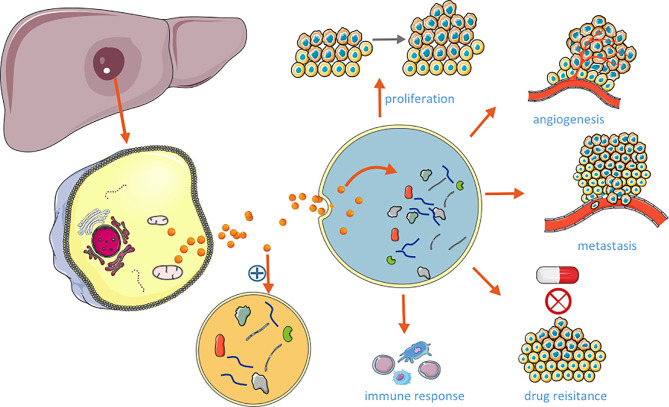
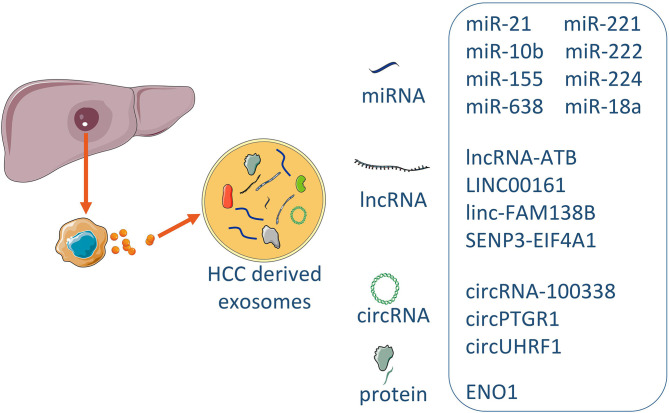
Exosomes are extracellular vesicles with a diameter of 30-150 nm that are released by most types of cells and have been confirmed to be involved in many physical and pathological processes, especially in cell to cell communication. Compared with other vesicles, exosomes have a unique double-layer saclike structure that allows them to be present stably in various body fluids, including blood, cerebrospinal fluid, urine, saliva, and serous cavity effusion. The cargoes of exosomes reflect the characteristics of host cells. Due to the nature of hepatocellular carcinoma (HCC) cells, heterogeneity in the bioactive substances usually exist in exosomes. In addition, exosomes can efficiently deliver cargoes to the target cells to exert pathological functions, playing important role in tumor occurrence, development, metastasis, immune regulation, and drug resistance. Previous studies have been shown that exosomes have wide applications in diagnosis and treatment of HCC. In this review, we discuss these recent findings and highlight the significant roles of exosomes in HCC, focusing on the effect and underlying mechanisms of exosomes to regulate HCC progression and the potential clinical value of exosomes as biomarkers and therapeutic targets.
外泌体是直径为30-150纳米的细胞外囊泡,由大多数类型的细胞释放,并且已被证实参与许多生理和病理过程,尤其是在细胞间通讯中。与其他囊泡相比,外泌体具有独特的双层囊状结构,这使得它们能够稳定存在于包括血液、脑脊液、尿液、唾液和浆膜腔积液在内的各种体液中。外泌体的货物反映了宿主细胞的特征。由于肝癌(HCC)细胞的性质,外泌体中生物活性物质通常存在异质性。此外,外泌体可以有效地将货物递送至靶细胞以发挥病理功能,在肿瘤发生、发展、转移、免疫调节和耐药性中起重要作用。先前的研究表明,外泌体在HCC的诊断和治疗中具有广泛应用。在本综述中,我们讨论了这些最新发现,并强调了外泌体在HCC中的重要作用,重点关注外泌体调节HCC进展的作用及潜在机制,以及外泌体作为生物标志物和治疗靶点的潜在临床价值。