Pan Yiming, Li Yun, Liu Pan, Zhang Yaxin, Li Bowen, Liu Zuyun, Shui Guanghou, Ma Lina
Department of Geriatrics, National Research Center for Geriatric Medicine, Xuanwu Hospital, Capital Medical University, Beijing, China.
LipidALL Technologies Company Limited, Changzhou, China.
Front Med (Lausanne). 2022 Jan 26;8:830723. doi: 10.3389/fmed.2021.830723. eCollection 2021.
BACKGROUND/OBJECTIVES: Owing to accelerated population aging, health in older adults is becoming increasingly important. Frailty can reflect the health status and disease risks of older adults; however, appropriate biomarkers for early screening of frailty have not been identified. Here, we applied metabolomics to identify frailty biomarkers and potential pathogenic mechanisms of frailty.
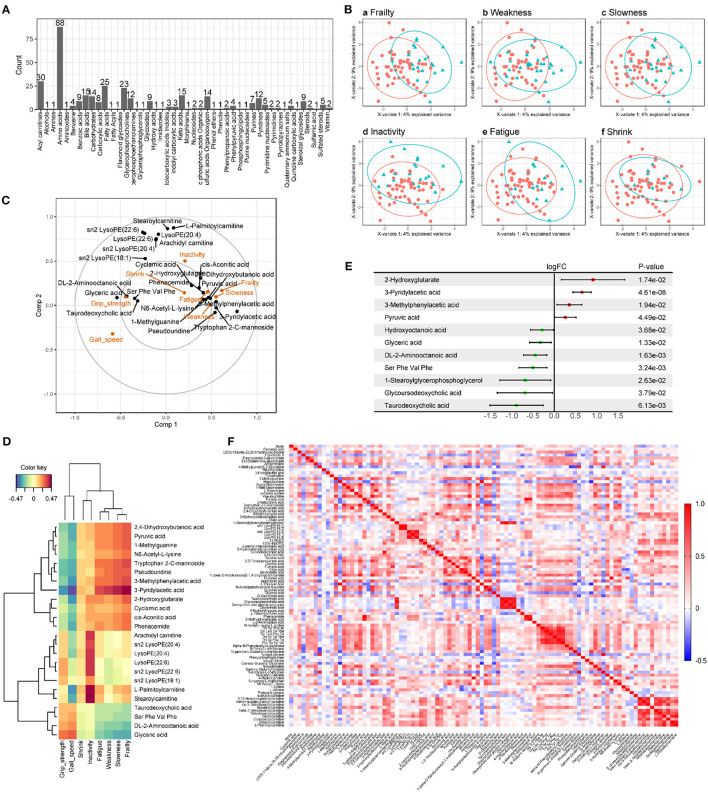
Serum metabolic profiles from 25 frail and 49 non-frail (control) older adults were systematically investigated by liquid chromatography-mass spectrometry-based metabolomics.
We identified 349 metabolites of 46 classes, with four increased and seven decreased metabolites in frail older adults. Pearson correlation analysis identified 11 and 21 metabolites that were positively and negatively correlated with grip strength, and 7 and 76 metabolites that were positively and negatively correlated with gait speed, respectively. Pathway analysis identified 10 metabolite sets and 13 pathways significantly associated with one or more frailty phenotype criteria.
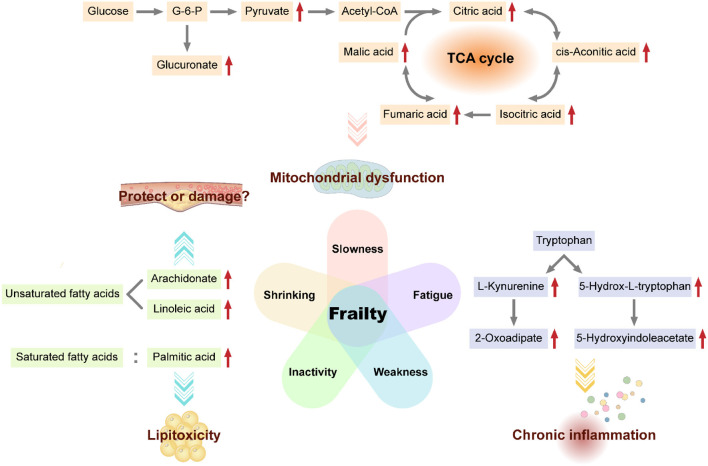
These results revealed the metabolite characteristics of serum in frail older adults. Intermediates of carbohydrate metabolism (e.g., isocitrate, malate, fumarate, cis-aconitate, glucuronate, and pyruvate), saturated fatty acids (e.g., palmitic acid), unsaturated fatty acids (e.g., arachidonate and linoleic acid), and certain essential amino acids (e.g., tryptophan) may be candidate biomarkers for the early diagnosis of frailty. Mitochondrial function disorders, saturated fatty acid-mediated lipotoxicity, aberrant unsaturated fatty acid metabolism, and increased tryptophan degradation could be potential mechanisms of frailty.
背景/目的:由于人口老龄化加速,老年人的健康变得越来越重要。衰弱能够反映老年人的健康状况和疾病风险;然而,尚未确定用于早期筛查衰弱的合适生物标志物。在此,我们应用代谢组学来识别衰弱生物标志物和衰弱的潜在致病机制。
通过基于液相色谱 - 质谱的代谢组学系统研究了25名衰弱老年人和49名非衰弱(对照)老年人的血清代谢谱。
我们鉴定出46类349种代谢物,衰弱老年人中有4种代谢物增加,7种代谢物减少。Pearson相关性分析确定了与握力呈正相关和负相关的11种和21种代谢物,以及与步速呈正相关和负相关的7种和76种代谢物。通路分析确定了10个代谢物集和13条通路与一种或多种衰弱表型标准显著相关。
这些结果揭示了衰弱老年人血清的代谢物特征。碳水化合物代谢中间体(如异柠檬酸、苹果酸、富马酸、顺乌头酸、葡萄糖醛酸和丙酮酸)、饱和脂肪酸(如棕榈酸)、不饱和脂肪酸(如花生四烯酸和亚油酸)以及某些必需氨基酸(如色氨酸)可能是早期诊断衰弱的候选生物标志物。线粒体功能障碍、饱和脂肪酸介导的脂毒性、异常的不饱和脂肪酸代谢以及色氨酸降解增加可能是衰弱的潜在机制。