Lozinski Brigit M, Frederick Brent, Li Yuzhi, Saqui-Salces Milena, Shurson Gerald C, Urriola Pedro E, Wilson Melissa L, Johnston Lee J
Department of Animal Science, University of Minnesota, St. Paul, MN 55108, USA.
Christensen Family Farms, Sleepy Eye, MN 56085, USA.
Transl Anim Sci. 2022 Jan 15;6(1):txac002. doi: 10.1093/tas/txac002. eCollection 2022 Jan.
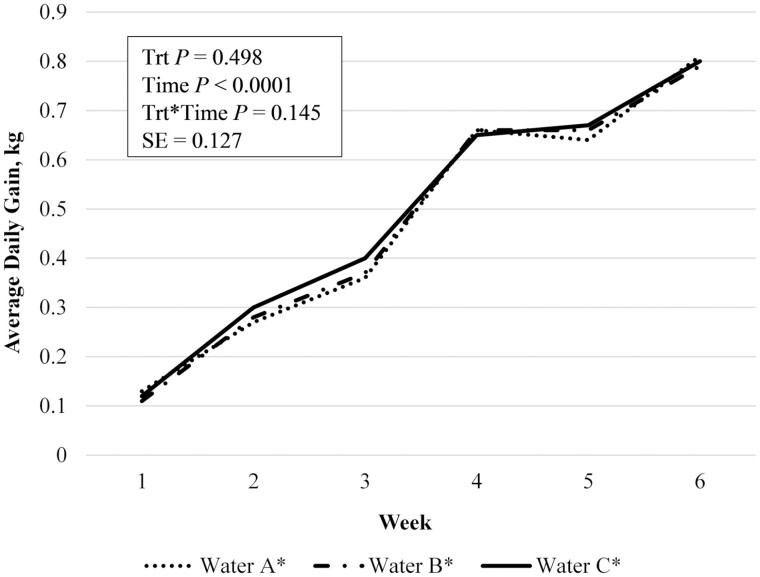
An experiment was conducted to determine the effects of providing drinking water of differing qualities on growth performance and health of nursery pigs. Weanling pigs ( = 450; 150 pigs/group; 10 pigs/pen) were assigned randomly to one of three experimental groups consisting of three water sources of varying qualities: 1) Water source A containing 1,410 ppm hardness (CaCO equivalent), 1,120 ppm sulfates, and 1,500 ppm total dissolved solids (TDS); 2) Water source B containing 909 ppm hardness (CaCO equivalent), 617 ppm sulfates, and 1,050 ppm TDS; and 3) Water source C containing 235 ppm hardness (CaCO equivalent), 2 ppm sulfates, and 348 ppm TDS. Pigs were provided ad libitum access to their respective water sources for the duration of the study which began at weaning (21 d of age) and ended 40 d later (61 d of age). Individual pig weights were recorded weekly along with feed intake on a pen basis. Occurrences of morbidity and mortality were recorded daily. Subjective fecal scores were assigned on a pen basis and blood samples were used to evaluate blood chemistry, cytokine concentrations, and phagocytic activity. A differential sugar absorption test was used to assess intestinal permeability. Fecal grab samples were used to establish diet digestibility, and drinking behavior was video-recorded to assess pigs' acceptance of water sources provided. The statistical model considered fixed effects of water source, room, and their interaction with the random effect of pen. A repeated measures analysis was conducted to determine the effects of water quality over time. There were no differences ( > 0.440) among water sources in average daily gain (A, 0.46 kg/d; B, 0.46 kg/d; C, 0.47 kg/d) or average daily feed intake (A, 0.68 kg/d; B, 0.69 kg/d; C, 0.71 kg/d). Overall mortality of pigs was 0.44% and did not differ across the three water sources. There were no differences in apparent total tract digestibility of the diet, intestinal permeability, immune parameters, or blood chemistry attributable to quality of water consumed by pigs. Pigs did not show an aversion to the water sources provided, because total time pigs spent at the drinker did not differ ( > 0.750) among water sources on days 1 through 3 of the experiment. These data indicate that the water sources of differing quality studied did not affect growth performance or health of nursery pigs.
进行了一项实验,以确定提供不同质量的饮用水对保育猪生长性能和健康的影响。断奶仔猪(n = 450;每组150头猪;每栏10头猪)被随机分配到三个实验组之一,这三个实验组由三种不同质量的水源组成:1)水源A,硬度为1410 ppm(碳酸钙当量),硫酸盐含量为1120 ppm,总溶解固体(TDS)含量为1500 ppm;2)水源B,硬度为909 ppm(碳酸钙当量),硫酸盐含量为617 ppm,TDS含量为1050 ppm;3)水源C,硬度为235 ppm(碳酸钙当量),硫酸盐含量为2 ppm,TDS含量为348 ppm。在整个研究期间,猪可以随意饮用各自的水源,研究从断奶(21日龄)开始,40天后(61日龄)结束。每周记录每头猪的体重以及每栏的采食量。每天记录发病率和死亡率。以栏为基础主观评定粪便评分,并采集血样以评估血液生化指标、细胞因子浓度和吞噬活性。采用差异糖吸收试验评估肠道通透性。采集粪便样本以确定日粮消化率,并对饮水行为进行视频记录以评估猪对所提供水源的接受程度。统计模型考虑了水源、栏舍及其与栏舍随机效应的交互作用的固定效应。进行重复测量分析以确定水质随时间的影响。不同水源之间的平均日增重(A组,0.46 kg/d;B组,0.46 kg/d;C组,0.47 kg/d)或平均日采食量(A组,0.68 kg/d;B组,0.69 kg/d;C组,0.71 kg/d)没有差异(P > 0.440)。猪的总体死亡率为0.44%,在三种水源之间没有差异。日粮的表观全肠道消化率、肠道通透性、免疫参数或血液生化指标在猪所饮用的不同质量水源之间没有差异。猪对所提供的水源没有表现出厌恶,因为在实验的第1至3天,猪在饮水器处花费的总时间在不同水源之间没有差异(P > 0.750)。这些数据表明,所研究的不同质量的水源对保育猪的生长性能或健康没有影响。