Caruso Damiano, Zerunian Marta, Polici Michela, Pucciarelli Francesco, Guido Gisella, Polidori Tiziano, Rucci Carlotta, Bracci Benedetta, Tremamunno Giuseppe, Laghi Andrea
Department of Medical Surgical Sciences and Translational Medicine, Sapienza University of Rome, Sant'Andrea University Hospital, Via di Grottarossa, 1035-1039, 00189, Rome, Italy.
Radiol Med. 2022 Mar;127(3):309-317. doi: 10.1007/s11547-022-01458-9. Epub 2022 Feb 14.
Lung severity score (LSS) and quantitative chest CT (QCCT) analysis could have a relevant impact to stratify patients affected by COVID-19 pneumonia at the hospital admission. The study aims to assess LSS and QCCT performances in severity stratification of COVID-19 patients.
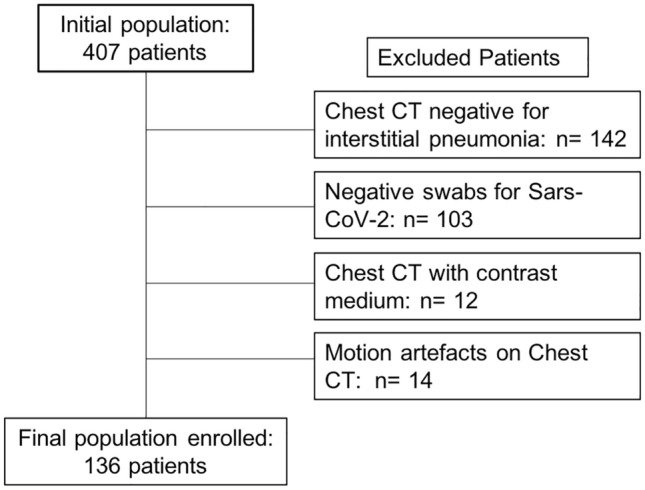
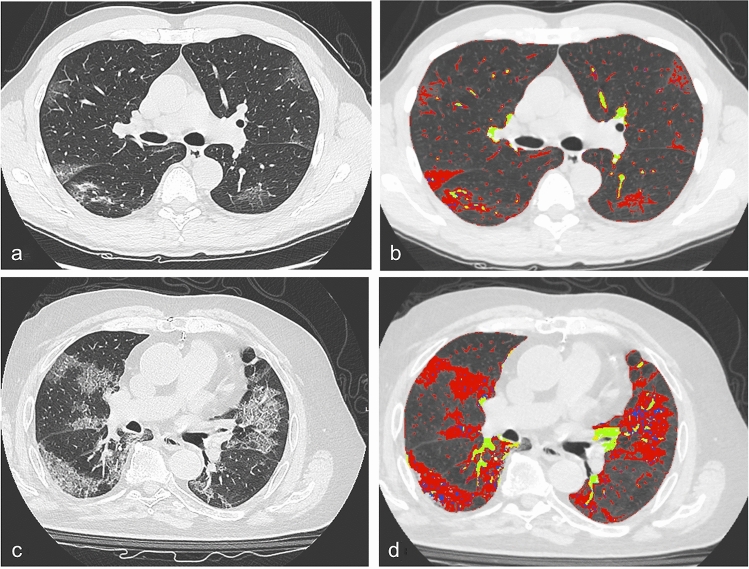
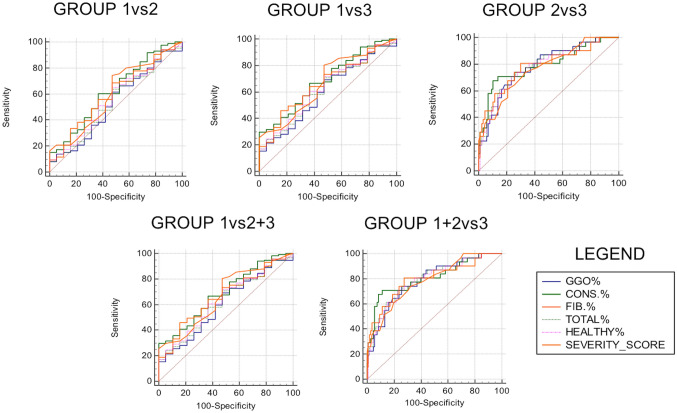
From April 19, 2020, until May 3, 2020, patients with chest CT suggestive for interstitial pneumonia and tested positive for COVID-19 were retrospectively enrolled and stratified for hospital admission as Group 1, 2 and 3 (home isolation, low intensive care and intensive care, respectively). For LSS, lungs were divided in 20 regions and visually assessed by two radiologists who scored for each region from non-lung involvement as 0, < 50% assigned as 1 and > 50% as 2. QCCT was performed with a dedicated software that extracts pulmonary involvement expressed in liters and percentage. LSS and QCCT were analyzed with ROC curve analysis to predict the performance of both methods. P values < 0.05 were considered statistically significant.
Final population enrolled included 136 patients (87 males, mean age 66 ± 16), 19 patients in Group 1, 86 in Group 2 and 31 in Group 3. Significant differences for LSS were observed in almost all comparisons, especially in Group 1 vs 3 (AUC 0.850, P < 0,0001) and Group 1 + 2 vs 3 (AUC 0.783, P < 0,0001). QCCT showed significant results in almost all comparisons, especially between Group 1 vs 3 (AUC 0.869, P < 0,0001). LSS and QCCT comparison between Group 1 and Group 2 did not show significant differences.
LSS and QCCT could represent promising tools to stratify COVID-19 patient severity at the admission.
肺部严重程度评分(LSS)和定量胸部CT(QCCT)分析可能对新冠病毒肺炎患者入院时的病情分层产生相关影响。本研究旨在评估LSS和QCCT在新冠病毒患者病情分层中的表现。
从2020年4月19日至2020年5月3日,对胸部CT提示间质性肺炎且新冠病毒检测呈阳性的患者进行回顾性纳入,并在入院时分为1组、2组和3组(分别为居家隔离、低强度监护和重症监护)。对于LSS,将肺部分为20个区域,由两名放射科医生进行视觉评估,他们对每个区域的评分如下:无肺部受累为0分,<50%受累为1分,>50%受累为2分。使用专门软件进行QCCT,该软件可提取以升和百分比表示的肺部受累情况。采用ROC曲线分析对LSS和QCCT进行分析,以预测两种方法的性能。P值<0.05被认为具有统计学意义。
最终纳入的研究对象包括136例患者(87例男性,平均年龄66±16岁),1组19例,2组86例,3组31例。几乎在所有比较中均观察到LSS存在显著差异,尤其是1组与3组(AUC 0.850,P<0.0001)以及1组+2组与3组(AUC 0.783,P<0.0001)。QCCT在几乎所有比较中均显示出显著结果,尤其是1组与3组之间(AUC 0.869,P<0.0001)。1组和2组之间的LSS和QCCT比较未显示出显著差异。
LSS和QCCT可能是入院时对新冠病毒患者病情进行分层的有前景的工具。