Urban Institute, University of Sheffield, 419 Portobello, Sheffield, S14DP, UK.
Copernicus Institute of Sustainable Development, Faculty of Geosciences, Vening Meineszgebouw A, Princetonlaan 8A, 3585CB, Utrecht, The Netherlands.
Ambio. 2022 Jun;51(6):1402-1415. doi: 10.1007/s13280-021-01697-6. Epub 2022 Feb 14.
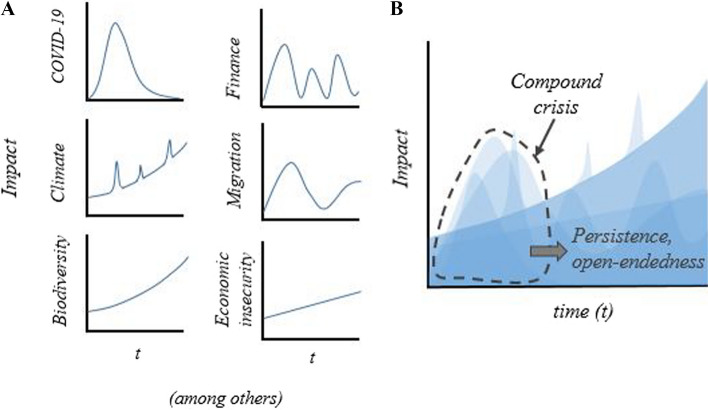
The crises that cities face-such as climate change, pandemics, economic downturn, and racism-are tightly interlinked and cannot be addressed in isolation. This paper addresses compound urban crises as a unique type of problem, in which discrete solutions that tackle each crisis independently are insufficient. Few scholarly debates address compound urban crises and there is, to date, a lack of interdisciplinary insights to inform urban governance responses. Combining ideas from complex adaptive systems and critical urban studies, we develop a set of boundary concepts (unsettlement, unevenness, and unbounding) to understand the complexities of compound urban crises from an interdisciplinary perspective. We employ these concepts to set a research agenda on compound urban crises, highlighting multiple interconnections between urban politics and global dynamics. We conclude by suggesting how these entry points provide a theoretical anchor to develop practical insights to inform and reform urban governance.
城市面临的危机——如气候变化、大流行病、经济衰退和种族主义——紧密交织在一起,不能孤立地解决。本文将复合城市危机视为一种独特类型的问题,其中独立解决每个危机的离散解决方案是不够的。很少有学术辩论涉及复合城市危机,而且迄今为止,缺乏跨学科的见解来为城市治理应对措施提供信息。我们结合复杂适应系统和批判性城市研究的思想,从跨学科的角度发展了一组边界概念(不稳定、不均匀和无边界)来理解复合城市危机的复杂性。我们利用这些概念为复合城市危机制定研究议程,强调城市政治和全球动态之间的多种相互联系。最后,我们建议这些切入点如何为发展提供理论依据,以获取实用见解,为城市治理提供信息并进行改革。