National Emergency Medical Center, National Medical Center, Seoul, Republic of Korea.
National Emergency Medical Center, National Medical Center, Seoul, Republic of Korea; Department of Emergency Medicine, Seoul National University Hospital, Seoul, Republic of Korea; Laboratory of Emergency Medical Services, Seoul National University Hospital Biomedical Research Institute, Seoul, Republic of Korea.
Am J Emerg Med. 2022 Apr;54:196-201. doi: 10.1016/j.ajem.2022.02.009. Epub 2022 Feb 7.
This study aimed to investigate the patterns of pediatric patients visiting emergency departments (EDs) before and after the COVID-19 pandemic and evaluate the interactive effect between the COVID-19 outbreak and age groups.
We performed a cross-sectional study using the nationwide emergency patient database in Korea from January 2019 to December 2020. Pediatric patients (≤18 years) who visited all 402 nationwide EDs were included. The age- and sex-standardized incidence rates of pediatric ED visits per 1,000,000 person-days were calculated, and the incidence rate ratio (IRR) was calculated. The adjusted odds ratio (aOR) and 95% confidence interval (CI) of in-hospital mortality were calculated by a multivariable logistic regression.
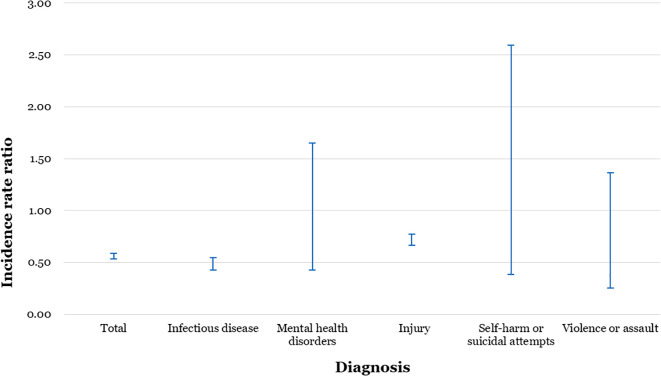
Among 2,808,756 patients, 1,835,045 (65.3%) patients visited before COVID-19, and 973,711 (34.7%) patients visited after the COVID-19 period. The standardized incidence rates of ED visits per 1,000,000 person-days were 589.3 in the before COVID-19 group and 326.9 in the after COVID-19 group (IRR (95% CI): 0.55 (0.53-0.58)). By diagnosis, the IRRs (95% CI) of mental health disorders (0.84 (0.42-1.65)) and self-harm or suicidal attempts (0.99 (0.38-2.59) were not significant, while the incidence rate of infectious disease was significantly decreased (0.48 (0.42-0.54)). The aOR (95% CI) of in-hospital mortality after COVID-19 was 1.58 (1.44-1.73) compared to that before COVID-19.
During the COVID-19 pandemic, the incidence of pediatric ED visits decreased, and these effects differed by age group. Age-specific policies are needed to ensure that children receive the care they need at the right time.
本研究旨在调查 COVID-19 大流行前后儿科患者到急诊部(ED)就诊的模式,并评估 COVID-19 爆发与年龄组之间的交互作用。
我们使用韩国全国性急诊患者数据库进行了一项横断面研究,研究对象为 2019 年 1 月至 2020 年 12 月期间所有 402 家全国性 ED 就诊的儿科患者(≤18 岁)。计算了每 100 万人日儿科 ED 就诊的年龄和性别标准化发病率,并计算了发病率比(IRR)。通过多变量逻辑回归计算了住院死亡率的调整比值比(aOR)和 95%置信区间(CI)。
在 2808756 名患者中,有 1835045 名(65.3%)患者在 COVID-19 之前就诊,973711 名(34.7%)患者在 COVID-19 之后就诊。每 100 万人日的 ED 就诊标准化发病率在 COVID-19 之前为 589.3,在 COVID-19 之后为 326.9(IRR(95%CI):0.55(0.53-0.58))。按诊断分类,精神健康障碍的 IRR(95%CI)无显著差异(0.84(0.42-1.65)),自伤或自杀企图的 IRR(95%CI)无显著差异(0.99(0.38-2.59)),而传染病的发病率显著下降(0.48(0.42-0.54))。与 COVID-19 之前相比,COVID-19 后住院死亡率的 aOR(95%CI)为 1.58(1.44-1.73)。
在 COVID-19 大流行期间,儿科 ED 就诊的发病率下降,且这些影响因年龄组而异。需要制定针对特定年龄组的政策,以确保儿童在需要时获得所需的护理。