Radiation Oncology Branch, Center for Cancer Research, National Cancer Institute, National Institutes of Health, Bethesda, MD 20892, USA.
Aging (Albany NY). 2022 Feb 14;14(3):1068-1086. doi: 10.18632/aging.203890.
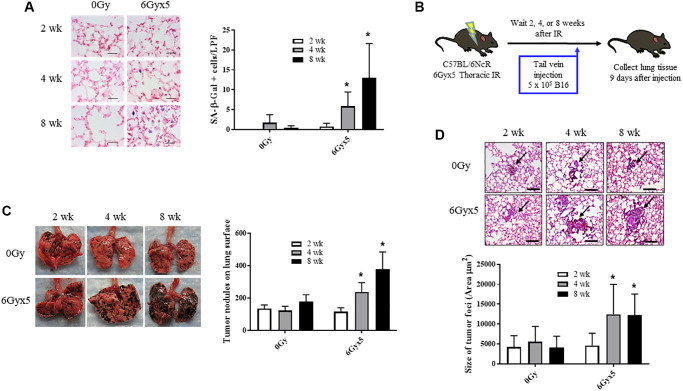
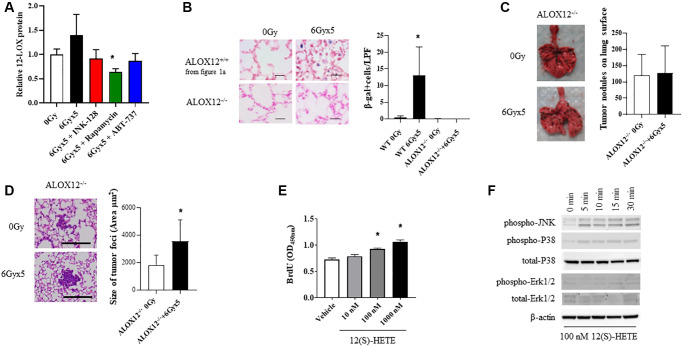
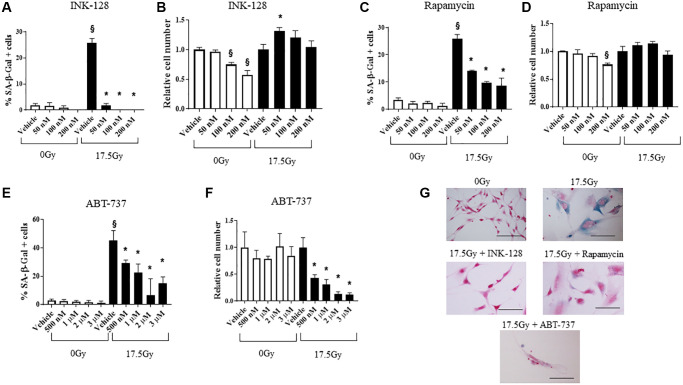
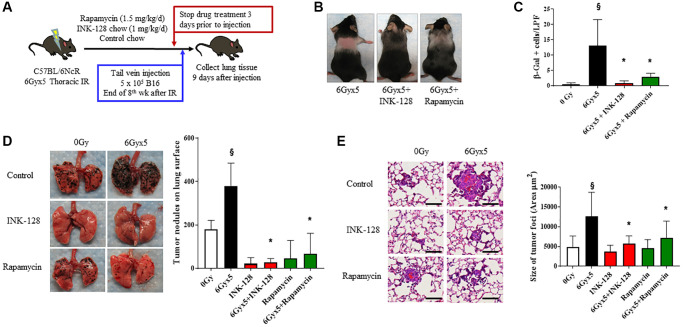
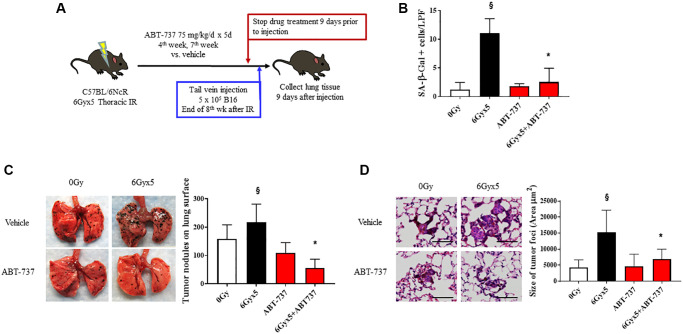
Radiation therapy is a commonly used treatment modality for cancer. Although effective in providing local tumor control, radiation causes oxidative stress, inflammation, immunomodulatory and mitogenic cytokine production, extracellular matrix production, and premature senescence in lung parenchyma. The senescence associated secretory phenotype (SASP) can promote inflammation and stimulate alterations in the surrounding tissue. Therefore, we hypothesized that radiation-induced senescent parenchymal cells in irradiated lung would enhance tumor growth. Using a murine syngeneic tumor model of melanoma and non-small cell lung cancer lung metastasis, we demonstrate that radiation causes a significant increase in markers of premature senescence in lung parenchyma within 4 to 8 weeks. Further, injection of B16F0 (melanoma) or Lewis Lung carcinoma (epidermoid lung cancer) cells at these time points after radiation results in an increase in the number and size of pulmonary tumor nodules relative to unirradiated mice. Treatment of irradiated mice with a senolytic agent (ABT-737) or agents that prevent senescence (rapamycin, INK-128) was sufficient to reduce radiation-induced lung parenchymal senescence and to mitigate radiation-enhanced tumor growth. These agents abrogated radiation-induced expression of 12-Lipoxygenase (12-LOX), a molecule implicated in several deleterious effects of senescence. Deficiency of 12-LOX prevented radiation-enhanced tumor growth. Together, these data demonstrate the pro-tumorigenic role of radiation-induced senescence, introduces the dual TORC inhibitor INK-128 as an effective agent for prevention of radiation-induced normal tissue senescence, and identifies senescence-associated 12-LOX activity as an important component of the pro-tumorigenic irradiated tissue microenvironment. These studies suggest that combining senotherapeutic agents with radiotherapy may decrease post-therapy tumor growth.
放射治疗是癌症常用的治疗方法。尽管放射治疗在提供局部肿瘤控制方面非常有效,但它会导致肺部实质产生氧化应激、炎症、免疫调节和有丝分裂原细胞因子产生、细胞外基质产生以及过早衰老。衰老相关分泌表型(SASP)可以促进炎症并刺激周围组织发生改变。因此,我们假设放射诱导的肺实质衰老细胞会增强肿瘤生长。使用黑色素瘤和非小细胞肺癌肺转移的小鼠同源肿瘤模型,我们证明放射治疗在 4 至 8 周内会导致肺实质中过早衰老的标志物显著增加。此外,在放射后这些时间点注射 B16F0(黑色素瘤)或 Lewis 肺癌(表皮样肺癌)细胞,会导致与未照射小鼠相比,肺肿瘤结节的数量和大小增加。用 senolytic 剂(ABT-737)或预防衰老的药物(雷帕霉素、INK-128)治疗照射的小鼠足以减少放射诱导的肺实质衰老并减轻放射增强的肿瘤生长。这些药物消除了放射诱导的 12-脂氧合酶(12-LOX)的表达,该分子与衰老的几种有害作用有关。12-LOX 的缺乏阻止了放射增强的肿瘤生长。总之,这些数据表明放射诱导的衰老具有促肿瘤作用,引入双重 TORC 抑制剂 INK-128 作为预防放射诱导的正常组织衰老的有效药物,并确定与衰老相关的 12-LOX 活性是促肿瘤辐射组织微环境的重要组成部分。这些研究表明,将 senotherapeutic 剂与放射治疗相结合可能会降低治疗后肿瘤的生长。