Wesseling-Rozendaal Yvonne, van Doorn Arie, Willard-Gallo Karen, van de Stolpe Anja
Molecular Pathway Diagnostics, Philips, 5656 AE Eindhoven, The Netherlands.
Philips Research, 5656 AE Eindhoven, The Netherlands.
Cancers (Basel). 2022 Jan 19;14(3):490. doi: 10.3390/cancers14030490.
Cancer immunotolerance may be reversed by checkpoint inhibitor immunotherapy; however, only a subset of patients responds to immunotherapy. The prediction of clinical response in the individual patient remains a challenge. CD4+ T cells play a role in activating adaptive immune responses against cancer, while the conversion to immunosuppression is mainly caused by CD4+ regulatory T cell (Treg) cells. Signal transduction pathways (STPs) control the main functions of immune cells. A novel previously described assay technology enables the quantitative measurement of activity of multiple STPs in individual cell and tissue samples. The activities of the TGFβ, NFκB, PI3K-FOXO, JAK-STAT1/2, JAK-STAT3, and Notch STPs were measured in CD4+ T cell subsets and used to investigate cellular mechanisms underlying breast cancer-induced immunotolerance.
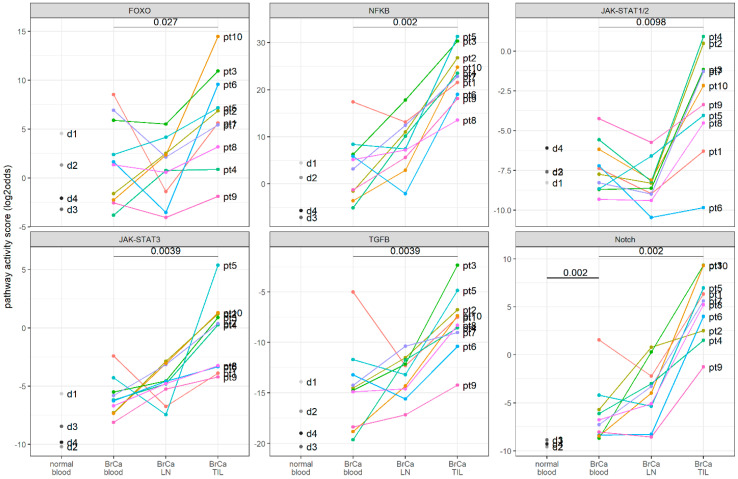
STP activity scores were measured on Affymetrix expression microarray data of the following: (1) resting and immune-activated CD4+ T cells; (2) CD4+ T-helper 1 (Th1) and T-helper 2 (Th2) cells; (3) CD4+ Treg cells; (4) immune-activated CD4+ T cells incubated with breast cancer tissue supernatants; and (5) CD4+ T cells from blood, lymph nodes, and cancer tissue of 10 primary breast cancer patients.
CD4+ T cell activation induced PI3K, NFκB, JAK-STAT1/2, and JAK-STAT3 STP activities. Th1, Th2, and Treg cells each showed a typical pathway activity profile. The incubation of activated CD4+ T cells with cancer supernatants reduced the PI3K, NFκB, and JAK-STAT3 pathway activities and increased the TGFβ pathway activity, characteristic of an immunotolerant state. Immunosuppressive Treg cells were characterized by high NFκB, JAK-STAT3, TGFβ, and Notch pathway activity scores. An immunotolerant pathway activity profile was identified in CD4+ T cells from tumor infiltrate and blood of a subset of primary breast cancer patients, which was most similar to the pathway activity profile in immunosuppressive Treg cells.
Signaling pathway assays can be used to quantitatively measure the functional immune response state of lymphocyte subsets in vitro and in vivo. Clinical results suggest that, in primary breast cancer, the adaptive immune response of CD4+ T cells may be frequently replaced by immunosuppressive Treg cells, potentially causing resistance to checkpoint inhibition. In vitro study results suggest that this is mediated by soluble factors from cancer tissue. Signaling pathway activity analysis on TIL and/or blood samples may improve response prediction and monitoring response to checkpoint inhibitors and may provide new therapeutic targets (e.g., the Notch pathway) to reduce resistance to immunotherapy.
癌症免疫耐受可通过检查点抑制剂免疫疗法逆转;然而,只有一部分患者对免疫疗法有反应。预测个体患者的临床反应仍然是一项挑战。CD4 + T细胞在激活针对癌症的适应性免疫反应中发挥作用,而向免疫抑制的转变主要由CD4 + 调节性T细胞(Treg细胞)引起。信号转导通路(STP)控制免疫细胞的主要功能。一种先前描述的新型检测技术能够定量测量单个细胞和组织样本中多种STP的活性。在CD4 + T细胞亚群中测量了TGFβ、NFκB、PI3K - FOXO、JAK - STAT1/2、JAK - STAT3和Notch STP的活性,并用于研究乳腺癌诱导的免疫耐受的细胞机制。
在以下Affymetrix表达微阵列数据上测量STP活性评分:(1)静息和免疫激活的CD4 + T细胞;(2)CD4 + 辅助性T细胞1(Th1)和辅助性T细胞2(Th2);(3)CD4 + Treg细胞;(4)与乳腺癌组织上清液孵育的免疫激活的CD4 + T细胞;以及(5)来自10名原发性乳腺癌患者血液、淋巴结和癌组织的CD4 + T细胞。
CD4 + T细胞激活诱导了PI3K、NFκB、JAK - STAT1/2和JAK - STAT3 STP活性。Th1、Th2和Treg细胞各自显示出典型的通路活性谱。激活的CD4 + T细胞与癌症上清液孵育降低了PI3K、NFκB和JAK - STAT3通路活性,并增加了TGFβ通路活性,这是免疫耐受状态的特征。免疫抑制性Treg细胞的特征是NFκB、JAK - STAT3、TGFβ和Notch通路活性评分高。在一部分原发性乳腺癌患者肿瘤浸润和血液中的CD4 + T细胞中鉴定出免疫耐受通路活性谱,其与免疫抑制性Treg细胞中的通路活性谱最相似。
信号通路检测可用于在体外和体内定量测量淋巴细胞亚群的功能性免疫反应状态。临床结果表明,在原发性乳腺癌中,CD4 + T细胞的适应性免疫反应可能经常被免疫抑制性Treg细胞取代,并可能导致对检查点抑制的抗性。体外研究结果表明,这是由癌症组织中的可溶性因子介导的。对肿瘤浸润淋巴细胞(TIL)和/或血液样本进行信号通路活性分析可能会改善反应预测并监测对检查点抑制剂的反应,并且可能提供新的治疗靶点(例如Notch通路)以降低对免疫疗法的抗性。