Moser Bernhard
Division of Infection & Immunity, Henry Wellcome Building, School of Medicine, Cardiff University, Cardiff CF14 4XN, UK.
Cancers (Basel). 2022 Jan 20;14(3):511. doi: 10.3390/cancers14030511.
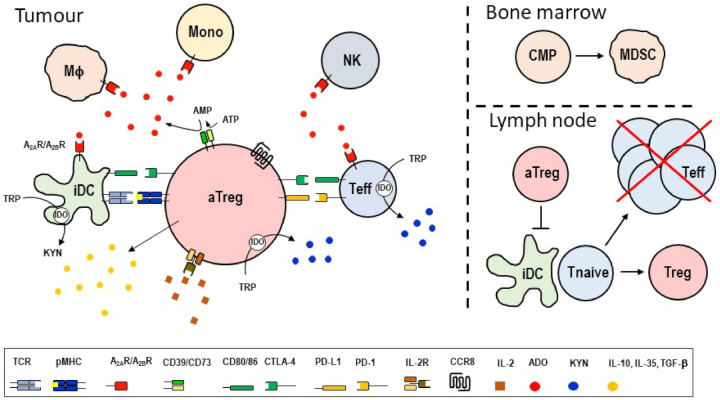
Immune checkpoint blockade inhibitors (CBIs) targeting cytotoxic T lymphocyte associated protein-4 (CTLA-4) and program death receptor-1 (PD-1) or its ligand-1 (PD-L1) have transformed the outlook of many patients with cancer. This remarkable progress has highlighted, from the translational point of view, the importance of immune cells in the control of tumor progression. There is still room for improvement, since current CBI therapies benefit a minority of patients. Moreover, interference with immune checkpoint receptors frequently causes immune related adverse events (irAEs) with life-threatening consequences in some of the patients. Immunosuppressive cells in the tumor microenvironment (TME), including intratumoral regulatory T (Treg) cells, tumor-associated macrophages (TAMs) and myeloid-derived suppressor cells (MDSCs), contribute to tumor progression and correlate with a negative disease outlook. Recent reports revealed the selective expression of the chemokine receptor CCR8 on tumor Treg cells, making CCR8 a promising target in translational research. In this review, I summarize our current knowledge about the cellular distribution and function of CCR8 in physiological and pathophysiological processes. The discussion includes an assessment of how the removal of CCR8-expressing cells might affect both anti-tumor immunity as well as immune homeostasis at remote sites. Based on these considerations, CCR8 appears to be a promising novel target to be considered in future translational research.
靶向细胞毒性T淋巴细胞相关蛋白4(CTLA-4)和程序性死亡受体1(PD-1)或其配体1(PD-L1)的免疫检查点阻断抑制剂(CBI)已经改变了许多癌症患者的前景。从转化医学的角度来看,这一显著进展突出了免疫细胞在控制肿瘤进展中的重要性。由于目前的CBI疗法仅使少数患者受益,因此仍有改进的空间。此外,干扰免疫检查点受体经常会导致免疫相关不良事件(irAE),在一些患者中会产生危及生命的后果。肿瘤微环境(TME)中的免疫抑制细胞,包括肿瘤内调节性T(Treg)细胞、肿瘤相关巨噬细胞(TAM)和髓源性抑制细胞(MDSC),促进肿瘤进展并与不良疾病预后相关。最近的报告揭示了趋化因子受体CCR8在肿瘤Treg细胞上的选择性表达,这使得CCR8成为转化医学研究中有前景的靶点。在这篇综述中,我总结了我们目前关于CCR8在生理和病理生理过程中的细胞分布和功能的知识。讨论内容包括评估去除表达CCR8的细胞可能如何影响抗肿瘤免疫以及远处部位的免疫稳态。基于这些考虑,CCR8似乎是未来转化医学研究中一个有前景的新靶点。