Caini Saverio, Chioccioli Sofia, Pastore Elisa, Fontana Miriam, Tortora Katia, Caderni Giovanna, Masala Giovanna
Institute for Cancer Research, Prevention and Clinical Network (ISPRO), Via Cosimo il Vecchio 2, 50139 Florence, Italy.
NEUROFARBA Department, Pharmacology and Toxicology Section, University of Florence, Viale Pieraccini 6, 50139 Florence, Italy.
Cancers (Basel). 2022 Jan 27;14(3):640. doi: 10.3390/cancers14030640.
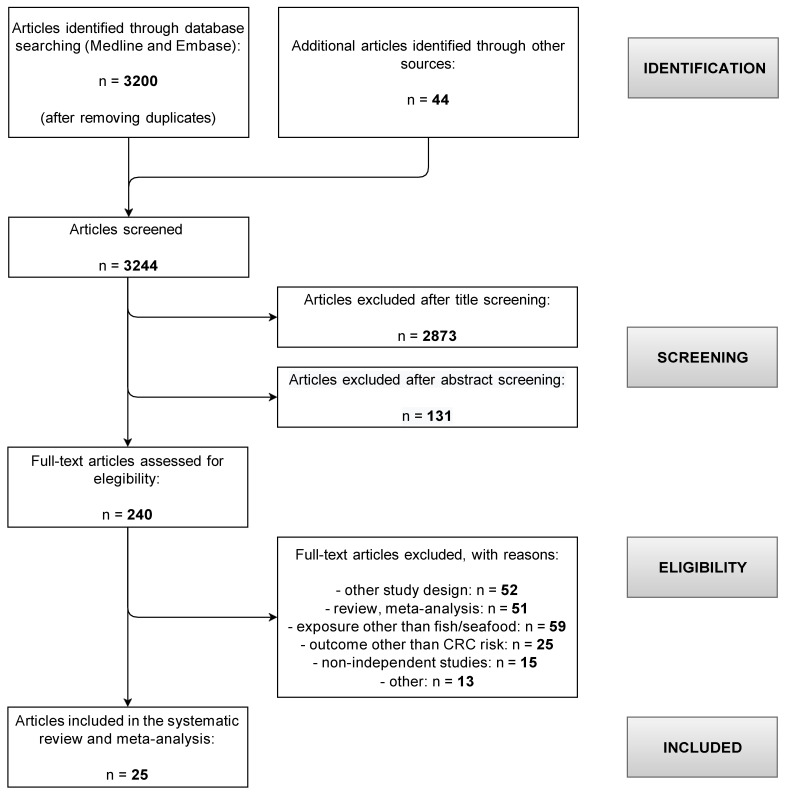
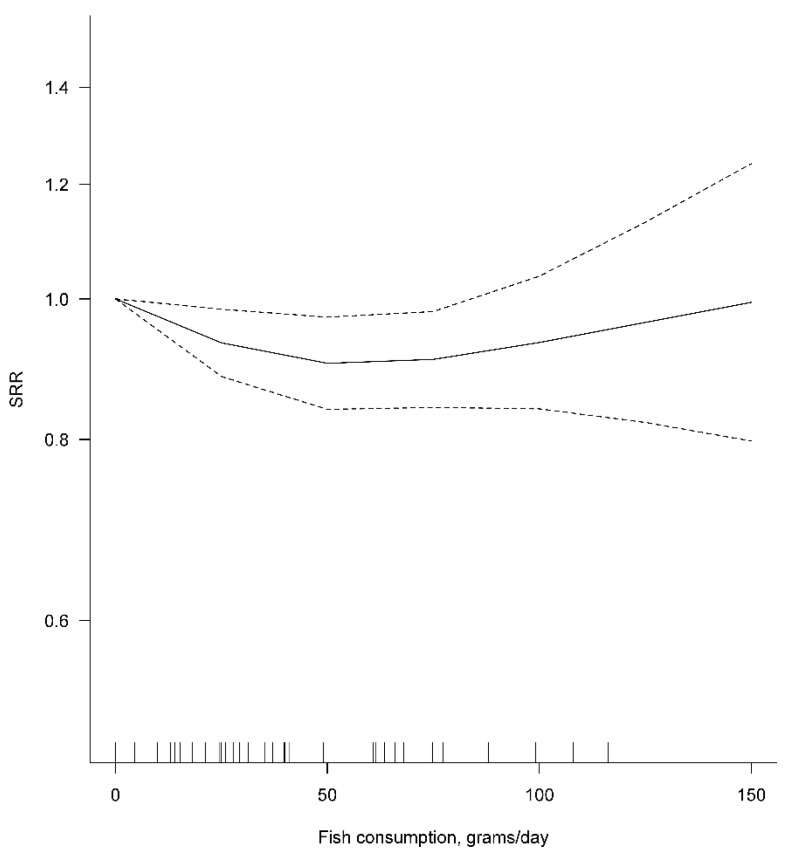
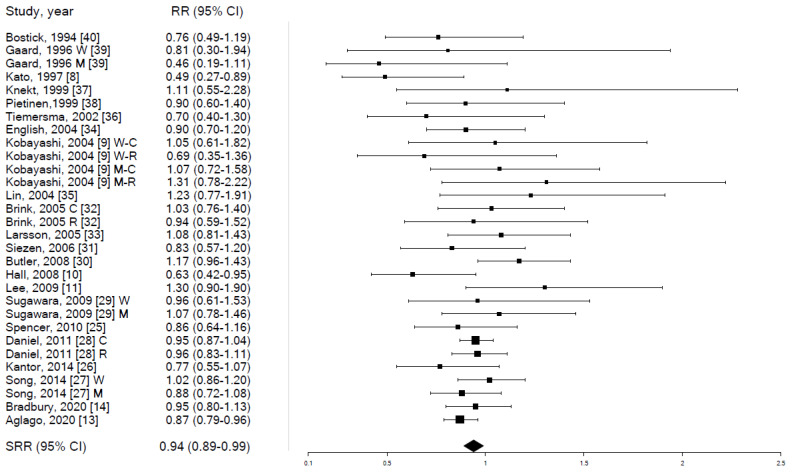
: Epidemiological studies on the association between fish consumption and colorectal cancer (CRC) risk have yielded inconsistent results, despite evidence from preclinical studies that long-chain ω-3 polyunsaturated fatty acids inhibit colorectal carcinogenesis. We conducted a meta-analysis of prospective epidemiological studies investigating the association between fish consumption and CRC risk among humans and reviewed studies examining the link between fish components and colorectal carcinogenesis in animal models. : We included studies published until November 2020. We calculated the summary risk ratio (SRR) and 95% confidence intervals (CI) through random effects meta-analysis models in order to summarize evidence from studies among humans. : Twenty-five prospective epidemiological studies encompassing 25,777 CRC cases were included. Individuals in the highest (vs. lowest) category of fish consumption had a significantly reduced risk of CRC (SRR 0.94, 95%CI 0.89-0.99). In dose-response meta-analysis, a 50-g increment in the daily consumption of fish was associated with a statistically significant 4% reduction in CRC risk (SRR 0.96, 95%CI 0.92-0.99). Preclinical studies (n = 25) identified multiple mechanisms of action of fish and fish components on colorectal carcinogenesis. : Dietary recommendations for cancer prevention should take into account the evidence from epidemiological and preclinical studies that increasing fish consumption may be effective in preventing CRC.
尽管临床前研究表明长链ω-3多不饱和脂肪酸可抑制结直肠癌发生,但关于鱼类消费与结直肠癌(CRC)风险之间关联的流行病学研究结果并不一致。我们对调查人类鱼类消费与CRC风险之间关联的前瞻性流行病学研究进行了荟萃分析,并回顾了在动物模型中研究鱼类成分与结直肠癌发生之间联系的研究。
我们纳入了截至2020年11月发表的研究。我们通过随机效应荟萃分析模型计算了汇总风险比(SRR)和95%置信区间(CI),以便总结来自人类研究的证据。
纳入了25项前瞻性流行病学研究,共25,777例CRC病例。鱼类消费最高(与最低)组的个体患CRC的风险显著降低(SRR 0.94,95%CI 0.89 - 0.99)。在剂量反应荟萃分析中,每日鱼类消费量增加50克与CRC风险在统计学上显著降低4%相关(SRR 0.96,95%CI 0.92 - 0.99)。临床前研究(n = 25)确定了鱼类及其成分对结直肠癌发生的多种作用机制。
癌症预防的饮食建议应考虑到流行病学和临床前研究的证据,即增加鱼类消费可能有效预防CRC。