Neri Benedetto, Scribano Maria Lia, Armuzzi Alessandro, Castiglione Fabiana, D'Incà Renata, Orlando Ambrogio, Festa Stefano, Riegler Gabriele, Fries Walter, Meucci Gianmichele, Alvisi Patrizia, Mocciaro Filippo, Papi Claudio, Mossa Michelangela, Sena Giorgia, Guidi Luisa, Testa Anna, Renna Sara, Frankovic Iris, Viola Anna, Patturelli Marta, Chiaramonte Carlo, Biancone Livia
GI Unit, Department of Systems Medicine, University of Rome "Tor Vergata", 00133 Rome, Italy.
Gastroenterology Unit, AO San Camillo Forlanini, 00152 Rome, Italy.
Cancers (Basel). 2022 Jan 30;14(3):721. doi: 10.3390/cancers14030721.
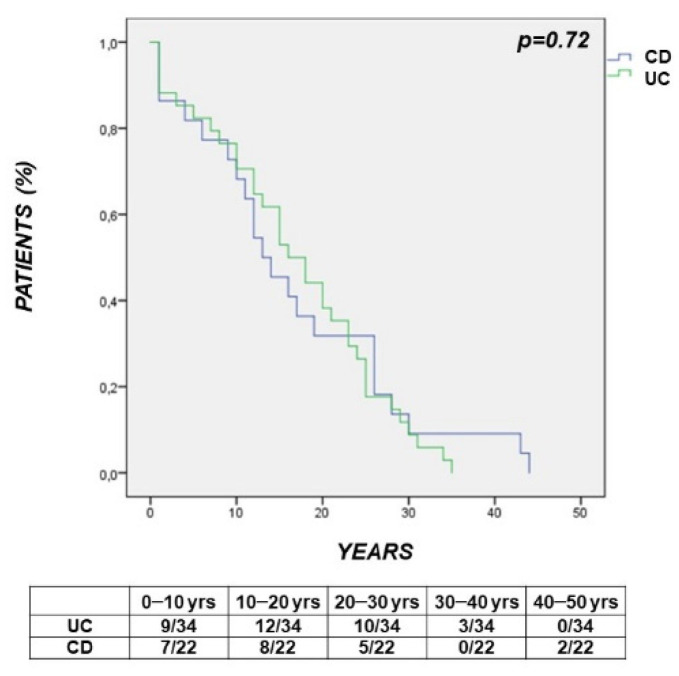
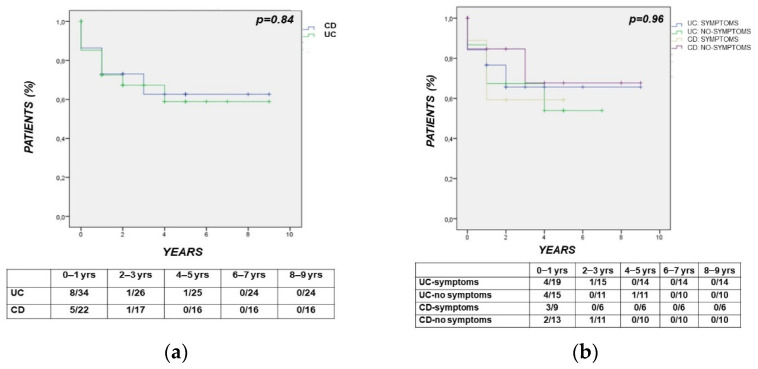
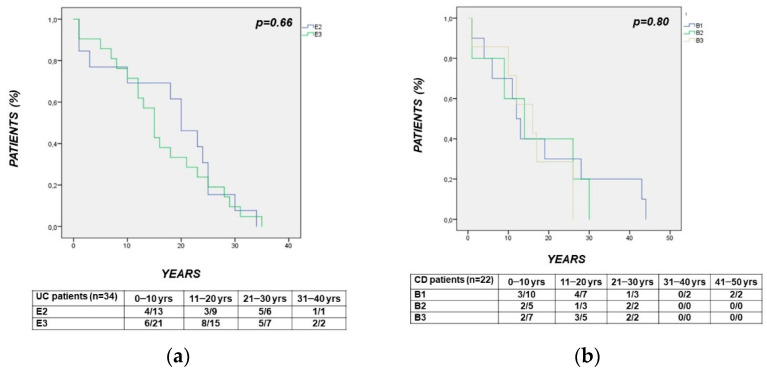
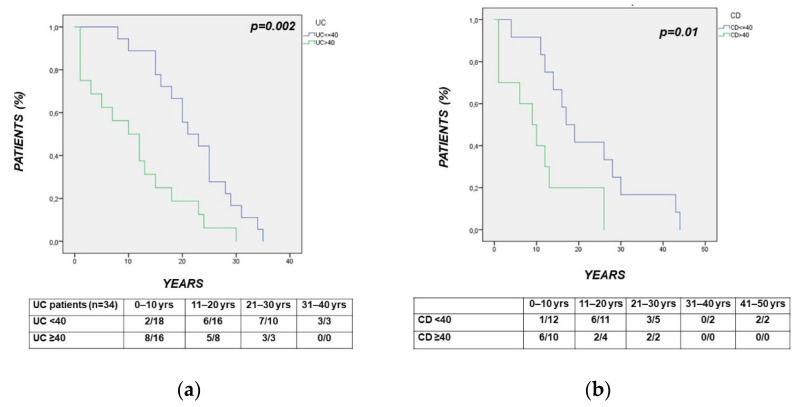
Colorectal cancer (CRC) risk is increased in Inflammatory Bowel Disease (IBD) and surveillance needs to be tailored according to individual risk. The open issues include the role of the characteristics of IBD and CRC in determining the long-term outcome. These issues were assessed in our multicenter study, including a cohort of 56 IBD patients with incident CRC. The clinical and histopathological features of IBD patients and of CRC were recorded. Incident CRC in IBD occurred at a young age (≤40 years) in 25% of patients (median age 55.5 (22-76)). Mucinous signet-ring carcinoma was detected in 6 out of the 56 (10.7%) patients, including 4 with Ulcerative Colitis (UC) and 2 with Crohn's disease (CD). CRC was more frequently diagnosed by colonoscopy in UC (85.4% vs. 50%; = 0.01) and by imaging in Crohn's Disease CD (5.8% vs. 31.8%; = 0.02). At onset, CRC-related symptoms occurred in 29 (51.9%) IBD patients. The time interval from the diagnosis of IBD to CRC was shorter in UC and CD patients with >40 years ( = 0.002; = 0.01). CRC-related death occurred in 10 (29.4%) UC and in 6 (27.2%) CD patients ( = 0.89), with a short time interval from CRC to death (UC vs. CD: 6.5 (1-68) vs. 14.5 (8-40); = 0.85; IBD: 12 months (1-68)). CRC occurring at a young age, a short time interval from the diagnosis of IBD to CRC-related death in the elderly, CRC-symptoms often mimicking IBD relapse and the observed high mortality rate may support the need of closer surveillance intervals in subgroups of patients.
炎症性肠病(IBD)患者患结直肠癌(CRC)的风险增加,需要根据个体风险进行针对性监测。目前仍存在的问题包括IBD和CRC的特征在决定长期预后方面所起的作用。我们的多中心研究对这些问题进行了评估,该研究纳入了56例新发CRC的IBD患者队列。记录了IBD患者和CRC的临床及组织病理学特征。IBD患者中25%在年轻时(≤40岁)发生新发CRC(中位年龄55.5岁(22 - 76岁))。56例患者中有6例(10.7%)检测出黏液印戒癌,其中4例为溃疡性结肠炎(UC)患者,2例为克罗恩病(CD)患者。UC患者通过结肠镜检查诊断CRC更为常见(85.4% 对50%;P = 0.01),而CD患者通过影像学检查诊断更为常见(5.8% 对31.8%;P = 0.02)。发病时,29例(51.9%)IBD患者出现了与CRC相关的症状。40岁以上的UC和CD患者从IBD诊断到CRC的时间间隔较短(P = 0.002;P = 0.01)。10例(29.4%)UC患者和6例(27.2%)CD患者发生了与CRC相关的死亡(P = 0.89),从CRC到死亡的时间间隔较短(UC对CD:6.5(1 - 68)对14.5(8 - 40);P = 0.85;IBD:12个月(1 - 68))。年轻时发生CRC、老年患者从IBD诊断到与CRC相关死亡的时间间隔短、CRC症状常类似IBD复发以及观察到的高死亡率可能支持对部分患者亚组进行更密切监测的必要性。