Tam Rachel Y, van Dorst Josie M, McKay Isabelle, Coffey Michael, Ooi Chee Y
Discipline of Paediatrics & Child Health, Randwick Clinical Campus, School of Clinical Medicine, UNSW Medicine & Health, University of New South Wales, Sydney, NSW 2031, Australia.
Wagga Wagga Base Hospital, Wagga Wagga, NSW 2650, Australia.
J Clin Med. 2022 Jan 27;11(3):649. doi: 10.3390/jcm11030649.
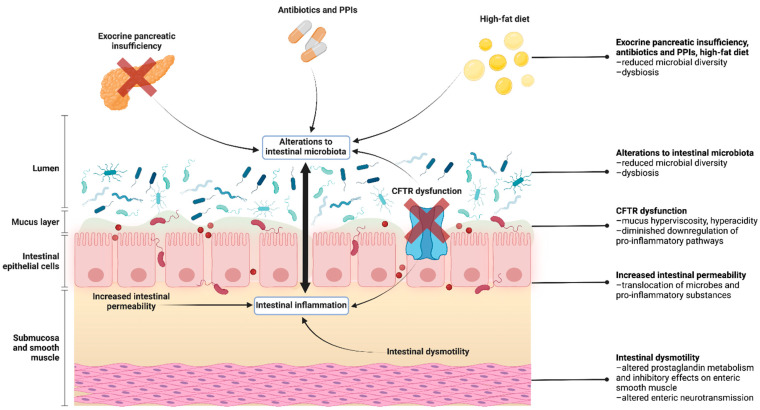
Cystic fibrosis (CF) is a life-limiting autosomal recessive multisystem disease. While its burden of morbidity and mortality is classically associated with pulmonary disease, CF also profoundly affects the gastrointestinal (GI) tract. Chronic low-grade inflammation and alterations to the gut microbiota are hallmarks of the CF intestine. The etiology of these manifestations is likely multifactorial, resulting from cystic fibrosis transmembrane conductance regulator (CFTR) dysfunction, a high-fat CF diet, and the use of antibiotics. There may also be a bidirectional pathophysiological link between intestinal inflammation and changes to the gut microbiome. Additionally, a growing body of evidence suggests that these GI manifestations may have significant clinical associations with growth and nutrition, quality of life, and respiratory function in CF. As such, the potential utility of GI therapies and long-term GI outcomes are areas of interest in CF. Further research involving microbial modulation and multi-omics techniques may reveal novel insights. This article provides an overview of the current evidence, pathophysiology, and future research and therapeutic considerations pertaining to intestinal inflammation and alterations in the gut microbiota in CF.
囊性纤维化(CF)是一种限制生命的常染色体隐性多系统疾病。虽然其发病率和死亡率负担传统上与肺部疾病相关,但CF也会对胃肠道(GI)产生深远影响。慢性低度炎症和肠道微生物群的改变是CF肠道的特征。这些表现的病因可能是多因素的,由囊性纤维化跨膜传导调节因子(CFTR)功能障碍、高脂肪的CF饮食以及抗生素的使用导致。肠道炎症与肠道微生物群变化之间可能还存在双向病理生理联系。此外,越来越多的证据表明,这些GI表现可能与CF患者的生长发育、营养状况、生活质量和呼吸功能存在显著临床关联。因此,GI治疗的潜在效用和长期GI结局是CF领域的关注重点。涉及微生物调节和多组学技术的进一步研究可能会揭示新的见解。本文概述了目前关于CF肠道炎症和肠道微生物群改变的证据、病理生理学以及未来研究和治疗方面的考虑因素。