4th Department of Internal Medicine, Attikon University Hospital, National and Kapodistrian University of Athens, Athens, Greece.
2nd Department of Pediatrics, P. & A. Kyriakou Children's Hospital, National and Kapodistrian University of Athens, Athens, Greece.
Front Immunol. 2021 Mar 18;12:644269. doi: 10.3389/fimmu.2021.644269. eCollection 2021.
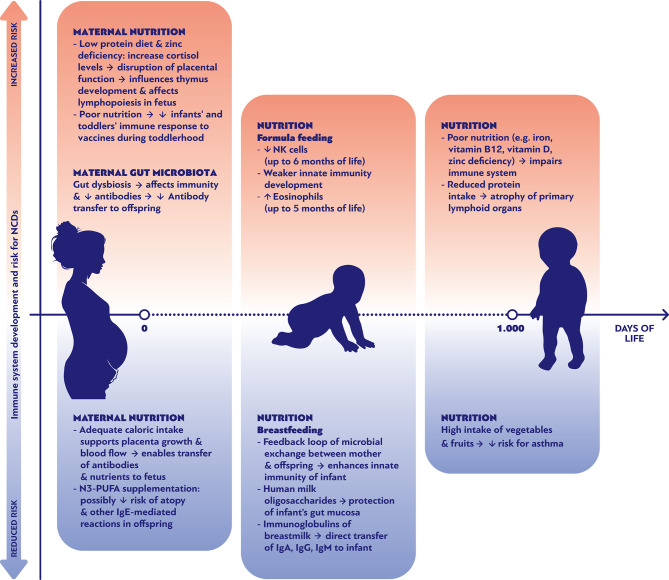
The first 1000 days of life, including the intrauterine period, are regarded as a fundamental stepping stone for the development of a human. Unequivocally, nutrition during this period plays a key role on the proper development of a child, both directly through the intake of essential nutrients and indirectly by affecting the composition of the gut microbiota. The gut microbiota, including bacteria, viruses, fungi, protists and other microorganisms, is a highly modifiable and adaptive system that is influenced by diet, lifestyle, medicinal products and the environment. Reversely, it affects the immune system in multiple complex ways. Many noncommunicable diseases (NCDs) associated with dysbiosis are "programmed" during childhood. Nutrition is a potent determinant of the children's microbiota composition and maturation and, therefore, a strong determinant of the NCDs' programming. In this review we explore the interplay between nutrition during the first 1000 days of life, the gut microbiota, virome and mycobiome composition and the development of NCDs.
生命的头 1000 天,包括宫内期,被视为人类发展的基本基石。毫无疑问,这一时期的营养对儿童的正常发育起着关键作用,既可以通过摄入必需营养素直接作用,也可以通过影响肠道微生物群的组成间接作用。肠道微生物群包括细菌、病毒、真菌、原生动物和其他微生物,是一个高度可塑和适应性的系统,受饮食、生活方式、药物和环境的影响。反过来,它以多种复杂的方式影响免疫系统。许多与肠道菌群失调相关的非传染性疾病(NCDs)都是在儿童时期“编程”的。营养是儿童肠道微生物群组成和成熟的重要决定因素,因此也是 NCDs 编程的重要决定因素。在这篇综述中,我们探讨了生命头 1000 天的营养、肠道微生物群、病毒组和真菌组组成与 NCDs 发展之间的相互作用。