Centre International de Recherche en Infectiologie (CIRI), 69007 Lyon, France.
Institut National de la Santé et de la Recherche Médicale (INSERM) Unité U1111, 69007 Lyon, France.
Int J Mol Sci. 2022 Jan 26;23(3):1394. doi: 10.3390/ijms23031394.
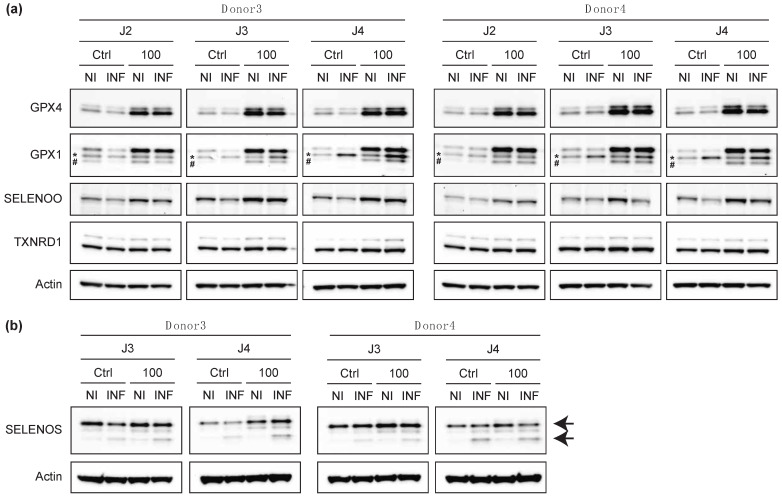
The infection of CD4 T-lymphocytes with human immunodeficiency virus (HIV), the etiological agent of acquired immunodeficiency syndrome (AIDS), disrupts cellular homeostasis, increases oxidative stress and interferes with micronutrient metabolism. Viral replication simultaneously increases the demand for micronutrients and causes their loss, as for selenium (Se). In HIV-infected patients, selenium deficiency was associated with a lower CD4 T-cell count and a shorter life expectancy. Selenium has an important role in antioxidant defense, redox signaling and redox homeostasis, and most of these biological activities are mediated by its incorporation in an essential family of redox enzymes, namely the selenoproteins. Here, we have investigated how selenium and selenoproteins interplay with HIV infection in different cellular models of human CD4 T lymphocytes derived from established cell lines (Jurkat and SupT1) and isolated primary CD4 T cells. First, we characterized the expression of the selenoproteome in various human T-cell models and found it tightly regulated by the selenium level of the culture media, which was in agreement with reports from non-immune cells. Then, we showed that selenium had no significant effect on HIV-1 protein production nor on infectivity, but slightly reduced the percentage of infected cells in a Jurkat cell line and isolated primary CD4 T cells. Finally, in response to HIV-1 infection, the selenoproteome was slightly altered.
CD4 T 淋巴细胞感染人类免疫缺陷病毒 (HIV),这是获得性免疫缺陷综合征 (AIDS) 的病原体,破坏细胞内稳态,增加氧化应激并干扰微量营养素代谢。病毒复制同时增加了对微量营养素的需求,并导致其流失,如硒 (Se)。在 HIV 感染患者中,硒缺乏与 CD4 T 细胞计数降低和预期寿命缩短有关。硒在抗氧化防御、氧化还原信号和氧化还原稳态中具有重要作用,其中大多数生物学活性是通过其整合到一系列必需的氧化还原酶中,即硒蛋白来介导的。在这里,我们研究了硒和硒蛋白如何在源自已建立细胞系 (Jurkat 和 SupT1) 和分离的原代 CD4 T 细胞的不同人类 CD4 T 淋巴细胞细胞模型中与 HIV 感染相互作用。首先,我们描述了各种人类 T 细胞模型中硒蛋白组的表达,并发现其受到培养介质中硒水平的严格调节,这与非免疫细胞的报告一致。然后,我们表明硒对 HIV-1 蛋白的产生或感染性没有显著影响,但在 Jurkat 细胞系和分离的原代 CD4 T 细胞中略微降低了感染细胞的百分比。最后,在 HIV-1 感染后,硒蛋白组略有改变。