International Health Program, Regió Sanitària Metropolitana Nord, Institut Català de la Salut, Badalona, Spain.
Infectious Diseases Unit, Hospital Universitari Germans Trias i Pujol, Badalona, Spain.
BMC Geriatr. 2022 Feb 14;22(1):123. doi: 10.1186/s12877-022-02779-0.
Covid-19 pandemic has particularly affected older people living in Long-term Care settings in terms of infection and mortality.
We carried out a cross-sectional analysis within a cohort of Long-term care nursing home residents between March first and June thirty, 2020, who were ≥ 65 years old and on whom at least one PCR test was performed. Socio-demographic, comorbidities, and clinical data were recorded. Facility size and community incidence of SARS-CoV-2 were also considered. The outcomes of interest were infection (PCR positive) and death.
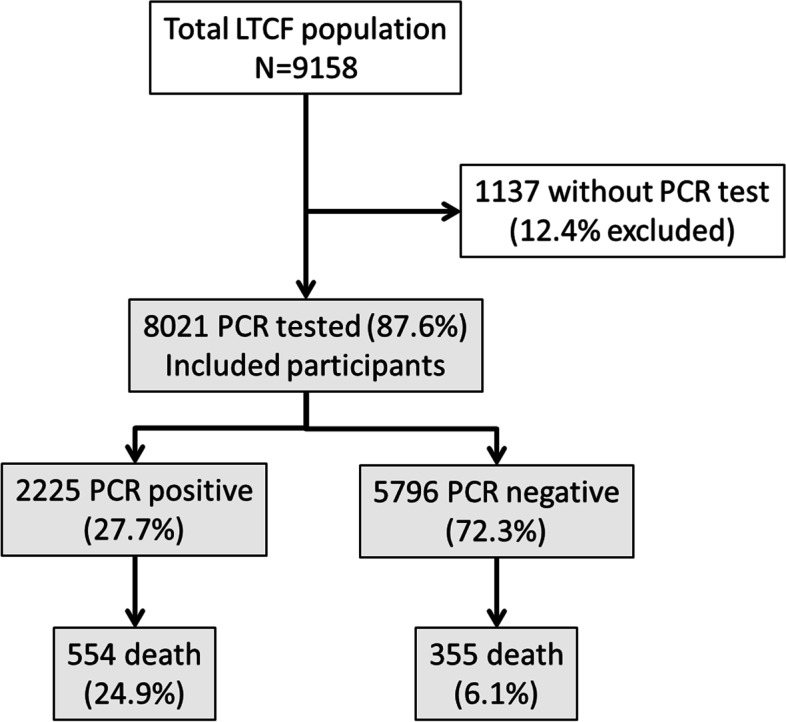
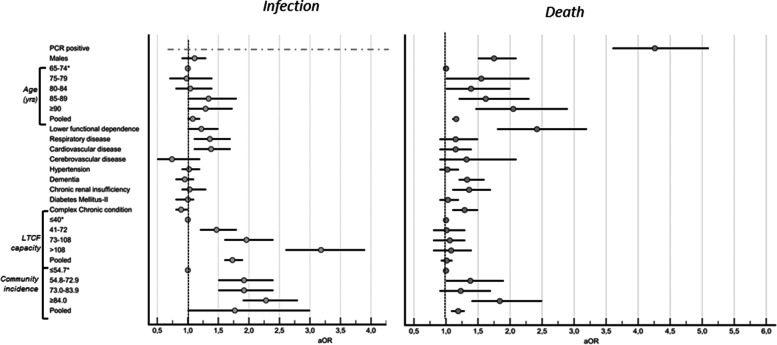
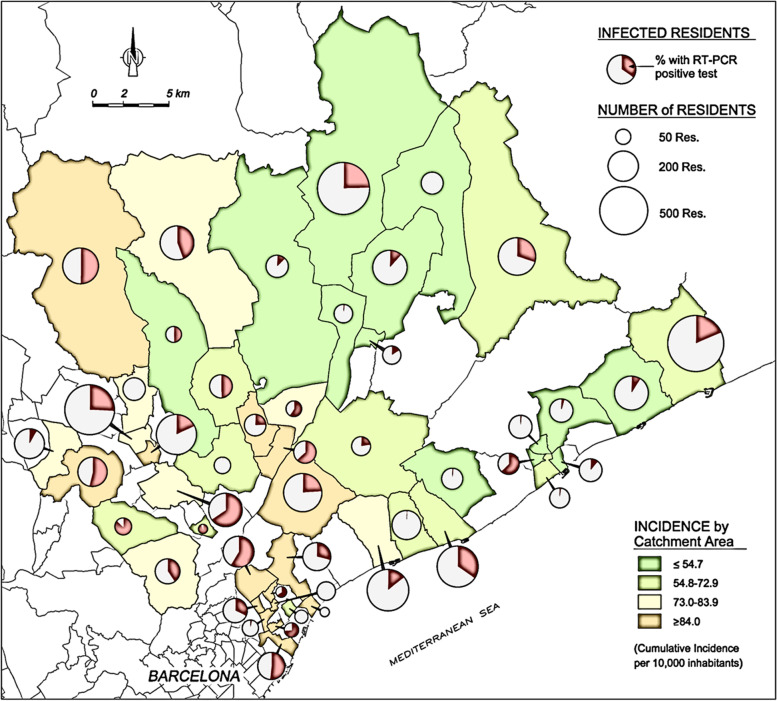
A total of 8021 residents were included from 168 facilities. Mean age was 86.4 years (SD = 7.4). Women represented 74.1%. SARS-CoV-2 infection was detected in 27.7% of participants, and the overall case fatality rate was 11.3% (24.9% among those with a positive PCR test). Epidemiological factors related to risk of infection were larger facility size (pooled aOR 1.73; P < .001), higher community incidence (pooled aOR 1.67, P = .04), leading to a higher risk than the clinical factor of low level of functional dependence (aOR 1.22, P = .03). Epidemiological risk factors associated with mortality were male gender (aOR 1.75; P < .001), age (pooled aOR 1.16; P < .001), and higher community incidence (pooled aOR 1.19, P = < 0.001) whereas clinical factors were low level of functional dependence (aOR 2.42, P < .001), Complex Chronic Condition (aOR 1.29, P < .001) and dementia (aOR 1.33, P <0.001). There was evidence of clustering for facility and health area when considering the risk of infection and mortality (P < .001).
Our results suggest a complex interplay between structural and individual factors regarding Covid-19 infection and its impact on mortality in nursing-home residents.
在感染和死亡率方面,Covid-19 大流行对长期护理环境中的老年人影响特别大。
我们对 2020 年 3 月 1 日至 6 月 30 日期间≥65 岁且至少进行过一次 PCR 检测的长期护理养老院居民进行了一项横断面分析。记录了社会人口统计学、合并症和临床数据。还考虑了设施规模和社区 SARS-CoV-2 的发生率。感兴趣的结果是感染(PCR 阳性)和死亡。
从 168 个设施中纳入了 8021 名居民。平均年龄为 86.4 岁(SD=7.4)。女性占 74.1%。参与者中有 27.7%检测到 SARS-CoV-2 感染,总病死率为 11.3%(PCR 检测阳性者为 24.9%)。与感染风险相关的流行病学因素包括较大的设施规模(合并的优势比 1.73;P<0.001)和较高的社区发病率(合并的优势比 1.67,P=0.04),高于临床因素低水平的功能依赖(优势比 1.22,P=0.03)。与死亡率相关的流行病学危险因素是男性(优势比 1.75;P<0.001)、年龄(合并的优势比 1.16;P<0.001)和较高的社区发病率(合并的优势比 1.19,P<0.001),而临床因素是低水平的功能依赖(优势比 2.42,P<0.001)、复杂的慢性疾病(优势比 1.29,P<0.001)和痴呆(优势比 1.33,P<0.001)。在考虑感染和死亡率的风险时,设施和卫生区域存在聚类现象(P<0.001)。
我们的研究结果表明,在长期护理院居民的 Covid-19 感染及其对死亡率的影响方面,结构因素和个体因素之间存在复杂的相互作用。