Ghanavati Elham, Salehinejad Mohammad Ali, De Melo Lorena, Nitsche Michael A, Kuo Min-Fang
Department of Psychology and Neurosciences, Leibniz Research Centre for Working Environment and Human Factors, Ardeystr. 67, 44139 Dortmund, Germany.
International Graduate School of Neuroscience, Ruhr University Bochum, Universitätsstr. 150, 44801 Bochum, Germany.
Cereb Cortex. 2022 Nov 21;32(23):5478-5488. doi: 10.1093/cercor/bhac028.
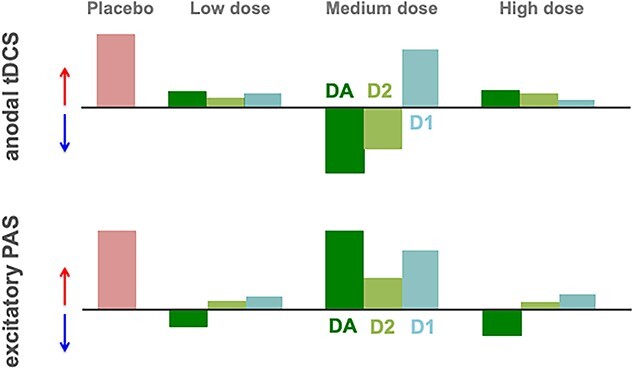
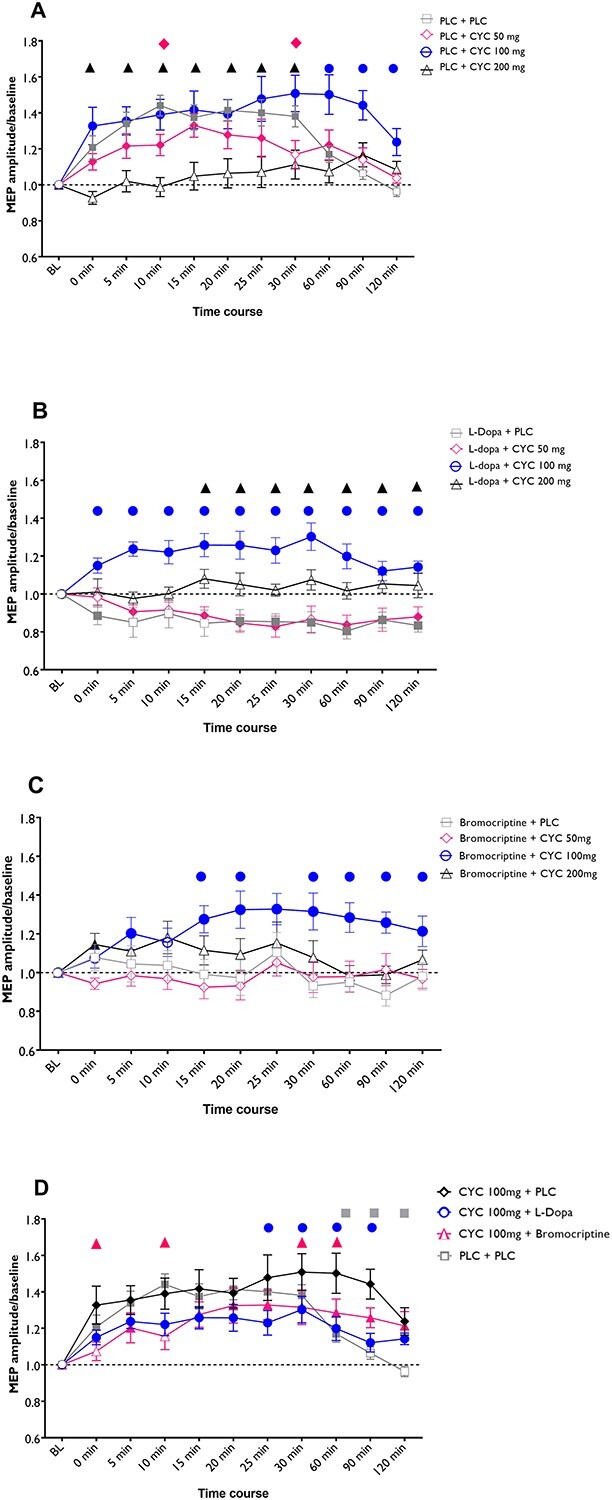
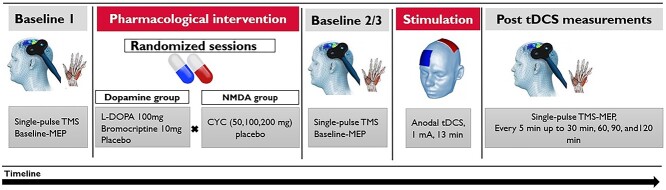
Dopamine is a key neuromodulator of neuroplasticity and an important neuronal substrate of learning, and memory formation, which critically involves glutamatergic N-methyl-D-aspartate (NMDA) receptors. Dopamine modulates NMDA receptor activity via dopamine D1 and D2 receptor subtypes. It is hypothesized that dopamine focuses on long-term potentiation (LTP)-like plasticity, i.e. reduces diffuse widespread but enhances locally restricted plasticity via a D2 receptor-dependent NMDA receptor activity reduction. Here, we explored NMDA receptor-dependent mechanisms underlying dopaminergic modulation of LTP-like plasticity induced by transcranial direct current stimulation (tDCS). Eleven healthy, right-handed volunteers received anodal tDCS (1 mA, 13 min) over the left motor cortex combined with dopaminergic agents (the D2 receptor agonist bromocriptine, levodopa for general dopamine enhancement, or placebo) and the partial NMDA receptor agonist D-cycloserine (dosages of 50, 100, and 200 mg, or placebo). Cortical excitability was monitored by transcranial magnetic stimulation-induced motor-evoked potentials. We found that LTP-like plasticity was abolished or converted into LTD-like plasticity via dopaminergic activation, but reestablished under medium-dose D-cycloserine. These results suggest that diffuse LTP-like plasticity is counteracted upon via D2 receptor-dependent reduction of NMDA receptor activity.
多巴胺是神经可塑性的关键神经调质,也是学习和记忆形成的重要神经元底物,这一过程关键涉及谷氨酸能N-甲基-D-天冬氨酸(NMDA)受体。多巴胺通过多巴胺D1和D2受体亚型调节NMDA受体活性。据推测,多巴胺聚焦于长时程增强(LTP)样可塑性,即通过依赖D2受体的NMDA受体活性降低来减少广泛弥散的可塑性,但增强局部受限的可塑性。在此,我们探究了经颅直流电刺激(tDCS)诱导的LTP样可塑性的多巴胺能调节作用背后的NMDA受体依赖性机制。11名健康的右利手志愿者在左侧运动皮层接受阳极tDCS(1 mA,13分钟),同时联合多巴胺能药物(D2受体激动剂溴隐亭、用于全面增强多巴胺的左旋多巴或安慰剂)以及部分NMDA受体激动剂D-环丝氨酸(剂量分别为50、100和200 mg,或安慰剂)。通过经颅磁刺激诱发的运动诱发电位监测皮层兴奋性。我们发现,通过多巴胺能激活,LTP样可塑性被消除或转变为LTD样可塑性,但在中等剂量的D-环丝氨酸作用下得以重建。这些结果表明,弥散的LTP样可塑性通过依赖D2受体的NMDA受体活性降低而受到抑制。