Johns Hopkins University School of Medicine, 5501 Hopkins Bayview Circle, Baltimore, MD, 21224, USA.
Johns Hopkins University School of Medicine, Baltimore MD - 733 N Broadway, Baltimore, MD, 21205, USA.
Pediatr Nephrol. 2022 Oct;37(10):2405-2413. doi: 10.1007/s00467-022-05479-4. Epub 2022 Feb 15.
This study aimed to compare attended home blood pressure (BP) measurements (HBPM) with ambulatory BP monitor (ABPM) readings and examine if level of agreement between measurement modalities differs overall and by subgroup.
This was a secondary analysis of data from a 2-year, multicenter observational study of children 11-19 years (mean 15, SD = 2.7) with chronic kidney disease. Participants had 3 standardized resting oscillometric home BPs taken by staff followed by 24-h ABPM within 2 weeks of home BP. BP indices (measured BP/95%ile BP) were calculated for mean triplicate attended HBPM and mean ABPM measurements. Paired HBPM and ABPM measurements taken during any of 5 study visits were compared using linear regression with robust standard errors. Generalized estimating equation-based logistic regression determined sensitivity, specificity, negative, and positive predictive values with ABPM as the gold standard. Analyses were conducted for the group overall and by subgroup.
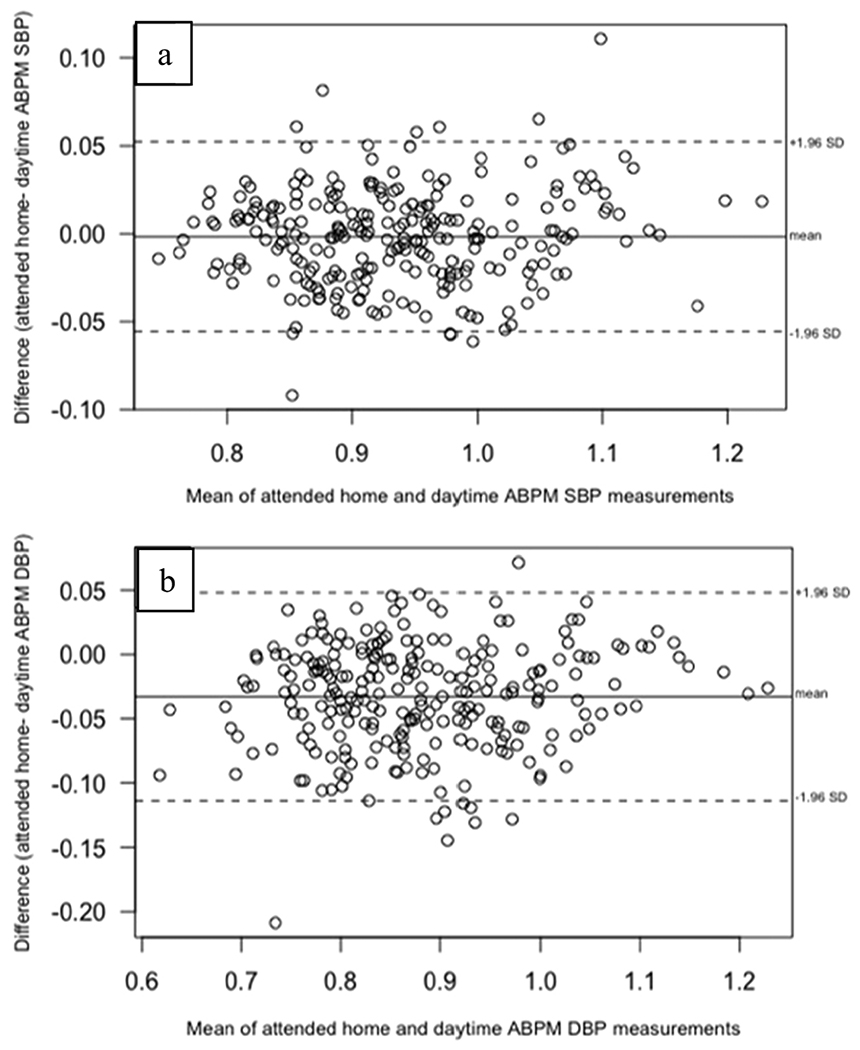
A total of 103 participants contributed 251 paired measurements. Indexed systolic BP did not differ between HBPM and daytime APBM (mean difference - 0.002; 95% CI: - 0.006, 0.003); the difference in indexed diastolic BP was minimal (mean difference - 0.033; 95% CI: - 0.040, - 0.025). Overall agreement between HBPM and 24-h ABPM in identifying abnormal BP was high (81.8%). HBPM had higher sensitivity (87.5%) than specificity (77.4%) and greater negative (89.8%) than positive (73.3%) predictive value, and findings were consistent in subgroups.
Attended HBPM may be reasonable for monitoring BP when ABPM is unavailable. The greater accessibility and feasibility of attended HBPM may potentially help improve BP control among at-risk youth. A higher resolution version of the Graphical abstract is available as Supplementary information.
本研究旨在比较有医护人员参与的家庭血压(HBPM)测量与动态血压监测(ABPM)读数,并检验这两种测量方式在整体和亚组间的一致性程度是否存在差异。
这是一项为期 2 年、多中心、观察性研究的二次分析,纳入了 11-19 岁(平均年龄 15 岁,标准差=2.7)患有慢性肾脏病的儿童。参与者在家中由工作人员进行 3 次标准化的振荡法测量血压,随后在 2 周内进行 24 小时 ABPM。为了计算平均 3 次重复 HBPM 和平均 ABPM 测量的血压指数(测量血压/95%血压百分位数),将其分别进行了计算。使用稳健标准误差的线性回归比较了任何 5 次研究访视期间同时采集的 HBPM 和 ABPM 测量值。以 ABPM 为金标准,采用广义估计方程逻辑回归确定敏感性、特异性、阴性和阳性预测值。对整体组和亚组分别进行了分析。
共有 103 名参与者贡献了 251 对测量值。HBPM 与日间 ABPM 的收缩压指数无差异(平均差值为-0.002;95%置信区间:-0.006,0.003);舒张压指数的差异较小(平均差值-0.033;95%置信区间:-0.040,-0.025)。HBPM 与 24 小时 ABPM 在识别异常血压方面的总体一致性较高(81.8%)。HBPM 的敏感性(87.5%)高于特异性(77.4%),阴性预测值(89.8%)高于阳性预测值(73.3%),且这些发现在亚组中一致。
当 ABPM 不可用时,有医护人员参与的 HBPM 可能是监测血压的合理选择。HBPM 具有更高的可及性和可行性,这可能有助于改善高危青少年的血压控制。高分辨率版本的图表摘要可在补充资料中查看。