Department of Biomedical Informatics, University of Utah, Salt Lake City, Utah, USA.
Center for Clinical Management Research, Department of Veterans Affairs, Ann Arbor, Michigan, USA.
J Am Med Inform Assoc. 2022 Apr 13;29(5):779-788. doi: 10.1093/jamia/ocac020.
The US Preventive Services Task Force (USPSTF) requires the estimation of lifetime pack-years to determine lung cancer screening eligibility. Leading electronic health record (EHR) vendors calculate pack-years using only the most recently recorded smoking data. The objective was to characterize EHR smoking data issues and to propose an approach to addressing these issues using longitudinal smoking data.
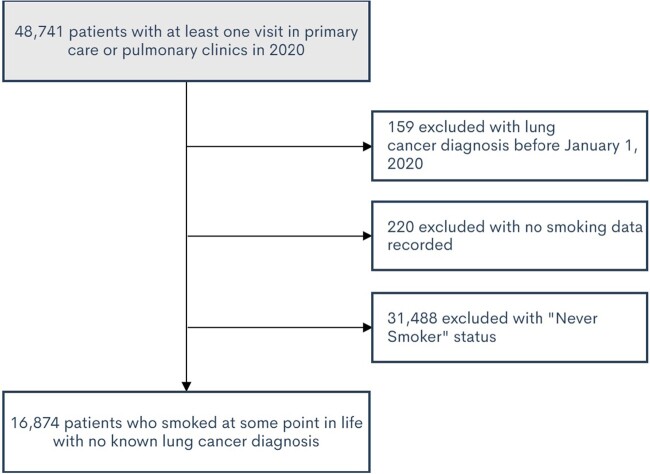
In this cross-sectional study, we evaluated 16 874 current or former smokers who met USPSTF age criteria for screening (50-80 years old), had no prior lung cancer diagnosis, and were seen in 2020 at an academic health system using the Epic® EHR. We described and quantified issues in the smoking data. We then estimated how many additional potentially eligible patients could be identified using longitudinal data. The approach was verified through manual review of records from 100 subjects.
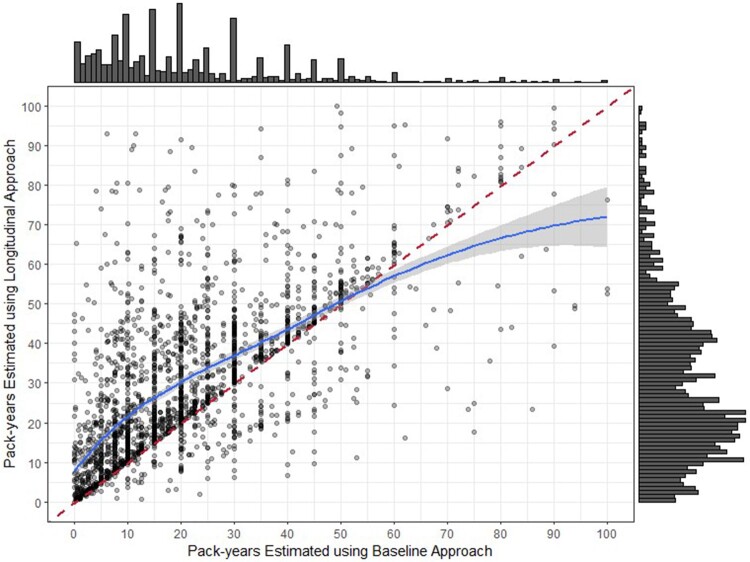
Over 80% of evaluated records had inaccuracies, including missing packs-per-day or years-smoked (42.7%), outdated data (25.1%), missing years-quit (17.4%), and a recent change in packs-per-day resulting in inaccurate lifetime pack-years estimation (16.9%). Addressing these issues by using longitudinal data enabled the identification of 49.4% more patients potentially eligible for lung cancer screening (P < .001).
Missing, outdated, and inaccurate smoking data in the EHR are important barriers to effective lung cancer screening. Data collection and analysis strategies that reflect changes in smoking habits over time could improve the identification of patients eligible for screening.
The use of longitudinal EHR smoking data could improve lung cancer screening.
美国预防服务工作组(USPSTF)要求估计终生吸烟包年数,以确定肺癌筛查的资格。领先的电子健康记录(EHR)供应商仅使用最近记录的吸烟数据计算吸烟包年数。目的是描述 EHR 吸烟数据问题,并提出一种使用纵向吸烟数据解决这些问题的方法。
在这项横断面研究中,我们评估了 16874 名符合 USPSTF 年龄筛查标准(50-80 岁)的当前或既往吸烟者,他们没有肺癌病史,并且在 2020 年在学术医疗系统中使用 Epic®EHR 就诊。我们描述并量化了吸烟数据中的问题。然后,我们估计使用纵向数据可以识别多少额外的潜在合格患者。该方法通过对 100 名患者的记录进行手动审查进行了验证。
超过 80%的评估记录存在不准确之处,包括缺少每日吸烟包数或吸烟年数(42.7%)、数据过时(25.1%)、缺少戒烟年数(17.4%)以及最近每日吸烟包数的变化导致不准确的终生吸烟包年数估计(16.9%)。通过使用纵向数据解决这些问题,可以识别出 49.4%更多的潜在符合肺癌筛查条件的患者(P<0.001)。
EHR 中缺失、过时和不准确的吸烟数据是有效肺癌筛查的重要障碍。反映吸烟习惯随时间变化的数据收集和分析策略可以提高对符合筛查条件的患者的识别。
使用纵向 EHR 吸烟数据可以改善肺癌筛查。