Villeneuve Paul J, Goldberg Mark S
School of Mathematics and Statistics, Carleton University, Ottawa, ON, Canada.
Department of Epidemiology, Biostatistics, and Occupational Health, McGill University, Montreal, QC, Canada.
Environ Epidemiol. 2022 Feb 4;6(1):e195. doi: 10.1097/EE9.0000000000000195. eCollection 2022 Feb.
Results from ecological studies have suggested that air pollution increases the risk of developing and dying from COVID-19. Drawing causal inferences from the measures of association reported in ecological studies is fraught with challenges given biases arising from an outcome whose ascertainment is incomplete, varies by region, time, and across sociodemographic characteristics, and cannot account for clustering or within-area heterogeneity. Through a series of analyses, we illustrate the dangers of using ecological studies to assess whether ambient air pollution increases the risk of dying from, or transmitting, COVID-19.
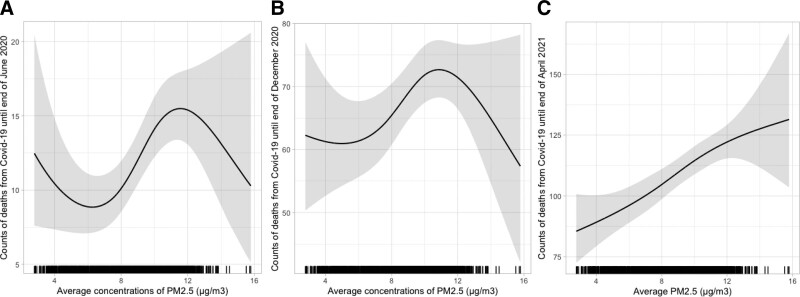
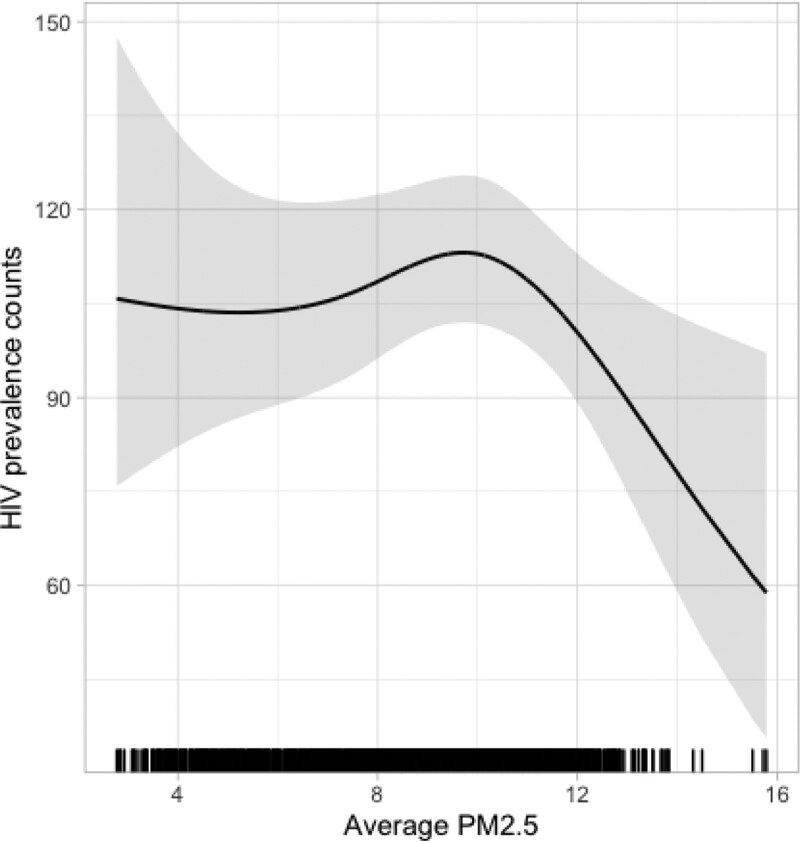
We performed an ecological analysis in the continental United States using county-level ambient concentrations of fine particulate matter (PM) between 2000 and 2016 and cumulative COVID-19 mortality counts through June 2020, December 2020, and April 2021. To show that spurious associations can be obtained in ecological data, we modeled the association between PM and the prevalence of human immunodeficiency virus (HIV). We fitted negative binomial models, with a logarithmic offset for county-specific population, to these data. Natural cubic splines were used to describe the shape of the exposure-response curves.
Our analyses revealed that the shape of the exposure-response curve between PM and COVID-19 changed substantially over time. Analyses of COVID-19 mortality through June 30, 2021, suggested a positive linear relationship. In contrast, an inverse pattern was observed using county-level concentrations of PM and the prevalence of HIV.
Our analyses indicated that ecological analyses are prone to showing spurious relationships between ambient air pollution and mortality from COVID-19 as well as the prevalence of HIV. We discuss the many potential biases inherent in any ecological-based analysis of air pollution and COVID-19.
生态学研究结果表明,空气污染会增加感染新型冠状病毒肺炎(COVID-19)并死于该疾病的风险。鉴于生态学研究报告的关联度测量结果存在偏差,因此从中得出因果推断充满挑战,这些偏差源于一个确定不完整、因地区、时间和社会人口特征而异且无法解释聚类或区域内异质性的结果。通过一系列分析,我们阐述了利用生态学研究评估环境空气污染是否会增加死于COVID-19或传播该疾病风险的危险性。
我们在美国大陆进行了一项生态学分析,使用了2000年至2016年县级细颗粒物(PM)的环境浓度以及截至2020年6月、2020年12月和2021年4月的COVID-19累计死亡人数。为了表明在生态数据中可能获得虚假关联,我们对PM与人类免疫缺陷病毒(HIV)流行率之间的关联进行了建模。我们对这些数据拟合了负二项式模型,并对特定县的人口进行了对数偏移。使用自然三次样条来描述暴露-反应曲线的形状。
我们的分析表明,PM与COVID- 19之间的暴露-反应曲线形状随时间发生了显著变化。对截至2021年6月30日的COVID-19死亡率分析表明存在正线性关系。相比之下,使用县级PM浓度和HIV流行率观察到的是相反的模式。
我们的分析表明,生态学分析容易显示环境空气污染与COVID-19死亡率以及HIV流行率之间的虚假关系。我们讨论了任何基于生态学的空气污染与COVID-19分析中固有的许多潜在偏差。