National Institute for Public Health and the Environment (RIVM), P.O. Box 1, 3720 BA, Bilthoven, the Netherlands.
National Institute for Public Health and the Environment (RIVM), P.O. Box 1, 3720 BA, Bilthoven, the Netherlands; Department of Natural Resources, Faculty of Geo-Information Science and Earth Observation (ITC), University of Twente, P.O Box 217, Enschede, 7500 AE, the Netherlands.
Int J Hyg Environ Health. 2022 Aug;245:114022. doi: 10.1016/j.ijheh.2022.114022. Epub 2022 Aug 15.
In the Netherlands, during the first phase of the COVID-19 epidemic, the hotspot of COVID-19 overlapped with the country's main livestock area, while in subsequent phases this distinct spatial pattern disappeared. Previous studies show that living near livestock farms influence human respiratory health and immunological responses. This study aimed to explore whether proximity to livestock was associated with SARS-CoV-2 infection.
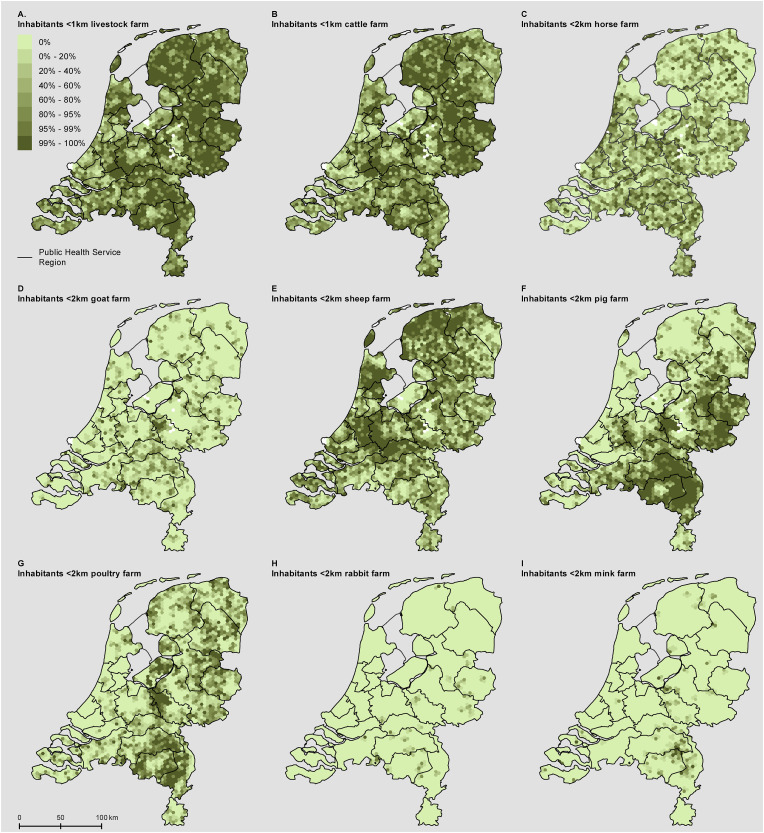
The study population was the population of the Netherlands excluding the very strongly urbanised areas and border areas, on January 1, 2019 (12, 628, 244 individuals). The cases are the individuals reported with a laboratory-confirmed positive SARS-CoV-2 test with onset before January 1, 2022 (2, 223, 692 individuals). For each individual, we calculated distance to nearest livestock farm (cattle, goat, sheep, pig, poultry, horse, rabbit, mink). The associations between residential (6-digit postal-code) distance to the nearest livestock farm and individuals' SARS-CoV-2 status was studied with multilevel logistic regression models. Models were adjusted for individuals' age categories, the social status of the postal code area, particulate matter (PM)- and nitrogen dioxide (NO)-concentrations. We analysed data for the entire period and population as well as separately for eight time periods (Jan-Mar, Apr-Jun, Jul-Sep and Oct-Dec in 2020 and 2021), four geographic areas of the Netherlands (north, east, west and south), and for five age categories (0-14, 15-24, 25-44, 45-64 and > 65 years).
Over the period 2020-2021, individuals' SARS-CoV-2 status was associated with living closer to livestock farms. This association increased from an Odds Ratio (OR) of 1.01 (95% Confidence Interval [CI] 1.01-1.02) for patients living at a distance of 751-1000 m to a farm to an OR of 1.04 (95% CI 1.04-1.04), 1.07 (95% CI 1.06-1.07) and 1.11 (95% CI 1.10-1.12) for patients living in the more proximate 501-750 m, 251-500m and 0-250 m zones around farms, all relative to patients living further than 1000 m around farms. This association was observed in three out of four quarters of the year in both 2020 and 2021, and in all studied geographic areas and age groups.
In this exploratory study with individual SARS-CoV-2 notification data and high-resolution spatial data associations were found between living near livestock farms and individuals' SARS-CoV-2 status in the Netherlands. Verification of the results in other countries is warranted, as well as investigations into possible underlying exposures and mechanisms.
在荷兰,在 COVID-19 疫情的第一阶段,COVID-19 的热点与该国主要的牲畜区重叠,而在随后的阶段,这种明显的空间模式消失了。先前的研究表明,居住在牲畜场附近会影响人类的呼吸健康和免疫反应。本研究旨在探讨接近牲畜是否与 SARS-CoV-2 感染有关。
研究人群为荷兰除高度城市化地区和边境地区以外的所有人口,时间为 2019 年 1 月 1 日(12628244 人)。病例是指在 2022 年 1 月 1 日前发病并经实验室确诊为 SARS-CoV-2 阳性的个体(2236922 人)。对于每个个体,我们计算了与最近的牲畜场(牛、山羊、绵羊、猪、家禽、马、兔、貂)的距离。使用多水平逻辑回归模型研究了居住(6 位邮政编码)距离最近的牲畜场与个体 SARS-CoV-2 状态之间的关系。模型调整了个体的年龄类别、邮政编码区域的社会地位、颗粒物(PM)和氮氧化物(NO)浓度。我们分析了整个时期和整个人口的数据,以及 2020 年和 2021 年四个时间区间(1 月至 3 月、4 月至 6 月、7 月至 9 月和 10 月至 12 月)、荷兰四个地理区域(北部、东部、西部和南部)以及五个年龄组(0-14 岁、15-24 岁、25-44 岁、45-64 岁和>65 岁)的数据。
在 2020 年至 2021 年期间,个体的 SARS-CoV-2 状态与居住在靠近牲畜场的地方有关。这种关联从居住在距离农场 751-1000 米处的患者的优势比(OR)1.01(95%置信区间[CI] 1.01-1.02)增加到居住在距离农场更近的 501-750 米、251-500 米和 0-250 米范围内的患者的 OR 1.04(95% CI 1.04-1.04)、1.07(95% CI 1.06-1.07)和 1.11(95% CI 1.10-1.12),所有这些患者与居住在农场 1000 米以外的患者相比。这种关联在 2020 年和 2021 年的四个季度中的三个季度以及所有研究的地理区域和年龄组中都观察到。
在这项使用个体 SARS-CoV-2 通知数据和高分辨率空间数据的探索性研究中,在荷兰发现了居住在牲畜场附近与个体 SARS-CoV-2 状态之间的关联。有必要在其他国家验证这些结果,并对可能的潜在暴露和机制进行调查。