Department of Medical Laboratory Science, Anhui No.2 Provincial People's Hospital, Hefei, Anhui, China.
Department of Oncology, Anhui No.2 Provincial People's Hospital, Hefei, Anhui, China.
J Cell Mol Med. 2022 Mar;26(5):1392-1401. doi: 10.1111/jcmm.17041. Epub 2022 Feb 15.
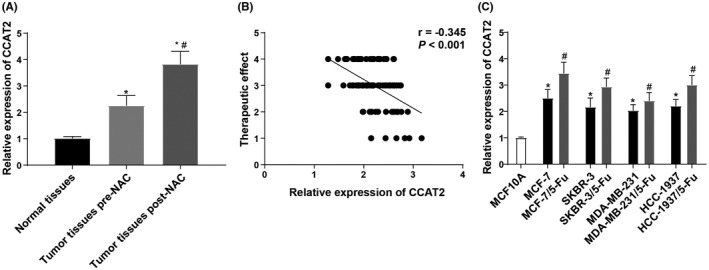
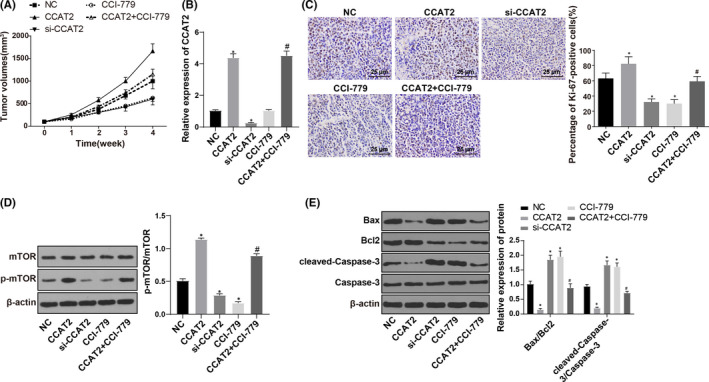
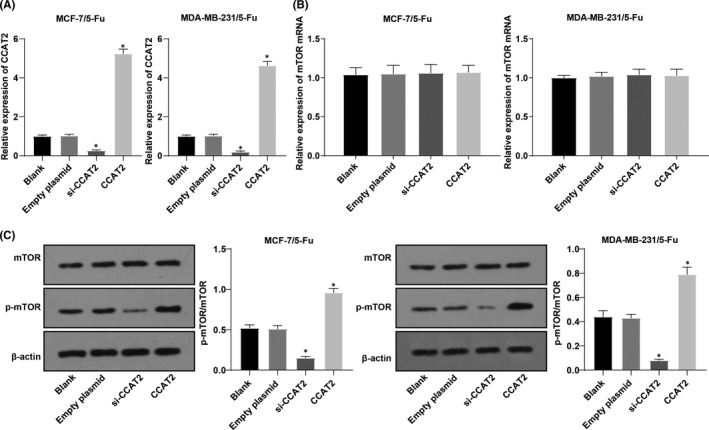
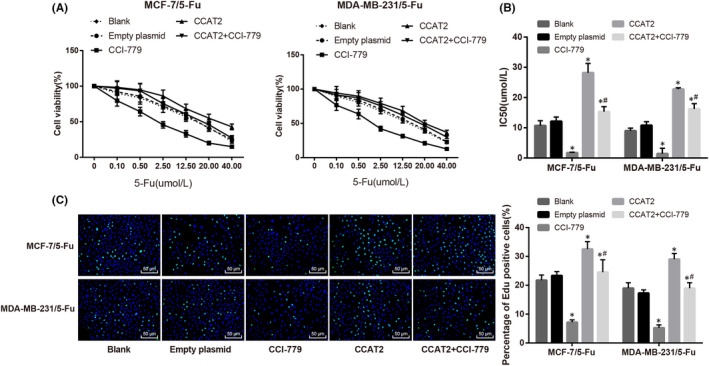
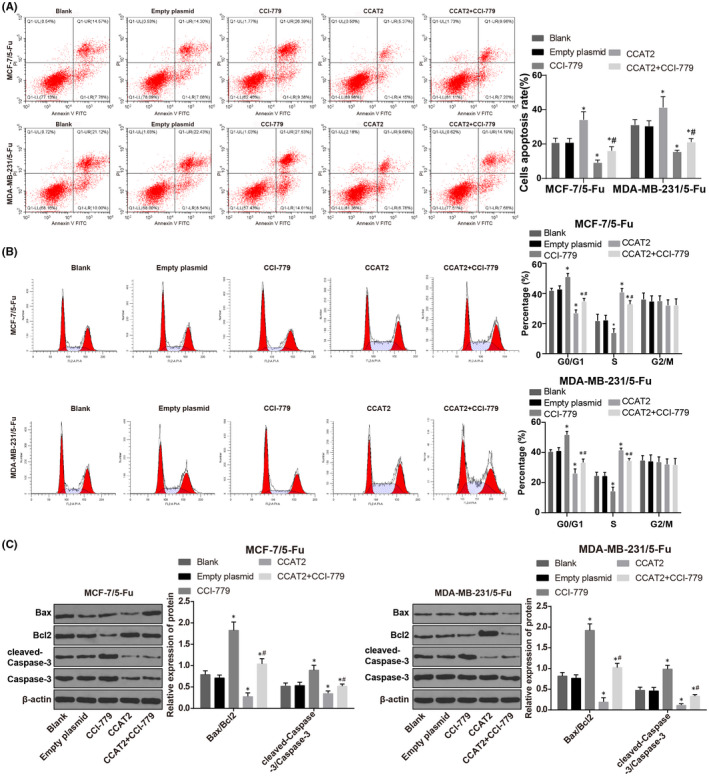
Breast cancer (BC) is the most prevalent cancer in women and the second leading cause for cancer-related death in women. LncRNA CCAT2 is involved in BC cell drug sensitivity. Drug resistance of BC cells after chemotherapy is the main obstacle to therapeutic effects. This study explored whether BC cell drug sensitivity to 5-Fu was related to lncRNA CCAT2-regulated mTOR pathway. Normal breast tissues and BC tissues before/after neoadjuvant chemotherapy were collected, and CCAT2 expression was detected by RT-qPCR. Correlation between CCATA2 expression and neoadjuvant chemotherapy efficacy was analysed using the Kendall's tau-b correlation analysis. Normal breast epithelial cells and BC cell lines were cultured. BC cell lines were treated with 5-Fu, and CCAT2 mRNA level in cells was detected. The 5-Fu-resistant MCF-7/5-Fu and MDA-MB-231/5-Fu cells were treated with CCAT2 overexpression/knockdown or CCI-779 (the mTOR pathway inhibitor). The mTOR pathway levels were detected. Expression of apoptosis-related factors was identified. A subcutaneous xenograft model was carried out. High CCAT2 expression was detected in BC tissues and BC drug-resistant cells after neoadjuvant chemotherapy, and a negative link was revealed between CCAT2 expression and efficacy of neoadjuvant chemotherapy. p-mTOR/mTOR in 5-Fu-resistant BC cells with inhibited CCAT2 was decreased, while CCAT2 overexpression activated the mTOR pathway. IC50 value, proliferation, cells in S phase increased and apoptosis reduced after CCAT2 overexpression. After si-CCAT2 or CCI-779 treatment, the growth rate of transplanted tumours was inhibited, while promoted after CCAT2 overexpression. CCAT2 may reduce BC cell chemosensitivity to 5-Fu by activating the mTOR pathway.
乳腺癌(BC)是女性中最常见的癌症,也是女性癌症相关死亡的第二大主要原因。长链非编码 RNA CCAT2 参与 BC 细胞药物敏感性。BC 细胞化疗后耐药是治疗效果的主要障碍。本研究探讨了 BC 细胞对 5-Fu 的药物敏感性是否与 lncRNA CCAT2 调节的 mTOR 通路有关。收集了正常乳腺组织和新辅助化疗前后的 BC 组织,通过 RT-qPCR 检测 CCAT2 表达。采用 Kendall's tau-b 相关分析分析 CCATA2 表达与新辅助化疗疗效的相关性。培养正常乳腺上皮细胞和 BC 细胞系。用 5-Fu 处理 BC 细胞系,检测细胞中 CCAT2 mRNA 水平。用 CCAT2 过表达/敲低或 CCI-779(mTOR 通路抑制剂)处理 5-Fu 耐药 MCF-7/5-Fu 和 MDA-MB-231/5-Fu 细胞。检测 mTOR 通路水平。鉴定凋亡相关因子的表达。进行皮下异种移植模型。新辅助化疗后 BC 组织和 BC 耐药细胞中检测到高 CCAT2 表达,CCAT2 表达与新辅助化疗疗效呈负相关。抑制 CCAT2 的 5-Fu 耐药 BC 细胞中 p-mTOR/mTOR 减少,而过表达 CCAT2 激活了 mTOR 通路。CCAT2 过表达后,IC50 值、增殖、S 期细胞增加,凋亡减少。用 si-CCAT2 或 CCI-779 处理后,移植瘤的生长速度受到抑制,而过表达 CCAT2 后则促进。CCAT2 可能通过激活 mTOR 通路降低 BC 细胞对 5-Fu 的化疗敏感性。