Department of Clinical Pharmacology, Medical University of Lodz, Lodz, Poland.
Department of Clinical Psychology and Psychopathology, Institute of Psychology, University of Lodz, Lodz, Poland.
Braz J Psychiatry. 2022 Jan-Feb;44(1):35-40. doi: 10.1590/1516-4446-2021-1747.
The bipolar spectrum concept has resulted in a paradigm shift that has affected both the diagnosis and therapy of mood disorders, with bipolarity becoming an indicator of treatment resistance in depression. Evening circadian preference has also been linked to affective disorders. The aim of our study was to confirm the relationship between the severity of depressive symptoms, bipolar features, chronotype, and sleep quality among patients with major depressive disorder.
A group of 55 individuals who were recruited from a mental health outpatient clinic completed the following psychometric tools: a Chronotype Questionnaire comprising morningness-eveningness (ME) and subjective amplitude of the rhythm (AM) scales, the Hypomania Checklist 32 (HCL-32), the Beck Depression Inventory (BDI) and the Pittsburgh Sleep Quality Index (PSQI).
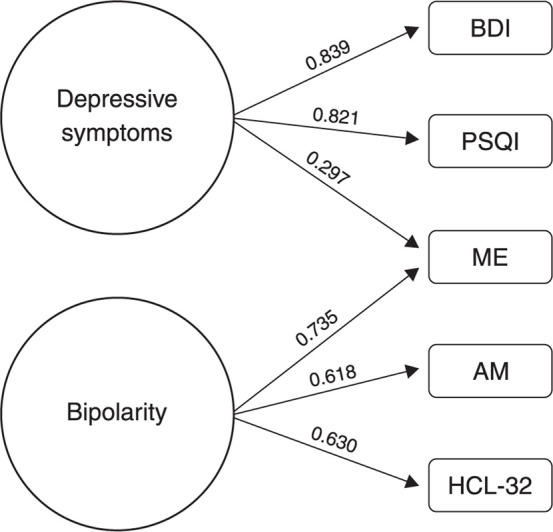
Factor analysis identified two latent components, accounting cumulatively for 58% of variables: depressive symptoms (BDI and PSQI) and bipolarity (ME, AM, and HCL-32). After rotation, ME loading in the first factor increased the result to a significant level. The correlation between the two components was very low.
Evening chronotype appears to be a bipolarity-related marker, with this relationship being independent of its link to depressive symptoms and sleep quality. Eveningness and high circadian rhythm amplitude may offer promise as diagnostic, prognostic, and therapeutic predictors.
双相谱概念带来了一种范式转变,不仅影响了心境障碍的诊断和治疗,而且双相性也成为抑郁症治疗抵抗的一个指标。夜间生理节奏偏好也与情感障碍有关。我们的研究目的是确认重度抑郁症患者的抑郁症状严重程度、双相特征、昼夜类型和睡眠质量之间的关系。
一组 55 名从精神科门诊招募的患者完成了以下心理计量学工具:包含晨型-晚型(ME)和节律主观幅度(AM)量表的昼夜类型问卷、32 项轻躁狂检查表(HCL-32)、贝克抑郁量表(BDI)和匹兹堡睡眠质量指数(PSQI)。
因子分析确定了两个潜在的成分,累计占变量的 58%:抑郁症状(BDI 和 PSQI)和双相性(ME、AM 和 HCL-32)。经旋转后,第一个因子中的 ME 负荷增加到显著水平。两个成分之间的相关性非常低。
夜间昼夜类型似乎是与双相性相关的标志物,这种关系与抑郁症状和睡眠质量无关。夜间型和高生理节奏幅度可能成为诊断、预后和治疗的预测指标。