International Food Policy Research Institute (IFPRI), Washington, DC, USA.
AFRICSante, Bobo-Dioulasso, Burkina Faso.
J Nutr. 2022 May 5;152(5):1336-1346. doi: 10.1093/jn/nxac034.
Soutenir l'Exploitation Familiale pour Lancer l'Élevage des Volailles et Valoriser l'Économie Rurale (SELEVER) is a nutrition- and gender-sensitive poultry value chain project designed and implemented by international nongovernmental organization Tanager, which consists of poultry market facilitation and behavior change activities aiming at increasing poultry production and improving diets without free inputs transfer.
The study aimed at assessing the impact of SELEVER on diets of women and children during the lean season.
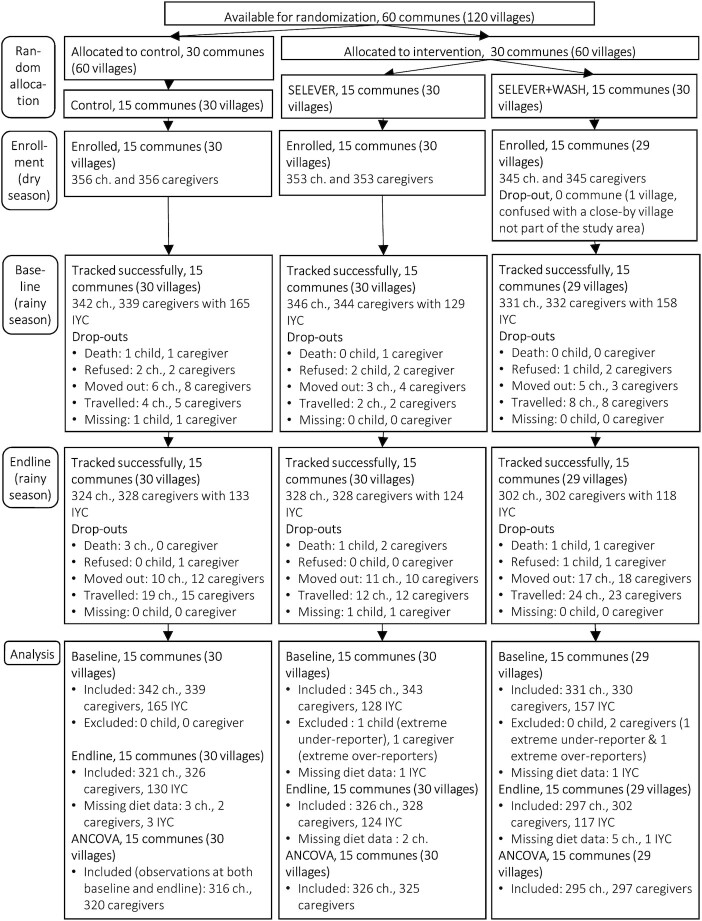
Within a cluster randomized controlled trial, 45 communes were assigned to 1 of 3 arms, including 1) SELEVER interventions, 2) SELEVER with an intensive hygiene and sanitation component (SELEVER + WASH), and 3) a control group without intervention. Two rounds of survey were conducted 2 y apart during the lean season. Primary dietary outcomes were the probability of adequacy (PA) of iron, zinc, and vitamin A intakes; mean PA of 11 micronutrients and individual dietary diversity score collected through quantitative 24-h recall in longitudinal samples of women and index children (2-4 y old) in 1054 households; and minimum acceptable diet in the repeated cross-sectional sample of their younger sibling aged 6-23 mo. Impacts were assessed by intention-to-treat ANCOVA.
Relative to control, SELEVER interventions (groups 1 + 2) increased the PA of iron intakes in women by 1.8 percentage points (pp) (P = 0.030). We found no further impact on primary outcomes, although egg consumption increased in index children (+0.73 pp, P = 0.010; +0.69 kcal/d, P = 0.036). Across the 3 groups, we observed negative effects of SELEVER on the PA of zinc intakes in women relative to SELEVER + WASH (-4.1 pp, P = 0.038) and on a variety of secondary dietary outcomes relative to both other groups. The study was registered on the ISCRCTN registry (ISRCTN16686478).
Information-only-based value chain interventions may not have meaningful positive effects on diets of women and children in the lean season in settings with largely inadequate diets. We found suggestive evidence that synergies between intervention components may have introduced heterogeneity in effects on diet.
Soutenir l'Exploitation Familiale pour Lancer l'Élevage des Volailles et Valoriser l'Économie Rurale(SELEVER)是一个由国际非政府组织 Tanager 设计和实施的营养和性别敏感的家禽价值链项目,由旨在增加家禽产量和改善饮食而无需免费投入转移的家禽市场促进和行为改变活动组成。
本研究旨在评估 SELEVER 在淡季对妇女和儿童饮食的影响。
在一项集群随机对照试验中,将 45 个社区分配到 3 个组中的 1 个,包括 1)SELEVER 干预,2)SELEVER 与强化卫生和环境卫生组件(SELEVER + WASH),以及 3)没有干预的对照组。在淡季进行了两轮为期 2 年的调查。主要饮食结果是铁、锌和维生素 A 摄入量充足的可能性(PA);通过定量 24 小时回顾纵向样本中妇女和指数儿童(2-4 岁)的 11 种微量营养素和个别饮食多样性得分的平均值(1054 户家庭);以及其年龄在 6-23 个月的弟弟妹妹的重复横断面样本中的最低可接受饮食。通过意向治疗 ANCOVA 评估影响。
与对照组相比,SELEVER 干预措施(第 1 组和第 2 组)使妇女铁摄入量的 PA 增加了 1.8 个百分点(pp)(P = 0.030)。我们没有发现对主要结果的进一步影响,尽管指数儿童的鸡蛋摄入量增加了(+0.73 pp,P = 0.010;+0.69 kcal/d,P = 0.036)。在 3 个组中,我们观察到 SELEVER 对妇女锌摄入量的 PA 产生了负面影响,相对于 SELEVER + WASH(-4.1 pp,P = 0.038),并相对于其他两组产生了各种次要饮食结果。该研究在 ISCRCTN 登记处(ISRCTN16686478)进行了登记。
在饮食严重不足的情况下,仅基于信息的价值链干预措施可能对妇女和儿童在淡季的饮食没有明显的积极影响。我们发现有迹象表明,干预措施组成部分之间的协同作用可能会对饮食产生异质性影响。