National Institute for Communicable Disease Control and Prevention, Chinese Center for Disease Control and Prevention, Beijing, China.
Hunan Provincial Chest hospital, Tuberculosis Control Institution of Hunan province, Changsha, Hunan, China.
Microbiol Spectr. 2022 Feb 23;10(1):e0154321. doi: 10.1128/spectrum.01543-21. Epub 2022 Feb 16.
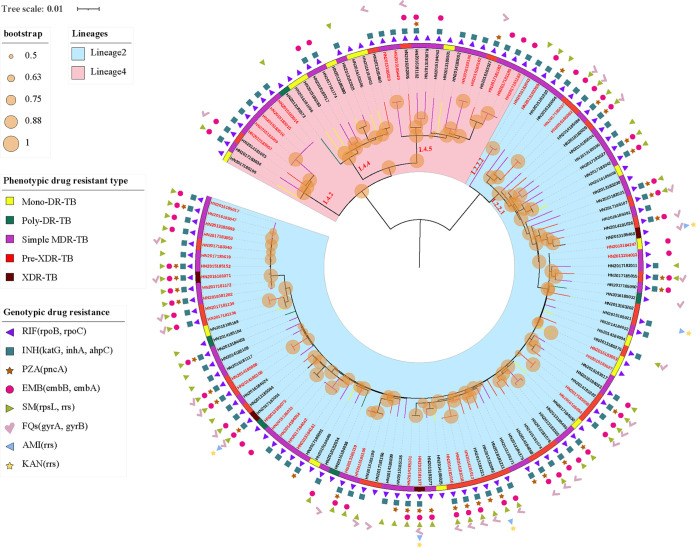
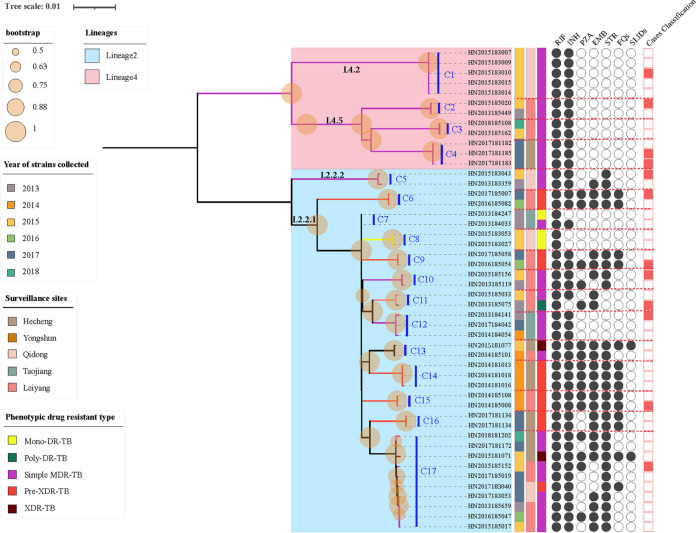
To gain a deep insight into the additional drug-resistant profiles, genetic diversity, and transmission dynamics of rifampicin-resistant tuberculosis (RR-TB) circulating in Hunan province, drug susceptibility testing and whole-genome-sequencing were performed among RR-TB strains collected from Jan. 2013 to Jun. 2018 in Hunan province. A total of 124 RR-TB strains were recovered successfully and included into the final analysis. Lineage 2.2.1 was the dominant sublineage, accounting for 72.6% (90/124), followed by lineage 4.5 (11.3%, 14/124), lineage 4.4 (8.1%, 10/124), lineage 4.2 (6.5%, 8/124) and lineage 2.2.2 (1.6%, 2/124). Overall, 83.1% (103/124) and 3.2% (4/124) of RR-TB were MDR-TB and XDR-TB, respectively. Nearly 30% of RR-TB isolates were resistant to fluoroquinolones, and 26.6% (33/124) were pre-XDR-TB. Moreover, 30.6% (38/124) of RR-TB strains were identified as phenotypically resistance to pyrazinamide. Totally, 17 clusters containing 48 (38.7%, 48/124) RR-TB strains were identified, ranging in size from 2 to 10 isolates. No significant difference was detected in clustering rate between lineage 2 and lineage 4 ( = 0.027, = 0.870). Our study revealed the complexity of RR-TB strains circulating in Hunan province with complex additional drug-resistant profile and relatively higher clustering rates. Comprehensive information based on WGS should be used to guide the design of treatment regimens and tailor public interventions. Comprehensive information such as genetic background and drug-resistant profile of MTB strains could help to tailor public interventions. However, these data are limited in Hunan province, one of the provinces with high-TB burden in China. So, this study aimed to provide us with deep insight into the molecular epidemiology of RR-TB isolates circulating in Hunan province by combining phenotypic drug susceptibility testing and whole-genome sequencing. To our knowledge, this is the first study to use whole-genome sequencing data of RR-TB strains spanning more than 5 years for molecular epidemiology analysis in Hunan province, which allows us to identify genetic background information and clustered strains more accurately. Our study revealed the complexity of RR-TB strains circulating in Hunan province with complex additional drug-resistant profile and relatively higher clustering rates. Comprehensive information based on WGS should be used to guide the design of treatment regimens and tailor public interventions.
为深入了解湖南省利福平耐药结核病(RR-TB)流行株的额外耐药谱、遗传多样性和传播动态,对 2013 年 1 月至 2018 年 6 月在湖南省采集的 RR-TB 菌株进行了药物敏感性试验和全基因组测序。共成功恢复 124 株 RR-TB 菌株,并纳入最终分析。谱系 2.2.1 是主要的亚谱系,占 72.6%(90/124),其次是谱系 4.5(11.3%,14/124)、谱系 4.4(8.1%,10/124)、谱系 4.2(6.5%,8/124)和谱系 2.2.2(1.6%,2/124)。总体而言,83.1%(103/124)和 3.2%(4/124)的 RR-TB 分别为耐多药结核病和广泛耐药结核病。近 30%的 RR-TB 分离株对氟喹诺酮类药物耐药,26.6%(33/124)为预广泛耐药结核病。此外,30.6%(38/124)的 RR-TB 菌株被鉴定为对吡嗪酰胺表型耐药。总共鉴定出含有 48 株(38.7%,48/124)RR-TB 菌株的 17 个簇,大小从 2 到 10 个分离株不等。谱系 2 和谱系 4 之间的聚类率无显著差异(=0.027,=0.870)。本研究揭示了湖南省 RR-TB 菌株流行的复杂性,具有复杂的额外耐药谱和相对较高的聚类率。基于 WGS 的综合信息应用于指导治疗方案的设计和调整公共干预措施。综合的 MTB 菌株的遗传背景和耐药谱信息可以帮助调整公共干预措施。然而,这些数据在湖南省(中国结核病负担较高的省份之一)有限。因此,本研究旨在通过结合表型药物敏感性试验和全基因组测序,为我们提供对湖南省 RR-TB 分离株分子流行病学的深入了解。据我们所知,这是湖南省首次使用超过 5 年的 RR-TB 菌株全基因组测序数据进行分子流行病学分析,这使我们能够更准确地识别遗传背景信息和聚类菌株。本研究揭示了湖南省 RR-TB 菌株流行的复杂性,具有复杂的额外耐药谱和相对较高的聚类率。基于 WGS 的综合信息应用于指导治疗方案的设计和调整公共干预措施。